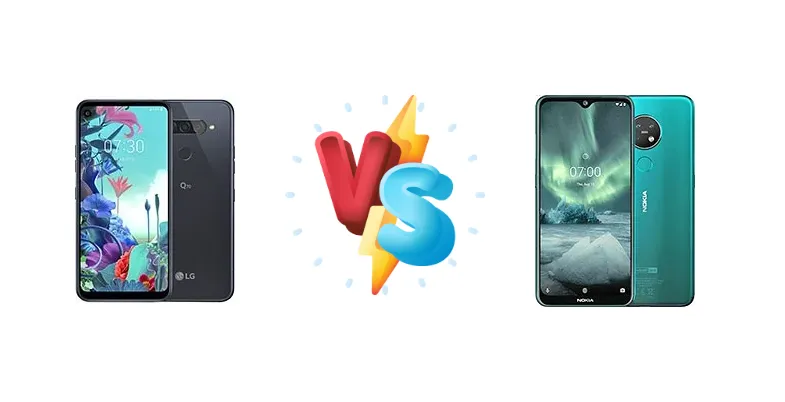
The LG Q70 and Nokia 7.2 represent a shrinking breed: affordable Android phones prioritizing core functionality over bleeding-edge features. Both devices aimed for the mid-range market, but launched with different approaches to chipset selection. This comparison dissects the key differences to determine which offers the best value in today's market.
🏆 Quick Verdict
For the average user, the LG Q70 is the stronger choice. Its Snapdragon 675 chipset, built on a more efficient 11nm process, delivers noticeably better performance than the Nokia 7.2’s Snapdragon 660. While both boast similar battery endurance ratings, the Q70’s Quick Charge 3.0 support provides a faster top-up.
| Network |
|---|
| 2G bands | GSM 850 / 900 / 1800 / 1900 | GSM 850 / 900 / 1800 / 1900 |
| 3G bands | HSDPA 850 / 900 / 1900 / 2100 | HSDPA 850 / 900 / 2100 - ROW |
| 4G bands | 2, 3, 4, 5, 7, 12, 13, 20, 66 - Verizon | 1, 3, 5, 7, 8, 20, 28, 38, 40, 41 - ROW |
| Speed | HSPA 42.2/5.76 Mbps, LTE (3CA) Cat11 600/75 Mbps | HSPA 42.2/5.76 Mbps, LTE (2CA) Cat6 300/50 Mbps or LTE Cat4 150/50 Mbps |
| Technology | GSM / CDMA / HSPA / EVDO / LTE | GSM / HSPA / LTE |
| | CDMA2000 1xEV-DO | 1, 3, 5, 8, 40, 41 - IN |
| Launch |
|---|
| Announced | 2019, September 28. Released 2019, October | 2019, September 05. Released 2019, September 23 |
| Status | Discontinued | Discontinued |
| Body |
|---|
| Build | Glass front (Gorilla Glass), glass back, aluminum frame | Glass front (Gorilla Glass 3), glass back (Gorilla Glass 3), plastic frame |
| Dimensions | 162.1 x 76.8 x 8.3 mm (6.38 x 3.02 x 0.33 in) | 159.9 x 75.2 x 8.3 mm (6.30 x 2.96 x 0.33 in) |
| SIM | · Nano-SIM· Nano-SIM + Nano-SIM | · Nano-SIM· Nano-SIM + Nano-SIM |
| Weight | 198 g (6.98 oz) | 180 g (6.35 oz) |
| | IP68 dust/water resistant (up to 1.5m for 30 min)
MIL-STD-810G compliant*
*does not guarantee ruggedness or use in extreme conditions | - |
| Display |
|---|
| Protection | Corning Gorilla Glass | Corning Gorilla Glass 3 |
| Resolution | 1080 x 2310 pixels (~398 ppi density) | 1080 x 2280 pixels, 19:9 ratio (~400 ppi density) |
| Size | 6.4 inches, 101.4 cm2 (~81.4% screen-to-body ratio) | 6.3 inches, 99.1 cm2 (~82.4% screen-to-body ratio) |
| Type | IPS LCD | IPS LCD, HDR10 |
| Platform |
|---|
| CPU | Octa-core (2x2.0 GHz Kryo 460 Gold & 6x1.7 GHz Kryo 460 Silver) | Octa-core (4x2.2 GHz Kryo 260 Gold & 4x1.8 GHz Kryo 260 Silver) |
| Chipset | Qualcomm SDM675 Snapdragon 675 (11 nm) | Qualcomm SDM660 Snapdragon 660 (14 nm) |
| GPU | Adreno 612 | Adreno 512 |
| OS | Android 9.0 (Pie), upgradable to Android 10, LG UX 9 | Android 9.0 (Pie), upgradable to Android 11, Android One |
| Memory |
|---|
| Card slot | microSDXC (dedicated slot) | microSDXC (dedicated slot) |
| Internal | 64GB 4GB RAM | 64GB 4GB RAM, 64GB 6GB RAM, 128GB 4GB RAM, 128GB 6GB RAM |
| | eMMC 5.1 | eMMC 5.1 |
| Main Camera |
|---|
| Dual or Triple | 32 MP, f/1.8, 26mm (wide), 1/2.8", 0.8µm, PDAF
13 MP, f/2.2, 13mm (ultrawide)
Auxiliary lens
or
32 MP, f/1.8, 26mm (wide), 1/2.8", 0.8µm, PDAF
Auxiliary lens | - |
| Features | LED flash, panorama, HDR | Zeiss optics, LED flash, panorama, HDR |
| Triple | - | 48 MP, f/1.8, (wide), 1/2.0", 0.8µm, PDAF
8 MP, f/2.2, 13mm (ultrawide), 1/4.0", 1.12µm
Auxiliary lens |
| Video | 4K@30fps, 1080p@30fps | 4K@30fps, 1080p@30fps (gyro-EIS) |
| Selfie camera |
|---|
| Features | HDR | Zeiss optics, HDR |
| Single | 16 MP, f/1.9, 26mm (wide), 1/2.8", 1.12µm | 20 MP, f/2.0, (wide), 1/3", 0.9µm |
| Video | 1080p@30fps | 1080p@30fps |
| Sound |
|---|
| 3.5mm jack | Yes | Yes |
| 35mm jack | Yes | Yes |
| Loudspeaker | Yes | Yes |
| | 32-bit/192kHz audio | - |
| Comms |
|---|
| Bluetooth | 5.0, A2DP, LE | 5.0, A2DP, EDR, LE, aptX |
| NFC | Yes | Yes (excl. India) |
| Positioning | GPS, GLONASS | GPS, GLONASS, GALILEO, BDS |
| Radio | No | FM radio |
| USB | USB Type-C 2.0 | USB Type-C 2.0, OTG |
| WLAN | Wi-Fi 802.11 a/b/g/n/ac, dual-band, Wi-Fi Direct, DLNA | Wi-Fi 802.11 b/g/n/ac, dual-band, Wi-Fi Direct |
| Features |
|---|
| Sensors | Fingerprint (rear-mounted), accelerometer, proximity, compass | Fingerprint (rear-mounted), accelerometer, gyro, proximity, compass |
| Battery |
|---|
| Charging | 15W wired, QC3 | 10W wired |
| Type | Li-Po 4000 mAh, non-removable | Li-Po 3500 mAh, non-removable |
| Misc |
|---|
| Colors | Mirror Black | Cyan Green, Charcoal, Ice |
| Models | LM-Q730N, LMQ620WA, LM-Q620WA, LM-Q620VAB, LMQ620VAB, LM-Q730 | TA-1193, TA-1178, TA-1196, TA-1181 |
| Price | About 320 EUR | About 240 EUR |
| SAR | - | 1.15 W/kg (head) 0.90 W/kg (body) |
| SAR EU | - | 0.99 W/kg (head) 1.44 W/kg (body) |
| Tests |
|---|
| Audio quality | - |
Noise -93.0dB / Crosstalk -93.4dB |
| Battery life | - |
Endurance rating 69h
|
| Camera | - |
Photo / Video |
| Display | - |
Contrast ratio: 1342:1 (nominal) |
| Loudspeaker | - |
-29.6 LUFS (Average)
|
| Performance | - |
AnTuTu: 139495 (v7), 164484 (v8)
GeekBench: 5440 (v4.4), 1398 (v5.1)
GFXBench: 8.1fps (ES 3.1 onscreen) |
LG Q70
- Faster Snapdragon 675 processor
- Quick Charge 3.0 support for faster charging
- More efficient 11nm chipset for better thermal management
- Display specifications are less detailed
- Camera details are limited
Nokia 7.2
- Brighter display (585 nits)
- Higher contrast ratio (1342:1)
- Nokia’s software update history (though now limited)
- Older and less powerful Snapdragon 660 processor
- Slower 10W charging
- Less efficient 14nm chipset
Display Comparison
Both the LG Q70 and Nokia 7.2 feature displays with a 1342:1 contrast ratio, suggesting similar visual pop. However, the Nokia 7.2 boasts a measured peak brightness of 585 nits, offering a potentially more visible screen outdoors. While the LG Q70’s display specifications aren’t provided, the Nokia 7.2’s brightness advantage is a tangible benefit for users frequently exposed to sunlight. The nominal contrast ratio suggests both utilize IPS panels, prioritizing viewing angles over the absolute blacks of OLED technology.
Camera Comparison
Both phones feature photo and video capabilities, but detailed camera specs are limited. Without sensor size or aperture information, a direct comparison is difficult. However, the market positioning suggests the Nokia 7.2 likely focused more on camera software enhancements, leveraging its Zeiss partnership. The LG Q70 likely prioritized a more straightforward camera experience. The presence of a 2MP macro lens on the Nokia 7.2 is likely a marketing feature with limited real-world benefit, given the small sensor size and lack of optical image stabilization (OIS) on either device.
Performance
The core difference lies in the chipsets. The LG Q70’s Snapdragon 675 (11nm) utilizes Kryo 460 cores – a 2x2.0 GHz Gold and 6x1.7 GHz Silver configuration – offering a performance edge over the Nokia 7.2’s Snapdragon 660 (14nm). The 660’s octa-core setup (4x2.2 GHz Kryo 260 Gold & 4x1.8 GHz Kryo 260 Silver) is older and less efficient. The 11nm fabrication process of the SDM675 translates to better thermal management and potentially less throttling during sustained workloads, benefiting gamers and power users. The Q70 will handle demanding apps and multitasking with greater ease.
Battery Life
Both the LG Q70 and Nokia 7.2 achieve an endurance rating of 69 hours, indicating comparable battery life under similar usage conditions. However, the LG Q70 supports 15W wired charging with Quick Charge 3.0, significantly faster than the Nokia 7.2’s 10W charging. This means the Q70 can replenish its battery from 0-100% in a shorter timeframe, a crucial advantage for users who frequently need to top up their devices.
Buying Guide
Buy the LG Q70 if you prioritize smoother multitasking, occasional gaming, and faster charging speeds. Its newer chipset provides a more future-proof experience. Buy the Nokia 7.2 if you value a slightly brighter display and prefer the Nokia brand’s commitment to software updates (though support is now limited). The Nokia 7.2 is a good option for users who prioritize display quality over raw processing power.
Frequently Asked Questions
❓ Will the LG Q70 handle demanding games like PUBG Mobile smoothly?
The Snapdragon 675 in the LG Q70 is capable of running PUBG Mobile, but expect to use medium graphics settings for a consistently smooth experience. The 660 in the Nokia 7.2 will likely struggle with higher settings and may exhibit more frame drops.
❓ Is the 10W charging on the Nokia 7.2 noticeably slow compared to the LG Q70’s Quick Charge 3.0?
Yes, the difference is significant. 10W charging will take considerably longer to fully charge the Nokia 7.2, potentially requiring several hours. Quick Charge 3.0 on the LG Q70 can significantly reduce charging times, making it more convenient for users on the go.
❓ Does either phone support 5G connectivity?
Neither the LG Q70 nor the Nokia 7.2 support 5G connectivity. Both devices were released before 5G became widespread and utilize 4G LTE technology.
❓ How does the software experience differ between the LG Q70 and Nokia 7.2?
The Nokia 7.2 was part of the Android One program, promising a clean, stock Android experience with guaranteed updates (though support has ended). The LG Q70 runs LG’s proprietary UX, which offers more customization options but may include pre-installed bloatware.