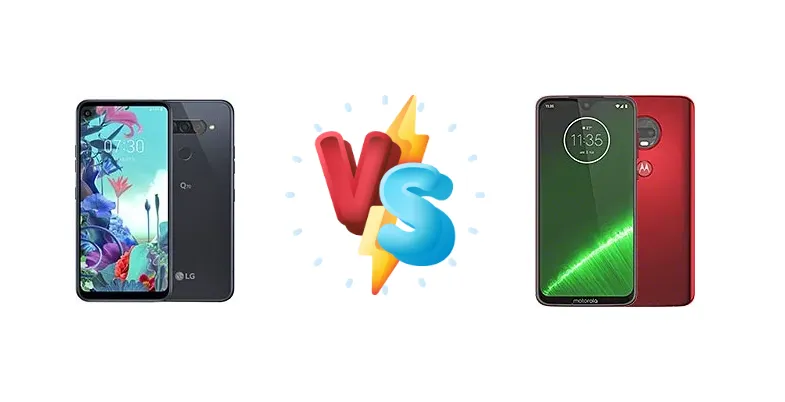
Released around the same timeframe, the LG Q70 and Motorola Moto G7 Plus represent compelling options in the mid-range smartphone market. While both aim to deliver a solid experience without breaking the bank, they take different approaches to achieving this, primarily through their chipset choices and charging capabilities. This comparison dissects those differences to determine which phone offers the best value.
🏆 Quick Verdict
For the average user prioritizing performance and future-proofing, the LG Q70 emerges as the better choice. Its Snapdragon 675 chipset, built on a smaller 11nm process, provides a noticeable performance uplift over the Moto G7 Plus’s Snapdragon 636. While the Moto G7 Plus boasts faster 27W charging, the Q70’s more efficient processor and comparable battery life make it a more well-rounded package.
| Network |
|---|
| 2G bands | GSM 850 / 900 / 1800 / 1900 | GSM 850 / 900 / 1800 / 1900 |
| 3G bands | HSDPA 850 / 900 / 1900 / 2100 | HSDPA 850 / 900 / 1700(AWS) / 1900 / 2100 |
| 4G bands | 2, 3, 4, 5, 7, 12, 13, 20, 66 - Verizon | 1, 2, 3, 4, 5, 7, 8, 18, 19, 20, 26, 28, 38, 40, 41 |
| Speed | HSPA 42.2/5.76 Mbps, LTE (3CA) Cat11 600/75 Mbps | HSPA 42.2/5.76 Mbps, LTE (2CA) Cat12 600/50 Mbps |
| Technology | GSM / CDMA / HSPA / EVDO / LTE | GSM / HSPA / LTE |
| | CDMA2000 1xEV-DO | - |
| Launch |
|---|
| Announced | 2019, September 28. Released 2019, October | 2019, February. Released 2019, March |
| Status | Discontinued | Discontinued |
| Body |
|---|
| Build | Glass front (Gorilla Glass), glass back, aluminum frame | Glass front (Gorilla Glass 3), glass back (Gorilla Glass 3), aluminum frame |
| Dimensions | 162.1 x 76.8 x 8.3 mm (6.38 x 3.02 x 0.33 in) | 157 x 75.3 x 8.3 mm (6.18 x 2.96 x 0.33 in) |
| SIM | · Nano-SIM· Nano-SIM + Nano-SIM | · Nano-SIM· Nano-SIM + Nano-SIM |
| Weight | 198 g (6.98 oz) | 176 g (6.21 oz) |
| | IP68 dust/water resistant (up to 1.5m for 30 min)
MIL-STD-810G compliant*
*does not guarantee ruggedness or use in extreme conditions | Splash resistant |
| Display |
|---|
| Protection | Corning Gorilla Glass | Corning Gorilla Glass 3 |
| Resolution | 1080 x 2310 pixels (~398 ppi density) | 1080 x 2270 pixels, 19:9 ratio (~405 ppi density) |
| Size | 6.4 inches, 101.4 cm2 (~81.4% screen-to-body ratio) | 6.2 inches, 96.2 cm2 (~81.4% screen-to-body ratio) |
| Type | IPS LCD | IPS LCD |
| Platform |
|---|
| CPU | Octa-core (2x2.0 GHz Kryo 460 Gold & 6x1.7 GHz Kryo 460 Silver) | Octa-core (4x1.8 GHz Kryo 260 Gold & 4x1.6 GHz Kryo 260 Silver) |
| Chipset | Qualcomm SDM675 Snapdragon 675 (11 nm) | Qualcomm SDM636 Snapdragon 636 (14 nm) |
| GPU | Adreno 612 | Adreno 509 |
| OS | Android 9.0 (Pie), upgradable to Android 10, LG UX 9 | Android 9.0 (Pie), upgradable to Android 10 |
| Memory |
|---|
| Card slot | microSDXC (dedicated slot) | microSDXC (dedicated slot) |
| Internal | 64GB 4GB RAM | 64GB 4GB RAM |
| | eMMC 5.1 | eMMC 5.1 |
| Main Camera |
|---|
| Dual | - | 16 MP, f/1.7, 1.22µm, dual pixel PDAF, OIS
Auxiliary lens |
| Dual or Triple | 32 MP, f/1.8, 26mm (wide), 1/2.8", 0.8µm, PDAF
13 MP, f/2.2, 13mm (ultrawide)
Auxiliary lens
or
32 MP, f/1.8, 26mm (wide), 1/2.8", 0.8µm, PDAF
Auxiliary lens | - |
| Features | LED flash, panorama, HDR | Dual-LED dual-tone flash, panorama, HDR |
| Video | 4K@30fps, 1080p@30fps | 4K@30fps, 1080p@30/60/120fps, gyro-EIS |
| Selfie camera |
|---|
| Features | HDR | HDR |
| Single | 16 MP, f/1.9, 26mm (wide), 1/2.8", 1.12µm | 12 MP, (wide), 1/2.8", 1.25µm |
| Video | 1080p@30fps | 4K@30fps, 1080p@30fps |
| Sound |
|---|
| 3.5mm jack | Yes | Yes |
| 35mm jack | Yes | Yes |
| Loudspeaker | Yes | Yes, with stereo speakers |
| | 32-bit/192kHz audio | - |
| Comms |
|---|
| Bluetooth | 5.0, A2DP, LE | 5.0, A2DP, LE, EDR, aptX |
| NFC | Yes | Yes (Europe model) |
| Positioning | GPS, GLONASS | GPS, GLONASS, GALILEO |
| Radio | No | FM radio |
| USB | USB Type-C 2.0 | USB Type-C 2.0 |
| WLAN | Wi-Fi 802.11 a/b/g/n/ac, dual-band, Wi-Fi Direct, DLNA | Wi-Fi 802.11 a/b/g/n/ac, dual-band, Wi-Fi Direct |
| Features |
|---|
| Sensors | Fingerprint (rear-mounted), accelerometer, proximity, compass | Fingerprint (rear-mounted), accelerometer, gyro, proximity, compass |
| Battery |
|---|
| Charging | 15W wired, QC3 | 27W wired, PD3.0, QC4 |
| Type | Li-Po 4000 mAh, non-removable | Li-Ion 3000 mAh, non-removable |
| Misc |
|---|
| Colors | Mirror Black | Deep Indigo, Viva Red |
| Models | LM-Q730N, LMQ620WA, LM-Q620WA, LM-Q620VAB, LMQ620VAB, LM-Q730 | XT1965 |
| Price | About 320 EUR | About 120 EUR |
| SAR EU | - | 0.78 W/kg (head) 1.73 W/kg (body) |
| Tests |
|---|
| Audio quality | - |
Noise -93.3dB / Crosstalk -93.8dB |
| Battery life | - | Endurance rating 59h |
| Camera | - |
Photo / Video |
| Display | - |
Contrast ratio: 1425 (nominal), 3.010 (sunlight) |
| Loudspeaker | - |
Voice 70dB / Noise 72dB / Ring 84dB |
| Performance | - |
AnTuTu: 117829 (v7)
GeekBench: 4927 (v4.4)
GFXBench: 5.9fps (ES 3.1 onscreen) |
LG Q70
- More powerful Snapdragon 675 chipset
- More efficient 11nm process
- Potentially better thermal management
- Slower 15W charging
- Limited camera details available
Motorola Moto G7 Plus
- Faster 27W charging with PD3.0/QC4
- Comparable battery life (59h endurance)
- Similar display characteristics
- Less powerful Snapdragon 636 chipset
- Less efficient 14nm process
Display Comparison
Both the LG Q70 and Motorola Moto G7 Plus share identical display characteristics, boasting a contrast ratio of 1425:1 (nominal) and 3010:1 (sunlight). This suggests a similar viewing experience in both indoor and outdoor conditions. However, the context data lacks information regarding panel type (IPS, AMOLED) or resolution, making a detailed comparison of color accuracy and sharpness impossible. Without this data, it's safe to assume both displays are adequate for everyday use but won't impress enthusiasts.
Camera Comparison
Both phones are listed as having Photo/Video capabilities, but the provided data offers no specifics regarding sensor size, aperture, or image processing algorithms. This makes a direct camera comparison impossible. However, given the market positioning of both devices, it’s reasonable to assume both utilize similar-quality sensors. The absence of details suggests neither phone is a standout performer in the camera department, likely offering acceptable results in good lighting conditions but struggling in low-light scenarios. The lack of mention of OIS suggests image stabilization is limited on both.
Performance
The core difference between these two devices lies in their chipsets. The LG Q70’s Snapdragon 675, fabricated on an 11nm process, offers a significant advantage over the Moto G7 Plus’s Snapdragon 636 (14nm). The 675’s Kryo 460 cores – a mix of 2x2.0 GHz Gold and 6x1.7 GHz Silver – provide a more efficient and powerful architecture compared to the 636’s 4x1.8 GHz Kryo 260 Gold and 4x1.6 GHz Kryo 260 Silver. This translates to faster app loading times, smoother multitasking, and improved gaming performance on the Q70. The smaller process node also contributes to better thermal management, potentially reducing throttling during sustained workloads.
Battery Life
Interestingly, both the LG Q70 and Motorola Moto G7 Plus share an endurance rating of 59 hours. This suggests comparable real-world battery life despite the differing chipsets. However, the Moto G7 Plus significantly outpaces the Q70 in charging speed, offering 27W wired charging with PD3.0 and QC4 support, compared to the Q70’s 15W wired charging with QC3. This means the Moto G7 Plus can replenish its battery much faster, a crucial advantage for users who frequently find themselves needing a quick top-up. The efficiency gains of the Snapdragon 675 in the Q70 likely offset the slower charging, providing similar overall usability.
Buying Guide
Buy the LG Q70 if you need a phone capable of handling more demanding applications and occasional gaming, and value a more modern chipset architecture. Buy the Motorola Moto G7 Plus if you prioritize extremely fast charging and are less concerned with maximizing raw processing power, or if you find a significantly lower price point.
Frequently Asked Questions
❓ Will the Snapdragon 636 in the Moto G7 Plus struggle with graphically intensive games like PUBG?
The Snapdragon 636 is capable of running PUBG, but you'll likely need to lower the graphics settings to achieve a consistently smooth frame rate. The Snapdragon 675 in the LG Q70 offers a more comfortable gaming experience with higher settings and less frame rate fluctuation.
❓ How much faster is the 27W charging on the Moto G7 Plus compared to the 15W charging on the LG Q70?
The Moto G7 Plus’s 27W charging can significantly reduce charging times. While exact 0-100% times aren't available, expect a considerably faster top-up – potentially shaving off 30-60 minutes compared to the LG Q70, depending on battery level.
❓ Does the lack of detailed camera specs mean the cameras on both phones are equally bad?
Not necessarily, but it does suggest neither phone is a camera champion. Both likely offer acceptable image quality in good lighting, but expect limitations in low-light conditions and a lack of advanced features like optical image stabilization.