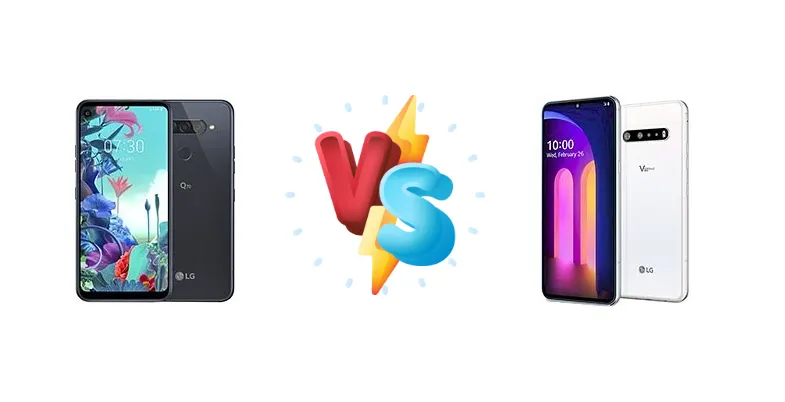
The LG V60 ThinQ 5G UW and the LG Q70 represent opposite ends of LG’s smartphone spectrum. The V60, released as a 2020 flagship, aimed to deliver cutting-edge 5G connectivity and performance. The Q70, positioned as a more affordable option, focused on providing a solid user experience without breaking the bank. This comparison dissects the key differences between these two devices, helping you determine which best suits your needs and budget.
🏆 Quick Verdict
For most users, the LG V60 ThinQ 5G UW is the superior choice. Its Snapdragon 865 chipset delivers significantly faster performance, enabling smoother multitasking, demanding gaming, and future-proof 5G connectivity. While the Q70 offers respectable performance for everyday tasks, the V60’s power and advanced features justify the price difference.
| Network |
|---|
| 2G bands | GSM 850 / 900 / 1800 / 1900 | GSM 850 / 900 / 1800 / 1900 |
| 3G bands | HSDPA 850 / 900 / 1900 / 2100 | HSDPA 850 / 900 / 1700(AWS) / 1900 / 2100 |
| 4G bands | 2, 3, 4, 5, 7, 12, 13, 20, 66 - Verizon | 2, 3, 4, 5, 7, 12, 13, 20, 28, 46, 48, 66 |
| 5G bands | - | 260, 261 mmWave |
| Speed | HSPA 42.2/5.76 Mbps, LTE (3CA) Cat11 600/75 Mbps | HSPA 42.2/5.76 Mbps, LTE (7CA) Cat22, 5G |
| Technology | GSM / CDMA / HSPA / EVDO / LTE | GSM / CDMA / HSPA / EVDO / LTE / 5G |
| | CDMA2000 1xEV-DO | CDMA2000 1xEV-DO |
| Launch |
|---|
| Announced | 2019, September 28. Released 2019, October | 2020, February 26. Released 2020, April 02 |
| Status | Discontinued | Discontinued |
| Body |
|---|
| Build | Glass front (Gorilla Glass), glass back, aluminum frame | Glass front (Gorilla Glass 5), glass back (Gorilla Glass 6), aluminum frame |
| Dimensions | 162.1 x 76.8 x 8.3 mm (6.38 x 3.02 x 0.33 in) | 169.3 x 77.6 x 8.9 mm (6.67 x 3.06 x 0.35 in) |
| SIM | · Nano-SIM· Nano-SIM + Nano-SIM | Nano-SIM (pre-installed) |
| Weight | 198 g (6.98 oz) | 218 g (7.69 oz) |
| | IP68 dust/water resistant (up to 1.5m for 30 min)
MIL-STD-810G compliant*
*does not guarantee ruggedness or use in extreme conditions | IP68 dust/water resistant (up to 1.5m for 30 min)
MIL-STD-810G compliant*
Method 516.6, Procedure IV "Transit Drop"
*does not guarantee ruggedness or use in extreme conditions |
| Display |
|---|
| Protection | Corning Gorilla Glass | Corning Gorilla Glass 5 |
| Resolution | 1080 x 2310 pixels (~398 ppi density) | 1080 x 2460 pixels (~395 ppi density) |
| Size | 6.4 inches, 101.4 cm2 (~81.4% screen-to-body ratio) | 6.8 inches, 109.8 cm2 (~83.6% screen-to-body ratio) |
| Type | IPS LCD | P-OLED, HDR10+ |
| | - | Always-on display |
| Platform |
|---|
| CPU | Octa-core (2x2.0 GHz Kryo 460 Gold & 6x1.7 GHz Kryo 460 Silver) | Octa-core (1x2.84 GHz Cortex-A77 & 3x2.42 GHz Cortex-A77 & 4x1.80 GHz Cortex-A55) |
| Chipset | Qualcomm SDM675 Snapdragon 675 (11 nm) | Qualcomm SM8250 Snapdragon 865 5G (7 nm+) |
| GPU | Adreno 612 | Adreno 650 |
| OS | Android 9.0 (Pie), upgradable to Android 10, LG UX 9 | Android 10, upgradable to Android 13 |
| Memory |
|---|
| Card slot | microSDXC (dedicated slot) | microSDXC (uses shared SIM slot) - dual-SIM model |
| Internal | 64GB 4GB RAM | 128GB 8GB RAM |
| | eMMC 5.1 | UFS 2.1 |
| Main Camera |
|---|
| Dual | - | 64 MP, f/1.8, 27mm (standard), 1/1.72", 0.8µm, dual pixel PDAF, OIS
13 MP, f/1.9, 12mm (ultrawide), 1/3.4", 1.0µm
0.3 MP, TOF 3D, f/1.4, (depth) |
| Dual or Triple | 32 MP, f/1.8, 26mm (wide), 1/2.8", 0.8µm, PDAF
13 MP, f/2.2, 13mm (ultrawide)
Auxiliary lens
or
32 MP, f/1.8, 26mm (wide), 1/2.8", 0.8µm, PDAF
Auxiliary lens | - |
| Features | LED flash, panorama, HDR | Dual-LED dual-tone flash, HDR, panorama |
| Video | 4K@30fps, 1080p@30fps | 8K@30fps, 4K@30/60fps, 1080p, HDR10+, 24-bit/192kHz stereo sound rec., gyro-EIS |
| Selfie camera |
|---|
| Features | HDR | HDR |
| Single | 16 MP, f/1.9, 26mm (wide), 1/2.8", 1.12µm | 10 MP, f/1.9, 30mm (standard), 1/3.1", 1.22µm |
| Video | 1080p@30fps | 4K@30fps, gyro-EIS |
| Sound |
|---|
| 3.5mm jack | Yes | Yes |
| 35mm jack | Yes | Yes |
| Loudspeaker | Yes | Yes, with stereo speakers |
| | 32-bit/192kHz audio | 32-bit/192kHz audio
24-bit/192kHz audio recording |
| Comms |
|---|
| Bluetooth | 5.0, A2DP, LE | 5.1, A2DP, LE, aptX HD |
| NFC | Yes | Yes |
| Positioning | GPS, GLONASS | GPS, GLONASS, GALILEO, BDS |
| Radio | No | FM radio (USA model only) |
| USB | USB Type-C 2.0 | USB Type-C 3.1, OTG |
| WLAN | Wi-Fi 802.11 a/b/g/n/ac, dual-band, Wi-Fi Direct, DLNA | Wi-Fi 802.11 a/b/g/n/ac/6, dual-band, Wi-Fi Direct, DLNA |
| Features |
|---|
| Sensors | Fingerprint (rear-mounted), accelerometer, proximity, compass | Fingerprint (under display, optical), accelerometer, gyro, proximity, compass, barometer |
| Battery |
|---|
| Charging | 15W wired, QC3 | Wired, PD2.0, QC4
Wireless |
| Type | Li-Po 4000 mAh, non-removable | Li-Po 5000 mAh |
| Misc |
|---|
| Colors | Mirror Black | Classy Blue, Classy White |
| Models | LM-Q730N, LMQ620WA, LM-Q620WA, LM-Q620VAB, LMQ620VAB, LM-Q730 | LM-V600VML, LMV600VML |
| Price | About 320 EUR | About 870 EUR |
| SAR | - | 0.85 W/kg (head) 1.12 W/kg (body) |
LG Q70
- Affordable price point
- Reliable Snapdragon 675 performance for basic tasks
- QC3 fast charging support
- Significantly slower performance than the V60
- Likely lower quality display
- Missing 5G connectivity
LG V60 ThinQ 5G UW
- Flagship Snapdragon 865 performance
- 5G connectivity for faster data speeds
- Faster charging with PD2.0 and QC4, plus wireless charging
- Higher price tag
- Potentially larger and heavier than the Q70
- May require a 5G data plan
Display Comparison
While both devices feature LCD panels, the specifics are not provided. However, given the V60’s flagship status, it likely boasts a higher resolution and potentially a higher refresh rate than the Q70. The V60’s panel likely benefits from LG’s display expertise, offering better color accuracy and viewing angles. The Q70, being a budget device, likely prioritizes cost-effectiveness over display quality, potentially resulting in lower peak brightness and less vibrant colors.
Camera Comparison
Details on camera sensors are missing, but the V60, as a flagship, almost certainly features a larger main sensor with optical image stabilization (OIS) – a feature likely absent on the Q70. The Snapdragon 865’s image signal processor (ISP) is also far more advanced, enabling better image processing, dynamic range, and low-light performance. While both phones may offer multiple lenses, the V60’s image quality will be noticeably superior, particularly in challenging conditions. The Q70’s camera is likely geared towards casual snapshots, while the V60 aims for more professional-looking results.
Performance
The performance gap between these two phones is substantial. The LG V60’s Snapdragon 865 5G (7nm+) is a flagship-tier chipset, featuring an octa-core CPU with a prime Cortex-A77 core clocked at 2.84 GHz. This architecture, combined with the 7nm+ manufacturing process, delivers significantly higher processing power and improved efficiency compared to the Q70’s Snapdragon 675 (11nm). The 675, while capable for everyday tasks, will struggle with demanding games and multitasking. The V60 also benefits from faster RAM (likely LPDDR5) compared to the Q70, further enhancing performance. The V60’s superior thermal design, expected in a flagship, will also minimize throttling during sustained workloads.
Battery Life
Battery capacity details are missing for both devices. However, the V60’s Snapdragon 865, despite its power, is more efficient than the Q70’s Snapdragon 675. More importantly, the V60 supports both PD2.0 and QC4 charging, offering significantly faster charging speeds than the Q70’s QC3-only support. The V60 also adds wireless charging, a feature absent on the Q70. This means the V60 can replenish its battery much quicker, minimizing downtime, even if the battery capacity is similar.
Buying Guide
Buy the LG Q70 if you prioritize affordability and a reliable, no-frills smartphone experience for basic tasks like calling, texting, and light social media use. You’ll appreciate its simplicity and lower price point. Buy the LG V60 ThinQ 5G UW if you demand high performance for gaming, video editing, or other resource-intensive applications, and if you want to take advantage of 5G network speeds. The V60 is the better choice for power users and those who want a phone that will remain capable for years to come.
Frequently Asked Questions
❓ Does the LG V60 ThinQ 5G UW support mmWave 5G, and is it compatible with all 5G carriers?
The 'UW' designation indicates support for mmWave 5G, which offers the fastest 5G speeds but has limited coverage. Compatibility depends on your carrier and region. Check with your carrier to ensure the V60 is compatible with their 5G network.
❓ Is the Snapdragon 675 in the LG Q70 powerful enough for modern mobile games like PUBG or Call of Duty?
The Snapdragon 675 can run PUBG and Call of Duty, but you’ll likely need to lower the graphics settings to achieve a smooth frame rate. Expect some stuttering and longer loading times compared to the V60’s Snapdragon 865.
❓ How much faster is the charging on the LG V60 compared to the LG Q70?
The V60’s support for PD2.0 and QC4 allows for significantly faster charging speeds than the Q70’s QC3. While exact charging times depend on the charger used, the V60 can likely charge from 0-100% in under an hour, while the Q70 may take closer to 2-3 hours.
❓ Will the LG Q70 receive software updates and security patches for an extended period?
As a budget device released in 2019, the LG Q70’s software update support is likely limited. While it may have received a few updates, it’s unlikely to receive major Android version upgrades or long-term security patches.