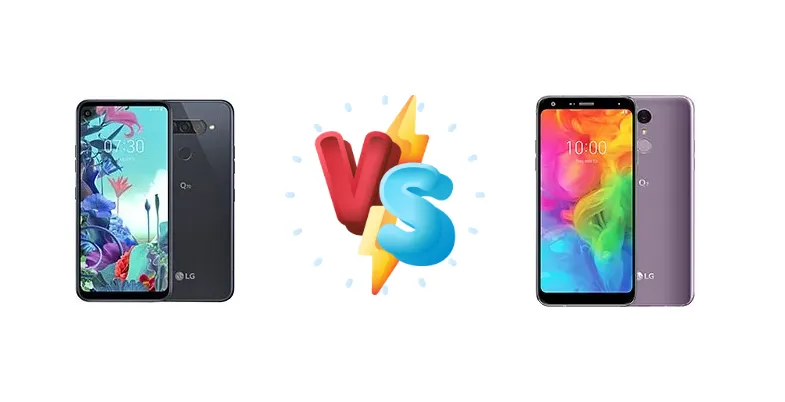
The LG Q70 and LG Q7 represent LG's attempts to deliver affordable smartphones with a focus on essential features. However, a significant divergence in chipset choice – Qualcomm's Snapdragon 675 in the Q70 versus Mediatek's MT6750S (or Snapdragon 450 in the Q7+) – creates a substantial performance gap. This comparison dissects these differences to determine which device offers the best experience for the price.
🏆 Quick Verdict
For the average user prioritizing responsiveness and future-proofing, the LG Q70 is the clear winner. Its Snapdragon 675 chipset delivers significantly better performance than the Mediatek MT6750S found in the standard Q7, making it a more capable device for multitasking, gaming, and overall usability. The Q7+ with the Snapdragon 450 narrows the gap, but still falls short.
| Network |
|---|
| 2G bands | GSM 850 / 900 / 1800 / 1900 | GSM 850 / 900 / 1800 / 1900 |
| 3G bands | HSDPA 850 / 900 / 1900 / 2100 | HSDPA 850 / 900 / 1900 / 2100 |
| 4G bands | 2, 3, 4, 5, 7, 12, 13, 20, 66 - Verizon | 1, 3, 5, 7, 8, 28, 38, 40, 41 |
| Speed | HSPA 42.2/5.76 Mbps, LTE (3CA) Cat11 600/75 Mbps | HSPA 42.2/5.76 Mbps, LTE (2CA) Cat6 300/50 Mbps |
| Technology | GSM / CDMA / HSPA / EVDO / LTE | GSM / HSPA / LTE |
| | CDMA2000 1xEV-DO | - |
| Launch |
|---|
| Announced | 2019, September 28. Released 2019, October | 2018, May. Released 2018, June |
| Status | Discontinued | Discontinued |
| Body |
|---|
| Build | Glass front (Gorilla Glass), glass back, aluminum frame | - |
| Dimensions | 162.1 x 76.8 x 8.3 mm (6.38 x 3.02 x 0.33 in) | 143.8 x 69.3 x 8.4 mm (5.66 x 2.73 x 0.33 in) |
| SIM | · Nano-SIM· Nano-SIM + Nano-SIM | · Nano-SIM· Nano-SIM + Nano-SIM |
| Weight | 198 g (6.98 oz) | 145 g (5.11 oz) |
| | IP68 dust/water resistant (up to 1.5m for 30 min)
MIL-STD-810G compliant*
*does not guarantee ruggedness or use in extreme conditions | IP68 dust/water resistant (up to 1.5m for 30 mins)
MIL-STD-810G compliant*
*does not guarantee ruggedness or use in extreme conditions |
| Display |
|---|
| Protection | Corning Gorilla Glass | - |
| Resolution | 1080 x 2310 pixels (~398 ppi density) | 1080 x 2160 pixels, 18:9 ratio (~442 ppi density) |
| Size | 6.4 inches, 101.4 cm2 (~81.4% screen-to-body ratio) | 5.5 inches, 77.0 cm2 (~77.3% screen-to-body ratio) |
| Type | IPS LCD | IPS LCD |
| Platform |
|---|
| CPU | Octa-core (2x2.0 GHz Kryo 460 Gold & 6x1.7 GHz Kryo 460 Silver) | Octa-core (4x1.5 GHz Cortex-A53 & 4x1.0 GHz Cortex-A53) - Q7, Q7αOcta-core 1.8 GHz Cortex-A53 - Q7+ |
| Chipset | Qualcomm SDM675 Snapdragon 675 (11 nm) | Mediatek MT6750S (28 nm) - Q7, Q7αQualcomm SDM450 Snapdragon 450 (14 nm) - Q7+ |
| GPU | Adreno 612 | Mali-T860MP2 - Q7, Q7αAdreno 506 - Q7+ |
| OS | Android 9.0 (Pie), upgradable to Android 10, LG UX 9 | Android 8.1 (Oreo), upgradable to Android 9.0 (Pie) |
| Memory |
|---|
| Card slot | microSDXC (dedicated slot) | microSDXC (dedicated slot) |
| Internal | 64GB 4GB RAM | 32GB 3GB RAM, 64GB 4GB RAM |
| | eMMC 5.1 | eMMC 5.1 |
| Main Camera |
|---|
| Dual or Triple | 32 MP, f/1.8, 26mm (wide), 1/2.8", 0.8µm, PDAF
13 MP, f/2.2, 13mm (ultrawide)
Auxiliary lens
or
32 MP, f/1.8, 26mm (wide), 1/2.8", 0.8µm, PDAF
Auxiliary lens | - |
| Features | LED flash, panorama, HDR | LED flash, panorama, HDR |
| Single | - | 13 MP, f/2.2, 1/3.1", 1.12µm, PDAF (Q7, Q7α)
16 MP, PDAF (Q7+) |
| Video | 4K@30fps, 1080p@30fps | 1080p@30fps (gyro-EIS) |
| Selfie camera |
|---|
| Features | HDR | - |
| Single | 16 MP, f/1.9, 26mm (wide), 1/2.8", 1.12µm | 5 MP (Q7α)
8 MP, f/1.9, 1/4.0", 1.12µm (Q7, Q7+) |
| Video | 1080p@30fps | 1080p@30fps |
| Sound |
|---|
| 3.5mm jack | Yes | Yes |
| 35mm jack | Yes | Yes |
| Loudspeaker | Yes | Yes |
| | 32-bit/192kHz audio | - |
| Comms |
|---|
| Bluetooth | 5.0, A2DP, LE | 4.2, A2DP, LE |
| NFC | Yes | Yes |
| Positioning | GPS, GLONASS | GPS, GLONASS |
| Radio | No | Stereo FM radio with RDS |
| USB | USB Type-C 2.0 | USB Type-C 2.0, OTG |
| WLAN | Wi-Fi 802.11 a/b/g/n/ac, dual-band, Wi-Fi Direct, DLNA | Wi-Fi 802.11 b/g/n, Wi-Fi Direct, DLNA |
| Features |
|---|
| Sensors | Fingerprint (rear-mounted), accelerometer, proximity, compass | Fingerprint (rear-mounted), accelerometer, gyro, proximity, compass |
| Battery |
|---|
| Charging | 15W wired, QC3 | 15W wired |
| Type | Li-Po 4000 mAh, non-removable | Li-Po 3000 mAh, non-removable |
| Misc |
|---|
| Colors | Mirror Black | Aurora Black, Moroccan Blue, Lavender Violet |
| Models | LM-Q730N, LMQ620WA, LM-Q620WA, LM-Q620VAB, LMQ620VAB, LM-Q730 | LM-Q610, LM-Q610.FG, LM-Q610.FGN, LM-Q610(FGN), LM-Q610.YN, LM-Q725L, LM-Q725K, LM-Q725S |
| Price | About 320 EUR | About 150 EUR |
LG Q70
- Significantly faster processor (Snapdragon 675)
- Better power efficiency
- Potentially superior camera image processing
- May be slightly more expensive
- Detailed display specs unknown
LG Q7
- Lower upfront cost
- Adequate for basic smartphone tasks
- 15W fast charging
- Slow processor (Mediatek MT6750S)
- Poor performance for multitasking and gaming
- Lower power efficiency
Display Comparison
Both the LG Q70 and Q7 feature displays that are adequate for their price point, but detailed specifications are lacking in the provided data. We can assume both utilize IPS LCD panels, common in this segment. The lack of information regarding resolution, brightness, and color gamut makes a direct comparison difficult. However, the Q70's more powerful chipset suggests it *could* support a higher resolution or refresh rate, though this isn't confirmed. Bezels are likely comparable, reflecting the budget nature of both devices.
Camera Comparison
Camera performance is difficult to assess without detailed sensor information. Both phones likely feature a multi-camera setup, but the provided data doesn't specify sensor sizes or apertures. The presence of a 2MP macro camera on both devices suggests limited utility, as these sensors typically produce low-quality images. The Q70’s more powerful ISP (Image Signal Processor) within the Snapdragon 675 *should* result in better image processing, dynamic range, and low-light performance, even with similar sensors. However, without concrete sensor details, this remains speculative.
Performance
The performance disparity is the defining factor in this comparison. The LG Q70’s Qualcomm Snapdragon 675 (11nm) is a substantial upgrade over the LG Q7’s Mediatek MT6750S (28nm). The Snapdragon 675’s Kryo 460 cores – a mix of 2x2.0 GHz Gold and 6x1.7 GHz Silver – offer significantly higher single-core and multi-core performance compared to the Q7’s 4x1.5 GHz Cortex-A53 and 4x1.0 GHz Cortex-A53. The 11nm process node of the SD675 also translates to better power efficiency and reduced thermal throttling. The Q7+ with the Snapdragon 450 (14nm) offers a modest improvement over the MT6750S, but still lags far behind the Q70. This difference is crucial for users who engage in multitasking, gaming, or use demanding applications.
Battery Life
Both the LG Q70 and Q7 support 15W wired charging, a standard offering in this price range. The actual battery capacity isn't specified, but the Snapdragon 675’s superior power efficiency in the Q70 means it will likely deliver longer battery life despite potentially having a similar capacity to the Q7. The Q7’s less efficient Mediatek chipset will drain the battery faster under similar usage conditions. While 0-100% charging times will likely be comparable due to the shared 15W charging, the Q70 will offer more usable time between charges.
Buying Guide
Buy the LG Q70 if you need a phone that can handle demanding apps, moderate gaming, and offers a smoother user experience. It's ideal for users who want a device that won't feel sluggish after a year of use. Buy the LG Q7 (or Q7α) if your primary needs are basic communication – calls, texts, and light social media – and you prioritize a lower upfront cost over performance. The Q7+ is a slight improvement, but the Q70 remains the better long-term investment.
Frequently Asked Questions
❓ Will the LG Q7 struggle with modern mobile games like PUBG or Call of Duty?
Yes, the Mediatek MT6750S in the LG Q7 is likely to struggle with demanding games like PUBG or Call of Duty, even at lower settings. Expect significant frame drops and lag. The LG Q70, with its Snapdragon 675, will provide a much smoother gaming experience, though still not at flagship levels.
❓ Is the Snapdragon 450 in the LG Q7+ a significant upgrade over the MT6750S in the standard Q7?
The Snapdragon 450 in the Q7+ is an improvement over the MT6750S, offering slightly better performance and efficiency. However, it still falls considerably short of the Snapdragon 675 in the Q70. It's a step up for basic tasks, but won't dramatically improve gaming or multitasking.
❓ Does either phone support Quick Charge beyond the stated 15W?
The LG Q70 specifically supports Qualcomm Quick Charge 3.0 (QC3), meaning it *can* potentially charge faster with a compatible QC3 charger. The LG Q7's compatibility with Quick Charge is not specified, and it may only support standard 15W charging.