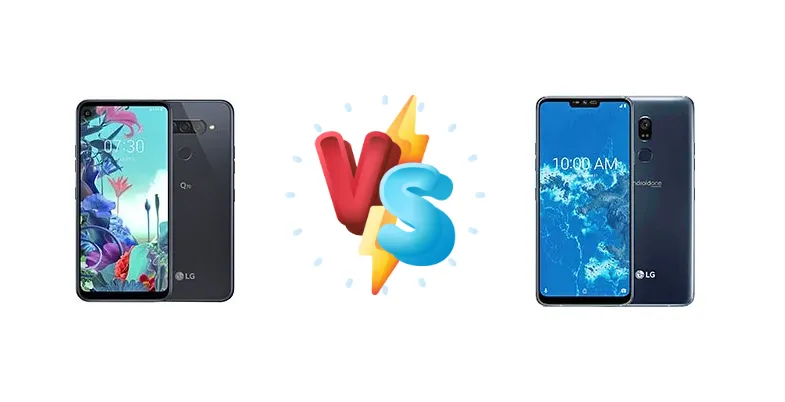
The LG G7 One and Q70 represent different approaches to the mid-range market. The G7 One, released as a more affordable flagship, leverages the older but potent Snapdragon 835. The Q70, a later offering, opts for the more efficient Snapdragon 675. This comparison dissects the trade-offs between raw power and optimized efficiency, helping you determine which LG device best suits your needs.
🏆 Quick Verdict
For most users, the LG G7 One offers a superior experience. While the Snapdragon 675 in the Q70 is efficient, the Snapdragon 835 in the G7 One delivers significantly better performance, especially for demanding tasks and gaming. The G7 One’s 18W charging and wireless charging (USA model) are also advantages.
| Network |
|---|
| 2G bands | GSM 850 / 900 / 1800 / 1900 | GSM 850 / 900 / 1800 / 1900 |
| 3G bands | HSDPA 850 / 900 / 1900 / 2100 | HSDPA 850 / 900 / 1900 / 2100 |
| 4G bands | 2, 3, 4, 5, 7, 12, 13, 20, 66 - Verizon | 1, 3, 5, 7, 8, 20 |
| Speed | HSPA 42.2/5.76 Mbps, LTE (3CA) Cat11 600/75 Mbps | HSPA, LTE |
| Technology | GSM / CDMA / HSPA / EVDO / LTE | GSM / HSPA / LTE |
| | CDMA2000 1xEV-DO | - |
| Launch |
|---|
| Announced | 2019, September 28. Released 2019, October | 2018, August. Released 2018, October |
| Status | Discontinued | Discontinued |
| Body |
|---|
| Build | Glass front (Gorilla Glass), glass back, aluminum frame | - |
| Dimensions | 162.1 x 76.8 x 8.3 mm (6.38 x 3.02 x 0.33 in) | 153.2 x 71.9 x 7.9 mm (6.03 x 2.83 x 0.31 in) |
| SIM | · Nano-SIM· Nano-SIM + Nano-SIM | · Nano-SIM· Nano-SIM + Nano-SIM |
| Weight | 198 g (6.98 oz) | 156 g (5.50 oz) |
| | IP68 dust/water resistant (up to 1.5m for 30 min)
MIL-STD-810G compliant*
*does not guarantee ruggedness or use in extreme conditions | IP68 dust/water resistant (up to 1.5m for 30 mins)
MIL-STD-810G compliant*
*does not guarantee ruggedness or use in extreme conditions |
| Display |
|---|
| Protection | Corning Gorilla Glass | - |
| Resolution | 1080 x 2310 pixels (~398 ppi density) | 1440 x 3120 pixels, 19.5:9 ratio (~563 ppi density) |
| Size | 6.4 inches, 101.4 cm2 (~81.4% screen-to-body ratio) | 6.1 inches, 91.3 cm2 (~82.9% screen-to-body ratio) |
| Type | IPS LCD | IPS LCD, HDR10 |
| | - | Always-on display |
| Platform |
|---|
| CPU | Octa-core (2x2.0 GHz Kryo 460 Gold & 6x1.7 GHz Kryo 460 Silver) | Octa-core (4x2.45 GHz Kryo & 4x1.9 GHz Kryo) |
| Chipset | Qualcomm SDM675 Snapdragon 675 (11 nm) | Qualcomm MSM8998 Snapdragon 835 (10 nm) |
| GPU | Adreno 612 | Adreno 540 |
| OS | Android 9.0 (Pie), upgradable to Android 10, LG UX 9 | Android 8.1 (Oreo), upgradable to Android 10, Android One |
| Memory |
|---|
| Card slot | microSDXC (dedicated slot) | microSDXC (uses shared SIM slot) |
| Internal | 64GB 4GB RAM | 32GB 4GB RAM, 64GB 4GB RAM |
| | eMMC 5.1 | - |
| Main Camera |
|---|
| Dual or Triple | 32 MP, f/1.8, 26mm (wide), 1/2.8", 0.8µm, PDAF
13 MP, f/2.2, 13mm (ultrawide)
Auxiliary lens
or
32 MP, f/1.8, 26mm (wide), 1/2.8", 0.8µm, PDAF
Auxiliary lens | - |
| Features | LED flash, panorama, HDR | Laser AF, LED flash, HDR, panorama |
| Single | - | 16 MP, f/1.6, 31mm (standard), 1/3.1", 1.0µm, PDAF, OIS |
| Video | 4K@30fps, 1080p@30fps | 4K@30fps |
| Selfie camera |
|---|
| Features | HDR | - |
| Single | 16 MP, f/1.9, 26mm (wide), 1/2.8", 1.12µm | 8 MP, f/1.9, 26mm (wide) |
| Video | 1080p@30fps | 1080p@30fps |
| Sound |
|---|
| 3.5mm jack | Yes | Yes |
| 35mm jack | Yes | Yes |
| Loudspeaker | Yes | Yes |
| | 32-bit/192kHz audio | 32-bit/192kHz audio |
| Comms |
|---|
| Bluetooth | 5.0, A2DP, LE | 5.0, A2DP, LE, aptX HD |
| NFC | Yes | Yes |
| Positioning | GPS, GLONASS | GPS, GLONASS, BDS |
| Radio | No | FM radio |
| USB | USB Type-C 2.0 | USB Type-C 3.1, OTG |
| WLAN | Wi-Fi 802.11 a/b/g/n/ac, dual-band, Wi-Fi Direct, DLNA | Wi-Fi 802.11 a/b/g/n/ac, dual-band, Wi-Fi Direct, DLNA |
| Features |
|---|
| Sensors | Fingerprint (rear-mounted), accelerometer, proximity, compass | Fingerprint (rear-mounted), accelerometer, gyro, proximity, compass, barometer |
| Battery |
|---|
| Charging | 15W wired, QC3 | 18W wired, QC3
Wireless (USA) |
| Type | Li-Po 4000 mAh, non-removable | Li-Po 3000 mAh, non-removable |
| Misc |
|---|
| Colors | Mirror Black | New Aurora Black, New Moroccan Blue |
| Models | LM-Q730N, LMQ620WA, LM-Q620WA, LM-Q620VAB, LMQ620VAB, LM-Q730 | LMQ910UM, LM-Q910, LM-X510K, LM-Q927L, LM-X510S |
| Price | About 320 EUR | About 350 EUR |
LG Q70
- More powerful Snapdragon 835 processor
- Faster 18W charging (and wireless charging in USA)
- Potentially better camera image processing
- Potentially lower battery life under heavy load
- Older chipset architecture
LG G7 One
- More power-efficient Snapdragon 675 processor
- Lower price point
- Potentially longer battery life with light usage
- Significantly slower performance for demanding tasks
- Slower 15W charging
Display Comparison
Neither device boasts a cutting-edge display. Both likely utilize IPS LCD panels, common for their price segments. The G7 One benefits from being a former flagship, potentially offering slightly better color calibration and viewing angles. However, detailed specs like peak brightness and color gamut coverage are unavailable. The Q70’s display is likely tuned for power efficiency, potentially at the expense of vibrancy. Bezels are expected to be comparable, reflecting the design trends of their respective release years.
Camera Comparison
Without detailed sensor information, a precise camera comparison is difficult. However, the G7 One, as a former flagship, likely features a more sophisticated image signal processor (ISP) within the Snapdragon 835. This results in better dynamic range, noise reduction, and overall image quality. The Q70’s camera system is likely geared towards providing acceptable results in good lighting conditions. The presence of OIS (Optical Image Stabilization) on the G7 One, if equipped, would further enhance low-light performance and video stabilization. We can assume both devices include standard features like HDR mode, but the G7 One’s processing will likely be more refined.
Performance
The core difference lies in the chipsets. The LG G7 One’s Snapdragon 835 (10nm) features a Kryo CPU with a peak clock speed of 2.45 GHz, offering a substantial performance advantage over the Q70’s Snapdragon 675 (11nm). While the 675’s Kryo 460 cores are efficient, the 835’s architecture is more capable in sustained workloads. The 10nm process of the 835, despite being older, is well-optimized. The Q70’s 11nm process doesn’t fully compensate for the architectural gap. This translates to faster app loading, smoother multitasking, and better gaming performance on the G7 One. The G7 One will exhibit less throttling under sustained load.
Battery Life
The LG Q70’s Snapdragon 675 is more power-efficient, potentially leading to longer battery life during typical usage. However, the G7 One’s 18W Quick Charge 3.0 support (and wireless charging in the USA model) offers a faster recharge time. The Q70’s 15W charging is comparatively slower. While the Q70 might last longer on a single charge with conservative use, the G7 One’s faster charging mitigates the impact of its potentially higher power consumption. The actual battery life difference will depend heavily on individual usage patterns.
Buying Guide
Buy the LG Q70 if you prioritize long battery life and a lower price point above all else, and your usage primarily consists of basic tasks like calling, texting, and light social media. Buy the LG G7 One if you value smoother performance for gaming, multitasking, and demanding applications, and appreciate the convenience of faster and wireless charging.
Frequently Asked Questions
❓ Will the Snapdragon 675 in the LG Q70 struggle with graphically intensive games like PUBG or Call of Duty?
The Snapdragon 675 can run these games, but you'll likely need to lower graphics settings to achieve a smooth frame rate. Expect occasional stuttering and potentially longer loading times compared to the Snapdragon 835 in the G7 One, which can handle these games at higher settings.
❓ Does the LG G7 One support fast charging with any charger other than the one included in the box?
Yes, the LG G7 One supports Qualcomm Quick Charge 3.0. Any QC3.0 compatible charger will provide fast charging speeds. However, using a non-QC3.0 charger will result in slower charging times.
❓ Is the difference in performance between the two phones noticeable for everyday tasks like browsing and social media?
For basic tasks, the difference will be minimal. However, when switching between apps, opening heavier applications, or performing more complex operations, the Snapdragon 835 in the G7 One will feel noticeably snappier and more responsive.
❓ Does the LG G7 One have any software features that the Q70 lacks?
As a former flagship, the G7 One may have received more software updates and feature additions during its lifespan. It's possible it includes features like a dedicated camera mode or advanced audio settings not present on the Q70.