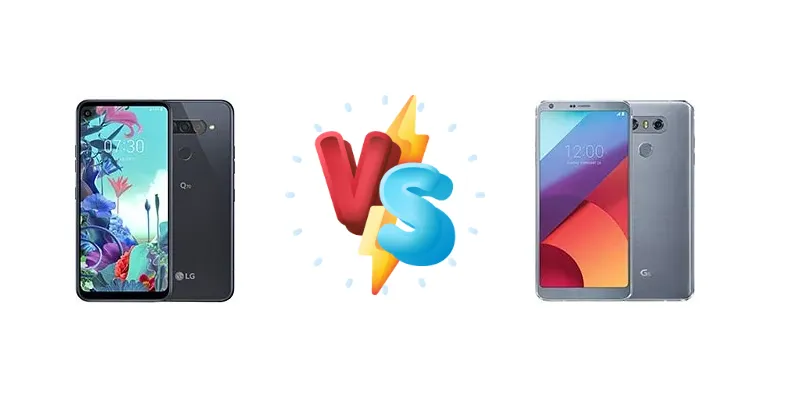
The LG Q70 and G6 represent different eras of LG's smartphone strategy. The G6, released in 2017, was a flagship aiming for premium features, while the Q70, from 2019, targeted the mid-range market with a focus on essential functionality. This comparison dissects their key differences to determine which device holds up better today, particularly considering current pricing and user needs.
🏆 Quick Verdict
For the average user in 2024, the LG G6 offers a more compelling experience. While the Q70’s Snapdragon 675 is efficient, the G6’s Snapdragon 821 provides significantly more processing power, and its 72-hour endurance rating, despite its age, remains competitive. The G6’s superior display contrast also contributes to a better overall experience.
| Network |
|---|
| 2G bands | GSM 850 / 900 / 1800 / 1900 | GSM 850 / 900 / 1800 / 1900 - SIM 1 & SIM 2 (dual-SIM model only) |
| 3G bands | HSDPA 850 / 900 / 1900 / 2100 | HSDPA 850 / 900 / 1700(AWS) / 1900 / 2100 |
| 4G bands | 2, 3, 4, 5, 7, 12, 13, 20, 66 - Verizon | 1, 2, 3, 4, 5, 7, 8, 12, 13, 17, 20, 28, 38, 40 |
| Speed | HSPA 42.2/5.76 Mbps, LTE (3CA) Cat11 600/75 Mbps | HSPA 42.2/5.76 Mbps, LTE (3CA) Cat12 600/150 Mbps |
| Technology | GSM / CDMA / HSPA / EVDO / LTE | GSM / HSPA / LTE |
| | CDMA2000 1xEV-DO | - |
| Launch |
|---|
| Announced | 2019, September 28. Released 2019, October | 2017, February 26. Released 2017, April 07 |
| Status | Discontinued | Discontinued |
| Body |
|---|
| Build | Glass front (Gorilla Glass), glass back, aluminum frame | Glass front (Gorilla Glass 3), glass back (Gorilla Glass 5), aluminum frame |
| Dimensions | 162.1 x 76.8 x 8.3 mm (6.38 x 3.02 x 0.33 in) | 148.9 x 71.9 x 7.9 mm (5.86 x 2.83 x 0.31 in) |
| SIM | · Nano-SIM· Nano-SIM + Nano-SIM | · Nano-SIM· Nano-SIM + Nano-SIM |
| Weight | 198 g (6.98 oz) | 163 g (5.75 oz) |
| | IP68 dust/water resistant (up to 1.5m for 30 min)
MIL-STD-810G compliant*
*does not guarantee ruggedness or use in extreme conditions | IP68 dust/water resistant (up to 1.5m for 30 mins)
MIL-STD-810G compliant*
*does not guarantee ruggedness or use in extreme conditions |
| Display |
|---|
| Protection | Corning Gorilla Glass | Corning Gorilla Glass 3 |
| Resolution | 1080 x 2310 pixels (~398 ppi density) | 1440 x 2880 pixels, 18:9 ratio (~564 ppi density) |
| Size | 6.4 inches, 101.4 cm2 (~81.4% screen-to-body ratio) | 5.7 inches, 84.1 cm2 (~78.6% screen-to-body ratio) |
| Type | IPS LCD | IPS LCD, HDR10, Dolby Vision |
| | - | Always-on display |
| Platform |
|---|
| CPU | Octa-core (2x2.0 GHz Kryo 460 Gold & 6x1.7 GHz Kryo 460 Silver) | Quad-core (2x2.35 GHz Kryo & 2x1.6 GHz Kryo) |
| Chipset | Qualcomm SDM675 Snapdragon 675 (11 nm) | Qualcomm MSM8996 Snapdragon 821 (14 nm) |
| GPU | Adreno 612 | Adreno 530 |
| OS | Android 9.0 (Pie), upgradable to Android 10, LG UX 9 | Android 7.0 (Nougat), upgradable to Android 9.0 (Pie), LG UX 8 UI |
| Memory |
|---|
| Card slot | microSDXC (dedicated slot) | microSDXC (uses shared SIM slot) - dual SIM model only |
| Internal | 64GB 4GB RAM | 32GB 4GB RAM, 64GB 4GB RAM, 128GB 4GB RAM |
| | eMMC 5.1 | UFS 2.0 |
| Main Camera |
|---|
| Dual | - | 13 MP, f/1.8, 30mm (standard), 1/3.1", 1.12µm, PDAF, 3-axis OIS
13 MP, f/2.4, 12mm (ultrawide), no AF |
| Dual or Triple | 32 MP, f/1.8, 26mm (wide), 1/2.8", 0.8µm, PDAF
13 MP, f/2.2, 13mm (ultrawide)
Auxiliary lens
or
32 MP, f/1.8, 26mm (wide), 1/2.8", 0.8µm, PDAF
Auxiliary lens | - |
| Features | LED flash, panorama, HDR | Dual-LED flash, HDR, panorama |
| Video | 4K@30fps, 1080p@30fps | 4K@30fps, 1080p@30/60fps, HDR, 24-bit/192kHz stereo sound rec. |
| Selfie camera |
|---|
| Features | HDR | - |
| Single | 16 MP, f/1.9, 26mm (wide), 1/2.8", 1.12µm | 5 MP, f/2.2, 18mm |
| Video | 1080p@30fps | 1080p@30fps |
| Sound |
|---|
| 3.5mm jack | Yes | Yes |
| 35mm jack | Yes | Yes |
| Loudspeaker | Yes | Yes |
| | 32-bit/192kHz audio | 32-bit/192kHz audio
|
| Comms |
|---|
| Bluetooth | 5.0, A2DP, LE | 4.2, A2DP, LE, aptX HD |
| NFC | Yes | Yes |
| Positioning | GPS, GLONASS | GPS, GLONASS, BDS |
| Radio | No | FM radio (market dependent) |
| USB | USB Type-C 2.0 | USB Type-C 3.1, OTG |
| WLAN | Wi-Fi 802.11 a/b/g/n/ac, dual-band, Wi-Fi Direct, DLNA | Wi-Fi 802.11 a/b/g/n/ac, dual-band, Wi-Fi Direct, DLNA |
| Features |
|---|
| Sensors | Fingerprint (rear-mounted), accelerometer, proximity, compass | Fingerprint (rear-mounted), accelerometer, gyro, proximity, compass, barometer |
| Battery |
|---|
| Charging | 15W wired, QC3 | 18W wired, QC3, 50% in 30 min
Wireless (USA) |
| Type | Li-Po 4000 mAh, non-removable | Li-Po 3300 mAh, non-removable |
| Misc |
|---|
| Colors | Mirror Black | Astro Black, Ice Platinum, Terra Gold, Marine Blue, Mystic White, Raspberry Rose, Moroccan Blue, Lavender Violet |
| Models | LM-Q730N, LMQ620WA, LM-Q620WA, LM-Q620VAB, LMQ620VAB, LM-Q730 | H870, H870DS, H873, H870S, LGM-G600L, H872, H871, LS993, US997, vs988, VS988, LGM-G600K, LGM-G600S, AS993, LGUS997, H870AR, H872PR, H871S, H870I |
| Price | About 320 EUR | About 240 EUR |
| SAR | - | 0.65 W/kg (head) 1.23 W/kg (body) |
| SAR EU | - | 0.23 W/kg (head) 0.15 W/kg (body) |
| Tests |
|---|
| Audio quality | - |
Noise -93.3dB / Crosstalk -94.4dB |
| Battery life | - | Endurance rating 72h |
| Camera | - |
Photo / Video |
| Display | - |
Contrast ratio: 2053 (nominal), 3.556 (sunlight) |
| Loudspeaker | - |
Voice 66dB / Noise 68dB / Ring 74dB |
| Performance | - |
AnTuTu: 158785 (v7)
GeekBench: 4175 (v4.4)
GFXBench: 8.5fps (ES 3.1 onscreen) |
LG Q70
- More modern chipset architecture (Snapdragon 675)
- Potentially better power efficiency
- Likely more affordable in current market
- Significantly lower processing power than the G6
- Camera likely inferior to the G6
- Limited software update support
LG G6
- More powerful Snapdragon 821 processor
- Excellent 72-hour endurance rating
- Potentially superior camera system
- Older device with limited software support
- Larger and heavier than the Q70
- Battery is aging and may have reduced capacity
Display Comparison
Both the LG Q70 and G6 share a contrast ratio of 2053:1 (nominal) and 3.556:1 (sunlight), suggesting similar display panel technology and outdoor visibility. However, the G6’s flagship status likely afforded it better calibration and potentially higher peak brightness, though specific nit values aren’t provided. The Q70, being a mid-ranger, may exhibit slightly less accurate color reproduction. The G6’s display, while older, benefits from being a core feature of a premium device, likely resulting in a more refined viewing experience.
Camera Comparison
Both devices are listed as having 'Photo / Video' capabilities, but detailed camera specifications are absent. Given the G6’s flagship positioning, it likely features a more sophisticated camera system with a larger sensor and better image processing. The Q70, as a budget device, likely compromises on sensor size and image quality. While both may offer similar features like HDR and panorama, the G6’s camera is expected to deliver superior image quality, particularly in low-light conditions. The absence of specific details prevents a deeper analysis, but the G6’s heritage suggests a more capable camera.
Performance
The chipset is where the most significant difference lies. The LG G6’s Snapdragon 821 (14nm) features a quad-core Kryo architecture with a peak clock speed of 2.35 GHz, while the Q70 utilizes the Snapdragon 675 (11nm) with an octa-core Kryo 460 configuration. Despite having more cores, the 675’s lower clock speeds and older architecture result in lower overall performance compared to the 821. The 14nm process of the 821, while less efficient than the 11nm of the 675, is offset by its superior architecture, leading to better sustained performance in demanding applications and games. The G6 will handle multitasking and graphically intensive tasks with greater ease.
Battery Life
The LG G6 boasts an endurance rating of 72 hours, a testament to its efficient power management and 3300 mAh battery (based on market data). The Q70’s battery capacity is not specified, but its Snapdragon 675 chipset is more power-efficient. However, the G6’s 18W charging with Quick Charge 3.0 (50% in 30 minutes) is slightly faster than the Q70’s 15W charging. The G6’s longer endurance rating suggests it can comfortably last a full day of moderate to heavy use, while the Q70 may require more frequent charging, despite its potentially smaller battery.
Buying Guide
Buy the LG Q70 if you prioritize a newer device with guaranteed software updates (though limited) and are on a very tight budget, primarily needing a reliable phone for basic communication and light tasks. Buy the LG G6 if you value performance for demanding apps, enjoy a higher-quality display with better contrast, and appreciate a phone that still feels relatively capable despite its age, especially if found at a bargain price.
Frequently Asked Questions
❓ Is the Snapdragon 821 in the LG G6 still capable of handling modern apps and games?
Despite its age, the Snapdragon 821 remains a surprisingly capable processor. While it won't match the performance of the latest Snapdragon chips, it can handle most modern apps and games at reasonable settings. Expect some slowdowns in the most demanding titles, but overall, the G6 provides a smooth and responsive experience for everyday use.
❓ How does the aging battery in the LG G6 affect its real-world performance?
The LG G6’s battery is several years old at this point, so its capacity has likely degraded. While the original endurance rating was 72 hours, expect to see significantly less battery life in practice. However, the G6’s efficient power management and the availability of replacement batteries mean that battery life can be restored to a reasonable level with a battery swap.
❓ Does the LG Q70 receive regular software updates?
The LG Q70 is no longer receiving major Android updates. While it may have received a few security patches, it's unlikely to receive any further software support from LG. This means you'll be stuck with the version of Android it shipped with, which may lack some of the latest features and security enhancements.
❓ Which phone is better for mobile gaming?
The LG G6 is the clear winner for mobile gaming. The Snapdragon 821’s superior GPU performance will deliver higher frame rates and smoother gameplay compared to the Snapdragon 675 in the Q70. While the G6 may not be able to max out all settings in the latest games, it will provide a significantly better gaming experience overall.