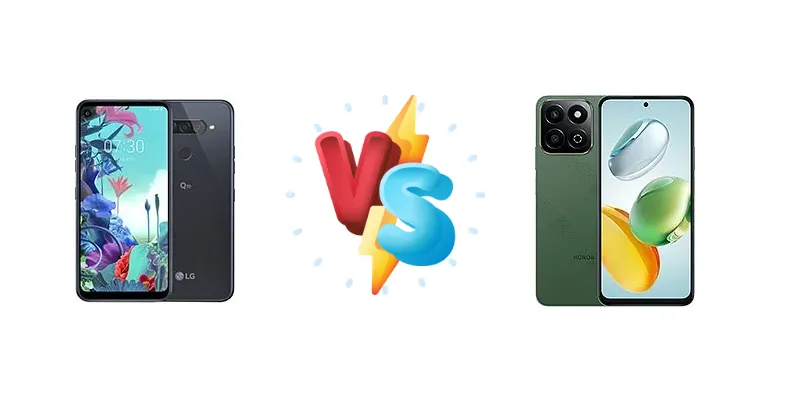
The LG Q70, released in 2019, represents a mature design from LG’s smartphone lineup, while the Honor 200 Smart is a more recent entrant aiming to deliver modern features at an accessible price point. This comparison focuses on the core differences – specifically, the generational leap in Qualcomm’s Snapdragon processors and the impact on performance and efficiency.
🏆 Quick Verdict
For the average user prioritizing efficiency and faster charging, the Honor 200 Smart is the clear winner. Its Snapdragon 4 Gen 2 (4nm) offers improved power efficiency and 35W charging compared to the LG Q70’s Snapdragon 675 (11nm) and 15W charging. While the Q70 remains usable, the 200 Smart provides a more future-proof experience.
| Network |
|---|
| 2G bands | GSM 850 / 900 / 1800 / 1900 | GSM 850 / 900 / 1800 / 1900 |
| 3G bands | HSDPA 850 / 900 / 1900 / 2100 | HSDPA 850 / 900 / 1700(AWS) / 1900 / 2100 |
| 4G bands | 2, 3, 4, 5, 7, 12, 13, 20, 66 - Verizon | LTE |
| 5G bands | - | SA/NSA |
| Speed | HSPA 42.2/5.76 Mbps, LTE (3CA) Cat11 600/75 Mbps | HSPA, LTE, 5G |
| Technology | GSM / CDMA / HSPA / EVDO / LTE | GSM / HSPA / LTE / 5G |
| | CDMA2000 1xEV-DO | - |
| Launch |
|---|
| Announced | 2019, September 28. Released 2019, October | 2024, September 17 |
| Status | Discontinued | Available. Released 2024, September 23 |
| Body |
|---|
| Build | Glass front (Gorilla Glass), glass back, aluminum frame | - |
| Dimensions | 162.1 x 76.8 x 8.3 mm (6.38 x 3.02 x 0.33 in) | 166.9 x 76.8 x 8.1 mm (6.57 x 3.02 x 0.32 in) |
| SIM | · Nano-SIM· Nano-SIM + Nano-SIM | Nano-SIM + Nano-SIM |
| Weight | 198 g (6.98 oz) | 191 g or 193 g (6.74 oz) |
| | IP68 dust/water resistant (up to 1.5m for 30 min)
MIL-STD-810G compliant*
*does not guarantee ruggedness or use in extreme conditions | - |
| Display |
|---|
| Protection | Corning Gorilla Glass | Aluminosilicate glass |
| Resolution | 1080 x 2310 pixels (~398 ppi density) | 1080 x 2412 pixels, 20:9 ratio (~389 ppi density) |
| Size | 6.4 inches, 101.4 cm2 (~81.4% screen-to-body ratio) | 6.8 inches, 111.3 cm2 (~86.8% screen-to-body ratio) |
| Type | IPS LCD | TFT LCD, 120Hz, 850 nits (peak) |
| Platform |
|---|
| CPU | Octa-core (2x2.0 GHz Kryo 460 Gold & 6x1.7 GHz Kryo 460 Silver) | Octa-core (2x2.2 GHz Cortex-A78 & 6x1.95 GHz Cortex-A55) |
| Chipset | Qualcomm SDM675 Snapdragon 675 (11 nm) | Qualcomm SM4450 Snapdragon 4 Gen 2 (4 nm) |
| GPU | Adreno 612 | Adreno 613 |
| OS | Android 9.0 (Pie), upgradable to Android 10, LG UX 9 | Android 14, Magic OS 8 |
| Memory |
|---|
| Card slot | microSDXC (dedicated slot) | No |
| Internal | 64GB 4GB RAM | 256GB 4GB RAM, 256GB 8GB RAM |
| | eMMC 5.1 | - |
| Main Camera |
|---|
| Dual | - | 50 MP, f/1.8, (wide), PDAF
Auxiliary lens |
| Dual or Triple | 32 MP, f/1.8, 26mm (wide), 1/2.8", 0.8µm, PDAF
13 MP, f/2.2, 13mm (ultrawide)
Auxiliary lens
or
32 MP, f/1.8, 26mm (wide), 1/2.8", 0.8µm, PDAF
Auxiliary lens | - |
| Features | LED flash, panorama, HDR | LED flash, HDR |
| Video | 4K@30fps, 1080p@30fps | 1080p@30fps |
| Selfie camera |
|---|
| Features | HDR | - |
| Single | 16 MP, f/1.9, 26mm (wide), 1/2.8", 1.12µm | 5 MP, f/2.2, (wide) |
| Video | 1080p@30fps | 1080p@30fps |
| Sound |
|---|
| 3.5mm jack | Yes | - |
| 35mm jack | Yes | Yes |
| Loudspeaker | Yes | Yes, with stereo speakers |
| | 32-bit/192kHz audio | - |
| Comms |
|---|
| Bluetooth | 5.0, A2DP, LE | 5.0, A2DP, LE |
| NFC | Yes | No |
| Positioning | GPS, GLONASS | GPS, GLONASS, GALILEO, BDS |
| Radio | No | No |
| USB | USB Type-C 2.0 | USB Type-C 2.0, OTG |
| WLAN | Wi-Fi 802.11 a/b/g/n/ac, dual-band, Wi-Fi Direct, DLNA | Wi-Fi 802.11 a/b/g/n/ac, dual-band, Wi-Fi Direct |
| Features |
|---|
| Sensors | Fingerprint (rear-mounted), accelerometer, proximity, compass | Fingerprint (side-mounted), accelerometer, proximity, compass |
| Battery |
|---|
| Charging | 15W wired, QC3 | 35W wired |
| Type | Li-Po 4000 mAh, non-removable | Li-Po 5200 mAh |
| Misc |
|---|
| Colors | Mirror Black | Midnight Black, Forest Green |
| Models | LM-Q730N, LMQ620WA, LM-Q620WA, LM-Q620VAB, LMQ620VAB, LM-Q730 | ALT-NX1 |
| Price | About 320 EUR | € 109.99 / £ 114.99 |
LG Q70
- Proven reliability and software stability (mature device)
- Potentially lower initial purchase price (due to age)
- Familiar user experience for LG users
- Older chipset with lower power efficiency
- Slower 15W charging
- Likely outdated display technology
Honor 200 Smart
- More efficient Snapdragon 4 Gen 2 (4nm)
- Faster 35W wired charging
- Likely more modern display technology
- Better long-term software support
- May have a slightly higher initial purchase price
- Potential for software bugs common in newer devices
Display Comparison
Neither device’s display specifications are provided, so a direct comparison is limited. However, given the Q70’s age, it likely utilizes an older LCD panel. The Honor 200 Smart, being a newer device, likely features a more modern LCD or potentially even an AMOLED panel with improved color accuracy and viewing angles. Bezels on the Q70 are expected to be more prominent due to its 2019 release date, while the 200 Smart should benefit from slimmer bezels.
Camera Comparison
Without specific camera specs, analysis is limited. However, it’s reasonable to assume the Honor 200 Smart benefits from more advanced image processing capabilities due to its newer chipset. The Q70 likely relies on older algorithms. Sensor size and lens apertures are unknown for both, but the 200 Smart likely incorporates improvements in these areas as well. The presence of Optical Image Stabilization (OIS) is also more probable on the newer device, leading to sharper images and more stable video recording.
Performance
The core difference lies in the chipsets. The LG Q70’s Snapdragon 675 (11nm) features a Kryo 460 CPU with a 2x2.0 GHz Gold and 6x1.7 GHz Silver configuration. The Honor 200 Smart’s Snapdragon 4 Gen 2 (4nm) utilizes a 2x2.2 GHz Cortex-A78 and 6x1.95 GHz Cortex-A55 setup. The 4nm process node of the Snapdragon 4 Gen 2 is a significant advantage, offering substantially better power efficiency and thermal performance. While the Q70’s CPU clock speeds are slightly higher on the ‘Gold’ cores, the architectural improvements and process node shrink of the 4 Gen 2 translate to better sustained performance and reduced throttling under load. The 4 Gen 2’s Cortex-A78 cores also offer a performance uplift over the Kryo 460 Gold cores.
Battery Life
Battery capacity is not specified for either device. However, the Honor 200 Smart’s 35W wired charging is a major advantage over the LG Q70’s 15W charging. This translates to significantly faster charging times – a full charge on the 200 Smart will likely take under 90 minutes, while the Q70 could take over two hours. The Snapdragon 4 Gen 2’s improved power efficiency also means the 200 Smart will likely deliver longer battery life, even with a similar capacity battery to the Q70.
Buying Guide
Buy the LG Q70 if you need a familiar, readily available device with a proven track record and are less concerned with the latest processor technology. It’s a solid option for basic smartphone tasks. Buy the Honor 200 Smart if you prioritize faster charging, improved power efficiency, and a more modern chipset architecture, making it better suited for sustained use and future software updates.
Frequently Asked Questions
❓ Will the Snapdragon 4 Gen 2 in the Honor 200 Smart handle demanding games like PUBG Mobile?
The Snapdragon 4 Gen 2 is capable of running PUBG Mobile, but likely at medium settings to maintain a stable frame rate. While not a gaming powerhouse, its improved efficiency over the Snapdragon 675 will prevent significant throttling during extended gaming sessions.
❓ Is the 15W charging on the LG Q70 slow enough to be a major inconvenience?
Yes, 15W charging is considerably slower than the 35W charging on the Honor 200 Smart. Expect a full charge to take over two hours, which can be inconvenient for users who need a quick top-up.
❓ Does the Snapdragon 675 in the LG Q70 still receive security updates?
Security update support for the LG Q70 is likely limited, given its age. LG has largely exited the smartphone market, meaning long-term software support is uncertain. The Honor 200 Smart, being a newer device, will receive more frequent and longer-lasting security updates.
❓ How much of a real-world performance difference will I notice between the two chipsets?
You'll notice a difference in responsiveness and multitasking. The Honor 200 Smart's Snapdragon 4 Gen 2 will feel snappier when switching between apps and handling everyday tasks. The Q70 may exhibit slight lag or slowdowns under heavier workloads.