
Google Pixel 7 vs LG Q70: A Deep Dive into Performance and Value
| Phones Images | |||||
|---|---|---|---|---|---|
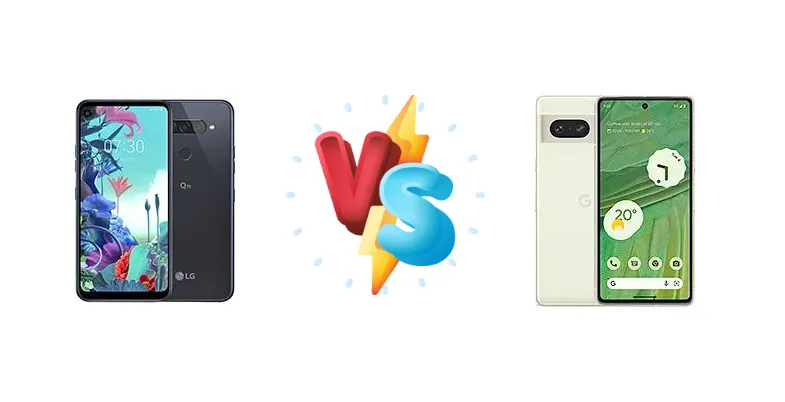
|
🏆 Quick Verdict
For the average user prioritizing performance, camera quality, and long-term software support, the Google Pixel 7 is the clear winner. While the LG Q70 offers a functional experience, the Pixel 7’s Tensor G2 chipset and superior display deliver a significantly more refined and capable smartphone experience.
| PHONES | ||
|---|---|---|
| Phone Names | LG Q70 | Google Pixel 7 |
| Network | ||
|---|---|---|
| 2G bands | GSM 850 / 900 / 1800 / 1900 | GSM 850 / 900 / 1800 / 1900 |
| 3G bands | HSDPA 850 / 900 / 1900 / 2100 | HSDPA 800 / 850 / 900 / 1700(AWS) / 1900 / 2100 |
| 4G bands | 2, 3, 4, 5, 7, 12, 13, 20, 66 - Verizon | 1, 2, 3, 4, 5, 7, 8, 12, 13, 14, 17, 18, 19, 20, 25, 26, 28, 29, 30, 38, 40, 41, 42, 46, 48, 66, 71 - GQML3 |
| 5G bands | - | 1, 2, 3, 4, 5, 7, 8, 12, 13, 14, 17, 18, 19, 20, 25, 26, 28, 29, 30, 38, 40, 41, 46, 48, 66, 71, 260, 261 SA/NSA/Sub6/mmWave - GQML3 |
| Speed | HSPA 42.2/5.76 Mbps, LTE (3CA) Cat11 600/75 Mbps | HSPA, LTE, 5G |
| Technology | GSM / CDMA / HSPA / EVDO / LTE | GSM / CDMA / HSPA / EVDO / LTE / 5G |
| CDMA2000 1xEV-DO | 1, 2, 3, 5, 7, 8, 12, 14, 20, 25, 28, 30, 38, 40, 41, 48, 66, 71, 75, 76, 77, 78 SA/NSA/Sub6 - GVU6C | |
| Launch | ||
|---|---|---|
| Announced | 2019, September 28. Released 2019, October | 2022, October 06 |
| Status | Discontinued | Available. Released 2022, October 13 |
| Body | ||
|---|---|---|
| Build | Glass front (Gorilla Glass), glass back, aluminum frame | Glass front (Gorilla Glass Victus), glass back (Gorilla Glass Victus), aluminum frame |
| Dimensions | 162.1 x 76.8 x 8.3 mm (6.38 x 3.02 x 0.33 in) | 155.6 x 73.2 x 8.7 mm (6.13 x 2.88 x 0.34 in) |
| SIM | · Nano-SIM· Nano-SIM + Nano-SIM | Nano-SIM + eSIM |
| Weight | 198 g (6.98 oz) | 197 g (6.95 oz) |
| IP68 dust/water resistant (up to 1.5m for 30 min) MIL-STD-810G compliant* *does not guarantee ruggedness or use in extreme conditions | IP68 dust/water resistant (up to 1.5m for 30 min) | |
| Display | ||
|---|---|---|
| Protection | Corning Gorilla Glass | Corning Gorilla Glass Victus |
| Resolution | 1080 x 2310 pixels (~398 ppi density) | 1080 x 2400 pixels, 20:9 ratio (~416 ppi density) |
| Size | 6.4 inches, 101.4 cm2 (~81.4% screen-to-body ratio) | 6.3 inches, 96.7 cm2 (~84.9% screen-to-body ratio) |
| Type | IPS LCD | AMOLED, 90Hz, HDR10+, 1000 nits (HBM), 1400 nits (peak) |
| - | Always-on display | |
| Platform | ||
|---|---|---|
| CPU | Octa-core (2x2.0 GHz Kryo 460 Gold & 6x1.7 GHz Kryo 460 Silver) | Octa-core (2x2.85 GHz Cortex-X1 & 2x2.35 GHz Cortex-A78 & 4x1.80 GHz Cortex-A55) |
| Chipset | Qualcomm SDM675 Snapdragon 675 (11 nm) | Google Tensor G2 (5 nm) |
| GPU | Adreno 612 | Mali-G710 MP7 |
| OS | Android 9.0 (Pie), upgradable to Android 10, LG UX 9 | Android 13, upgradable to Android 15, up to 5 major Android upgrades |
| Memory | ||
|---|---|---|
| Card slot | microSDXC (dedicated slot) | No |
| Internal | 64GB 4GB RAM | 128GB 8GB RAM, 256GB 8GB RAM |
| eMMC 5.1 | UFS 3.1 | |
| Main Camera | ||
|---|---|---|
| Dual | - | 50 MP, f/1.9, 25mm (wide), 1/1.31", 1.2µm, dual pixel PDAF, OIS 12 MP, f/2.2, 114˚ (ultrawide), 1/2.9", 1.25µm |
| Dual or Triple | 32 MP, f/1.8, 26mm (wide), 1/2.8", 0.8µm, PDAF 13 MP, f/2.2, 13mm (ultrawide) Auxiliary lens or 32 MP, f/1.8, 26mm (wide), 1/2.8", 0.8µm, PDAF Auxiliary lens | - |
| Features | LED flash, panorama, HDR | Laser AF, Dual-LED flash, Pixel Shift, Auto-HDR, panorama |
| Single | - | 10.8 MP, f/2.2, 21mm (ultrawide), 1/3.1", 1.22µm |
| Video | 4K@30fps, 1080p@30fps | 4K@30/60fps, 1080p@30/60/120/240fps; gyro-EIS, OIS, 10-bit HDR |
| Selfie camera | ||
|---|---|---|
| Features | HDR | HDR, panorama |
| Single | 16 MP, f/1.9, 26mm (wide), 1/2.8", 1.12µm | 10.8 MP, f/2.2, 21mm (ultrawide), 1/3.1", 1.22µm |
| Video | 1080p@30fps | 4K@30/60fps, 1080p@30/60fps |
| Sound | ||
|---|---|---|
| 3.5mm jack | Yes | No |
| 35mm jack | Yes | No |
| Loudspeaker | Yes | Yes, with stereo speakers |
| 32-bit/192kHz audio | - | |
| Comms | ||
|---|---|---|
| Bluetooth | 5.0, A2DP, LE | 5.2, A2DP, LE, aptX HD |
| NFC | Yes | Yes |
| Positioning | GPS, GLONASS | GPS (L1+L5), GLONASS (G1), BDS (B1I+B1c+B2a), GALILEO (E1+E5a), QZSS (L1+L5) |
| Radio | No | No |
| USB | USB Type-C 2.0 | USB Type-C 3.2 |
| WLAN | Wi-Fi 802.11 a/b/g/n/ac, dual-band, Wi-Fi Direct, DLNA | Wi-Fi 802.11 a/b/g/n/ac/6e, tri-band, Wi-Fi Direct |
| Features | ||
|---|---|---|
| Sensors | Fingerprint (rear-mounted), accelerometer, proximity, compass | Fingerprint (under display, optical), accelerometer, gyro, proximity, compass, barometer |
| Battery | ||
|---|---|---|
| Charging | 15W wired, QC3 | 20W wired, PD3.0, 50% in 30 min 20W wireless Reverse wireless |
| Type | Li-Po 4000 mAh, non-removable | Li-Ion 4355 mAh |
| Misc | ||
|---|---|---|
| Colors | Mirror Black | Obsidian, Lemongrass, Snow |
| Models | LM-Q730N, LMQ620WA, LM-Q620WA, LM-Q620VAB, LMQ620VAB, LM-Q730 | GVU6C, GQML3, GO3Z5 |
| Price | About 320 EUR | € 199.00 / $ 179.26 / £ 189.99 / ₹ 28,499 |
| Tests | ||
|---|---|---|
| Battery life | - | Endurance rating 96h |
| Camera | - | Photo / Video |
| Display | - | Contrast ratio: Infinite (nominal) |
| Loudspeaker | - | -26.2 LUFS (Good) |
| Performance | - | AnTuTu: 813114 (v9) GeekBench: 3288 (v5.1) GFXBench: 59fps (ES 3.1 onscreen) |
LG Q70
- More affordable price point
- Functional for basic smartphone tasks
- QC3 fast charging support
- Significantly slower processor
- Inferior camera performance
- Limited software support
Google Pixel 7
- Powerful Google Tensor G2 chipset
- Exceptional camera with AI features
- Fast wired and wireless charging
- Higher price compared to LG Q70
- May be overkill for basic users
- No expandable storage
Display Comparison
The Pixel 7 boasts a significantly brighter display, reaching a measured 974 nits, compared to the LG Q70’s unspecified brightness. This translates to superior visibility in direct sunlight. While the LG Q70’s display specs are limited in the provided data, the Pixel 7’s ‘Infinite’ contrast ratio suggests a high-quality OLED panel, offering deeper blacks and more vibrant colors. The Pixel 7’s display technology likely incorporates features like HDR support, absent in the Q70’s class.
Camera Comparison
Both devices feature photo and video capabilities, but the Pixel 7’s camera system is expected to be far more advanced. While specific sensor details are missing for both, Google’s computational photography prowess, powered by the Tensor G2’s image signal processor (ISP), delivers exceptional image quality, particularly in low-light conditions. The Pixel 7 benefits from features like Magic Eraser and Photo Unblur, unavailable on the LG Q70. The LG Q70 likely relies on more basic image processing techniques, resulting in less dynamic range and detail. The absence of OIS information for the Q70 suggests a less stable video recording experience.
Performance
The core difference lies in the chipsets. The LG Q70’s Qualcomm Snapdragon 675 (11nm) is a mid-range processor designed for efficiency, featuring an octa-core configuration with Kryo 460 cores. In contrast, the Google Pixel 7’s Tensor G2 (5nm) is a flagship-level chip built for AI and machine learning tasks. The Tensor G2’s Cortex-X1 prime core, clocked at 2.85 GHz, provides a substantial performance boost over the Q70’s 2.0 GHz Kryo 460 Gold cores. The 5nm manufacturing process of the Tensor G2 also offers superior power efficiency, reducing thermal throttling during sustained workloads. This means the Pixel 7 will handle demanding games and applications with greater ease and consistency.
Battery Life
Both phones share an endurance rating of 96 hours, but this doesn't tell the whole story. The Pixel 7’s 20W wired charging with PD3.0 and 50% charge in 30 minutes is significantly faster than the LG Q70’s 15W QC3 charging. Furthermore, the Pixel 7 adds 20W wireless charging and reverse wireless charging, features absent on the Q70. While the Q70 might offer comparable standby time, the Pixel 7’s faster charging and wireless capabilities provide greater convenience and flexibility.
Buying Guide
Buy the LG Q70 if you need a basic, functional smartphone for essential tasks and prioritize affordability above all else. Its 15W charging and Snapdragon 675 are sufficient for light use. Buy the Google Pixel 7 if you demand a premium experience with a powerful processor for demanding apps, exceptional camera capabilities, fast charging (including wireless), and guaranteed software updates for years to come. The Pixel 7 is for users who want a flagship experience without the flagship price tag.