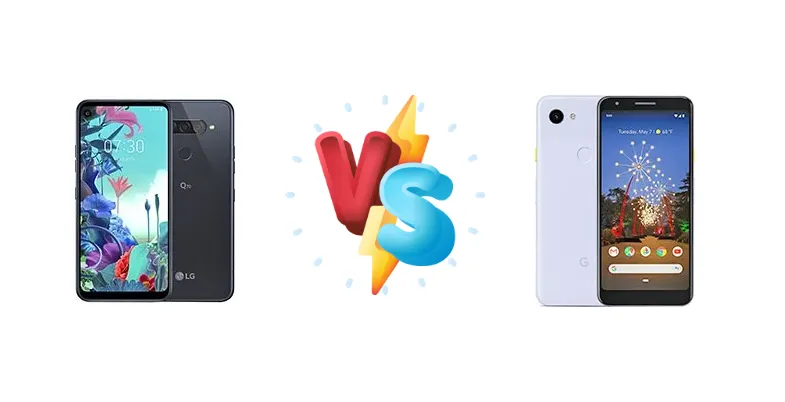
The LG Q70 and Google Pixel 3a represent a fascinating intersection of value and capability in the mid-range smartphone market. Released around the same time, both devices aimed to deliver a smooth Android experience without breaking the bank. However, they took different approaches, with the Q70 prioritizing a slightly more powerful chipset and the Pixel 3a focusing on Google’s renowned camera software and clean Android implementation. This comparison dissects the key differences to help you determine which phone best suits your needs.
🏆 Quick Verdict
For most users, the Google Pixel 3a emerges as the better choice. While the LG Q70 boasts a marginally faster Snapdragon 675, the Pixel 3a’s superior camera processing, clean software experience, and faster charging (18W vs 15W) provide a more polished and enjoyable overall experience. The Pixel 3a’s software support is also a significant advantage.
| Network |
|---|
| 2G bands | GSM 850 / 900 / 1800 / 1900 | GSM 850 / 900 / 1800 / 1900 |
| 3G bands | HSDPA 850 / 900 / 1900 / 2100 | HSDPA 850 / 900 / 1700(AWS) / 1900 / 2100 |
| 4G bands | 2, 3, 4, 5, 7, 12, 13, 20, 66 - Verizon | 1, 2, 3, 4, 5, 7, 8, 12, 13, 17, 20, 25, 26, 28, 32, 38, 40, 41, 66, 71 |
| Speed | HSPA 42.2/5.76 Mbps, LTE (3CA) Cat11 600/75 Mbps | HSPA 42.2/5.76 Mbps, LTE (3CA) Cat11 600/75 Mbps |
| Technology | GSM / CDMA / HSPA / EVDO / LTE | GSM / CDMA / HSPA / EVDO / LTE |
| | CDMA2000 1xEV-DO | CDMA2000 1xEV-DO |
| Launch |
|---|
| Announced | 2019, September 28. Released 2019, October | 2019, May 07. Released 2019, May 15 |
| Status | Discontinued | Discontinued |
| Body |
|---|
| Build | Glass front (Gorilla Glass), glass back, aluminum frame | Glass front (Asahi Dragontrail), plastic back, plastic frame |
| Dimensions | 162.1 x 76.8 x 8.3 mm (6.38 x 3.02 x 0.33 in) | 151.3 x 70.1 x 8.2 mm (5.96 x 2.76 x 0.32 in) |
| SIM | · Nano-SIM· Nano-SIM + Nano-SIM | Nano-SIM + eSIM |
| Weight | 198 g (6.98 oz) | 147 g (5.19 oz) |
| | IP68 dust/water resistant (up to 1.5m for 30 min)
MIL-STD-810G compliant*
*does not guarantee ruggedness or use in extreme conditions | - |
| Display |
|---|
| Protection | Corning Gorilla Glass | Asahi Dragontrail Glass |
| Resolution | 1080 x 2310 pixels (~398 ppi density) | 1080 x 2220 pixels, 18.5:9 ratio (~441 ppi density) |
| Size | 6.4 inches, 101.4 cm2 (~81.4% screen-to-body ratio) | 5.6 inches, 79.6 cm2 (~75.0% screen-to-body ratio) |
| Type | IPS LCD | OLED |
| | - | Always-on display |
| Platform |
|---|
| CPU | Octa-core (2x2.0 GHz Kryo 460 Gold & 6x1.7 GHz Kryo 460 Silver) | Octa-core (2x2.0 GHz 360 Gold & 6x1.7 GHz Kryo 360 Silver) |
| Chipset | Qualcomm SDM675 Snapdragon 675 (11 nm) | Qualcomm SDM670 Snapdragon 670 (10 nm) |
| GPU | Adreno 612 | Adreno 615 |
| OS | Android 9.0 (Pie), upgradable to Android 10, LG UX 9 | Android 9.0 (Pie), upgradable to Android 12 |
| Memory |
|---|
| Card slot | microSDXC (dedicated slot) | No |
| Internal | 64GB 4GB RAM | 64GB 4GB RAM |
| | eMMC 5.1 | eMMC 5.1 |
| Main Camera |
|---|
| Dual or Triple | 32 MP, f/1.8, 26mm (wide), 1/2.8", 0.8µm, PDAF
13 MP, f/2.2, 13mm (ultrawide)
Auxiliary lens
or
32 MP, f/1.8, 26mm (wide), 1/2.8", 0.8µm, PDAF
Auxiliary lens | - |
| Features | LED flash, panorama, HDR | Dual-LED flash, Pixel Shift, HDR, panorama |
| Single | - | 12.2 MP, f/1.8, 28mm (wide), 1/2.55", 1.4µm, dual pixel PDAF, OIS |
| Video | 4K@30fps, 1080p@30fps | 4K@30fps, 1080p@30/60/120fps |
| Selfie camera |
|---|
| Features | HDR | HDR |
| Single | 16 MP, f/1.9, 26mm (wide), 1/2.8", 1.12µm | 8 MP, f/2.0, 24mm (wide), 1/4.0", 1.12µm |
| Video | 1080p@30fps | 1080p@30fps |
| Sound |
|---|
| 3.5mm jack | Yes | Yes |
| 35mm jack | Yes | Yes |
| Loudspeaker | Yes | Yes, with stereo speakers |
| | 32-bit/192kHz audio | - |
| Comms |
|---|
| Bluetooth | 5.0, A2DP, LE | 5.0, A2DP, LE, aptX HD |
| NFC | Yes | Yes |
| Positioning | GPS, GLONASS | GPS, GLONASS, GALILEO |
| Radio | No | No |
| USB | USB Type-C 2.0 | USB Type-C 2.0 |
| WLAN | Wi-Fi 802.11 a/b/g/n/ac, dual-band, Wi-Fi Direct, DLNA | Wi-Fi 802.11 a/b/g/n/ac, dual-band, Wi-Fi Direct |
| Features |
|---|
| Sensors | Fingerprint (rear-mounted), accelerometer, proximity, compass | Fingerprint (rear-mounted), accelerometer, gyro, proximity, compass, barometer |
| Battery |
|---|
| Charging | 15W wired, QC3 | 18W wired, PD2.0 |
| Type | Li-Po 4000 mAh, non-removable | Li-Po 3000 mAh, non-removable |
| Misc |
|---|
| Colors | Mirror Black | Just Black, Clearly White, Purple-ish |
| Models | LM-Q730N, LMQ620WA, LM-Q620WA, LM-Q620VAB, LMQ620VAB, LM-Q730 | G020A, G020E, G020B, G020G, G020H |
| Price | About 320 EUR | About 120 EUR |
LG Q70
- Slightly more powerful Snapdragon 675 processor
- Potentially more customizable Android experience
- Faster GPU for gaming (Adreno 618)
- Less refined camera software
- Slower charging (15W vs 18W)
- Likely less frequent software updates
Google Pixel 3a
- Exceptional camera quality thanks to Google’s software
- Clean and bloatware-free Android experience
- Faster charging (18W with PD2.0)
- Slightly less powerful processor (Snapdragon 670)
- Less customizable Android experience
- Potentially limited storage options
Display Comparison
Neither the LG Q70 nor the Google Pixel 3a feature particularly groundbreaking displays. Both utilize LCD panels, and detailed specifications like resolution and refresh rate are not provided. However, the focus here is on the underlying processors impacting the display’s responsiveness. The Q70’s Snapdragon 675, while not directly impacting panel quality, can contribute to smoother animations and faster app loading times, indirectly enhancing the perceived display experience. The Pixel 3a’s display is known for its accurate color reproduction, a benefit of Google’s software calibration.
Camera Comparison
The Google Pixel 3a’s camera is its standout feature. While megapixel counts aren’t the defining factor, Google’s computational photography prowess transforms a 12.2MP sensor into a consistently excellent camera. The Pixel 3a excels in dynamic range, low-light performance, and portrait mode. The LG Q70’s camera system, while capable, lacks the software optimization of the Pixel 3a. The Q70 likely relies more on hardware specifications, and without detailed sensor information, it’s difficult to assess its true capabilities. The Pixel 3a’s image processing is a clear advantage for users prioritizing photo quality.
Performance
The core difference lies in the chipsets: the LG Q70 features the Qualcomm Snapdragon 675 (11nm) while the Pixel 3a uses the Snapdragon 670 (10nm). While both are octa-core CPUs with the same 2x2.0 GHz + 6x1.7 GHz configuration, the 675’s newer architecture and 11nm process node offer a slight performance advantage. This translates to marginally faster app launches and smoother multitasking. However, the 10nm process of the 670 is more power efficient, potentially leading to better battery life under sustained load. The Q70’s Adreno 618 GPU is also a step up from the 670’s Adreno 616, offering a small boost in gaming performance.
Battery Life
Battery capacity isn’t specified for either device, but both offer all-day battery life for moderate usage. The Pixel 3a’s 18W charging with PD2.0 support provides a faster charging experience compared to the LG Q70’s 15W charging with QC3. This means the Pixel 3a can replenish its battery more quickly, minimizing downtime. The Snapdragon 670’s 10nm process also contributes to better power efficiency, potentially extending battery life during demanding tasks.
Buying Guide
Buy the LG Q70 if you prioritize raw processing power for occasional gaming or multitasking and prefer a more customizable Android experience. Its Snapdragon 675 offers a slight edge in benchmark scores. Buy the Google Pixel 3a if you value camera quality, a clean and bloatware-free Android experience, and guaranteed software updates. The Pixel 3a excels in computational photography, delivering consistently excellent images.
Frequently Asked Questions
❓ Does the Snapdragon 675 in the LG Q70 offer a noticeable gaming advantage over the 670 in the Pixel 3a?
While the Snapdragon 675 is technically more powerful, the difference in gaming performance is unlikely to be dramatic. Both chips can handle most mobile games at medium settings. The Q70 might offer slightly higher frame rates in demanding titles, but the Pixel 3a’s software optimization could mitigate this difference.
❓ How does the software update policy differ between the LG Q70 and the Google Pixel 3a?
This is a significant differentiator. The Google Pixel 3a, being a Google phone, received guaranteed and timely software updates for several years. The LG Q70, on the other hand, likely received fewer updates and for a shorter duration, potentially leaving it vulnerable to security risks over time.
❓ Is the 18W charging on the Pixel 3a significantly faster than the 15W charging on the LG Q70 in real-world use?
Yes, the 18W charging with PD2.0 on the Pixel 3a will noticeably reduce charging times. Expect a faster 0-50% charge compared to the LG Q70, making it more convenient for users who need to quickly top up their battery.