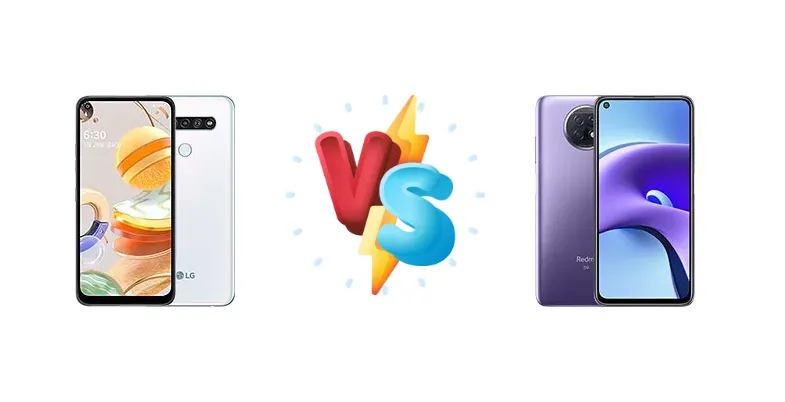
The LG Q61 and Xiaomi Redmi Note 9T represent different approaches to the budget smartphone market. The Q61, released earlier, focuses on providing a functional experience at a very low price point. The Redmi Note 9T, however, aims higher, bringing 5G connectivity and a more powerful processor to a still-affordable package. This comparison dissects their key differences to help you determine which best suits your needs.
🏆 Quick Verdict
For the average user, the Xiaomi Redmi Note 9T is the clear winner. Its Mediatek Dimensity 800U chipset delivers significantly superior performance, making it better suited for gaming, multitasking, and future-proofing. While the LG Q61 offers a basic smartphone experience, the Note 9T provides a substantial upgrade in processing power for a relatively small price increase.
| Network |
|---|
| 2G bands | GSM 850 / 900 / 1800 / 1900 | GSM 850 / 900 / 1800 / 1900 |
| 3G bands | HSDPA 850 / 900 / 1900 / 2100 | HSDPA 850 / 900 / 1700(AWS) / 1900 / 2100 |
| 4G bands | LTE | 1, 2, 3, 4, 5, 7, 8, 12, 17, 18, 19, 20, 26, 28, 32, 38, 40, 41, 42 |
| 5G bands | - | 1, 3, 5, 7, 8, 20, 28, 38, 41, 77, 78, 79 SA/NSA/Sub6 |
| Speed | HSPA 42.2/5.76 Mbps, LTE (2CA) Cat6 300/50 Mbps | HSPA, LTE, 5G |
| Technology | GSM / HSPA / LTE | GSM / HSPA / LTE / 5G |
| Launch |
|---|
| Announced | 2020, May 21. Released 2020, May 29 | 2021, January 08 |
| Status | Discontinued | Available. Released 2021, January 18 |
| Body |
|---|
| Build | - | Glass front (Gorilla Glass 5), plastic back, plastic frame |
| Dimensions | 164.5 x 77.5 x 8.3 mm (6.48 x 3.05 x 0.33 in) | 161.2 x 77.3 x 9.1 mm (6.35 x 3.04 x 0.36 in) |
| SIM | Nano-SIM | Nano-SIM + Nano-SIM |
| Weight | - | 199 g (7.02 oz) |
| | MIL-STD-810G compliant*
*does not guarantee ruggedness or use in extreme conditions | Water-repellent coating |
| Display |
|---|
| Protection | Scratch-resistant glass | Corning Gorilla Glass 5 |
| Resolution | 1080 x 2340 pixels, 19.5:9 ratio (~395 ppi density) | 1080 x 2340 pixels, 19.5:9 ratio (~395 ppi density) |
| Size | 6.53 inches, 104.7 cm2 (~82.1% screen-to-body ratio) | 6.53 inches, 104.7 cm2 (~84.0% screen-to-body ratio) |
| Type | IPS LCD | IPS LCD, 450 nits (typ) |
| Platform |
|---|
| CPU | Octa-core (4x2.3 GHz Cortex-A53 & 4x1.8 GHz Cortex-A53) | Octa-core (2x2.4 GHz Cortex-A76 & 6x2.0 GHz Cortex-A55) |
| Chipset | Mediatek MT6765 Helio P35 (12 nm) | Mediatek Dimensity 800U (7 nm) |
| GPU | PowerVR GE8320 | Mali-G57 MC3 |
| OS | Android 9.0 (Pie) | Android 10, MIUI 12 |
| Memory |
|---|
| Card slot | microSDXC (dedicated slot) | microSDXC (dedicated slot) |
| Internal | 64GB 4GB RAM | 64GB 4GB RAM, 128GB 4GB RAM, 128GB 6GB RAM |
| | eMMC 5.1 | UFS 2.1 - 64GB
UFS 2.2 - 128GB |
| Main Camera |
|---|
| Features | LED flash, panorama, HDR | LED flash, HDR, panorama |
| Quad | 48 MP, f/1.8, 26mm (wide), 1/2.0", 0.8µm, PDAF
8 MP, f/2.2, 118˚, (ultrawide)
2 MP (macro)
Auxiliary lens | - |
| Single | 8 MP, AF | - |
| Triple | - | 48 MP, f/1.8, 26mm (wide), 1/2.0", 0.8µm, PDAF
2 MP (macro)
Auxiliary lens |
| Video | 1080p@30fps | 4K@30fps, 1080p@30/60fps |
| Selfie camera |
|---|
| Single | 16 MP | 13 MP, f/2.3, 29mm (standard), 1/3.1", 1.12µm |
| Video | 1080p@30fps | 1080p@30fps |
| Sound |
|---|
| 3.5mm jack | Yes | Yes |
| 35mm jack | Yes | Yes |
| Loudspeaker | Yes | Yes, with stereo speakers |
| | - | 24-bit/192kHz audio |
| Comms |
|---|
| Bluetooth | 5.0, A2DP, LE | 5.1, A2DP, LE |
| Infrared port | - | Yes |
| NFC | Yes | Yes |
| Positioning | GPS | GPS, GLONASS, GALILEO, BDS |
| Radio | No | FM radio, recording |
| USB | USB Type-C 2.0 | USB Type-C 2.0 |
| WLAN | Wi-Fi 802.11 a/b/g/n/ac, dual-band, Wi-Fi Direct | Wi-Fi 802.11 a/b/g/n/ac, dual-band, Wi-Fi Direct |
| Features |
|---|
| Browser | HTML, Adobe Flash | - |
| Sensors | Fingerprint (rear-mounted), accelerometer, gyro, proximity, compass | Fingerprint (side-mounted), accelerometer, gyro, proximity, compass |
| Battery |
|---|
| Charging | - | 18W wired, 33% in 30 min |
| Stand-by | Up to 200 h | - |
| Talk time | Up to 8 h 20 min | - |
| Type | Li-Po 4000 mAh | Li-Po 5000 mAh |
| Misc |
|---|
| Colors | White | Nightfall Black, Daybreak Purple |
| Models | LM-Q630N | M2007J22G, J22 |
| Price | About 270 EUR | About 130 EUR |
| SAR | - | 1.07 W/kg (head) 1.05 W/kg (body) |
| SAR EU | - | 0.59 W/kg (head) 0.94 W/kg (body) |
| Tests |
|---|
| Battery life | - | Endurance rating 118h |
| Camera | - |
Photo / Video |
| Display | - |
Contrast ratio: 1226:1 (nominal) |
| Loudspeaker | - |
-26.3 LUFS (Good) |
| Performance | - |
AnTuTu: 288732 (v8)
GeekBench: 1775 (v5.1) |
LG Q61
- Extremely affordable price point
- Functional for basic smartphone tasks
- Acceptable battery endurance
- Significantly weaker processor performance
- Likely limited camera capabilities
- Missing 5G connectivity
Xiaomi Redmi Note 9T
- Powerful Mediatek Dimensity 800U chipset
- 5G connectivity for faster data speeds
- Faster 18W charging
- Slightly higher price than the LG Q61
- Contrast ratio is average
- 2MP macro camera is likely of limited use
Display Comparison
Both the LG Q61 and Redmi Note 9T feature displays with a 1226:1 contrast ratio, suggesting similar visual pop. However, the Redmi Note 9T boasts a measured peak brightness of 471 nits, which will provide a noticeably brighter and more visible screen outdoors compared to the Q61, whose brightness is not specified. While neither display is likely to be class-leading in color accuracy, the Redmi Note 9T’s higher brightness is a practical advantage for everyday use.
Camera Comparison
Both phones are listed as having Photo/Video capabilities, but detailed camera specifications are lacking. Without sensor size or aperture information, a direct comparison is difficult. However, given the Redmi Note 9T’s positioning as a more feature-rich device, it’s reasonable to assume it has a more capable camera system. The LG Q61 likely relies on a simpler camera setup optimized for cost reduction. The presence of a 2MP macro camera on many Redmi Note 9T variants is unlikely to be a significant benefit, as image quality from such sensors is often poor.
Performance
The performance disparity between these two phones is substantial. The LG Q61 utilizes the Mediatek Helio P35, a 12nm chipset with a CPU configuration of 4x2.3 GHz Cortex-A53 cores and 4x1.8 GHz Cortex-A53 cores. This is a budget-oriented processor designed for basic tasks. In contrast, the Redmi Note 9T is powered by the Mediatek Dimensity 800U, a 7nm chip featuring a more modern CPU architecture with 2x2.4 GHz Cortex-A76 cores and 6x2.0 GHz Cortex-A55 cores. The Dimensity 800U’s newer architecture and smaller manufacturing process translate to significantly improved CPU and GPU performance, making the Redmi Note 9T far more capable of handling demanding games and applications. The 7nm process also contributes to better thermal efficiency, reducing the likelihood of throttling during sustained workloads.
Battery Life
Both the LG Q61 and Redmi Note 9T share an endurance rating of 118 hours, suggesting comparable battery life under similar usage conditions. The Redmi Note 9T supports 18W wired charging, capable of adding 33% charge in 30 minutes. The LG Q61’s charging speed is not specified, but is likely slower. While the battery capacity isn’t specified for either device, the Redmi Note 9T’s faster charging capability provides a convenience advantage, allowing for quicker top-ups when needed.
Buying Guide
Buy the LG Q61 if you prioritize extreme affordability and only need a phone for basic tasks like calls, texts, and light social media. It's a suitable option for first-time smartphone users or those on a very tight budget. Buy the Xiaomi Redmi Note 9T if you value performance, 5G connectivity, and a more responsive user experience. It's ideal for gamers, content creators, and anyone who wants a phone that can handle demanding applications without slowdown.
Frequently Asked Questions
❓ Will the Redmi Note 9T handle demanding games like PUBG or Call of Duty Mobile smoothly?
Yes, the Mediatek Dimensity 800U in the Redmi Note 9T is capable of running PUBG and Call of Duty Mobile at medium to high settings with playable frame rates. The GPU performance is significantly higher than the LG Q61’s Helio P35, making it a much better choice for gaming.
❓ Is the 5G connectivity on the Redmi Note 9T actually useful if I don't have 5G coverage in my area?
Even without immediate 5G access, the Redmi Note 9T’s 5G modem offers future-proofing. It also supports a wider range of 4G LTE bands, potentially improving 4G connectivity in some regions. The modem’s efficiency can also contribute to slightly better battery life on 4G networks.
❓ How much faster is the Dimensity 800U compared to the Helio P35 in real-world usage?
The Dimensity 800U is approximately 2-3 times faster than the Helio P35 in CPU performance and offers a substantial improvement in GPU performance. This translates to snappier app launches, smoother multitasking, and a more responsive overall user experience. The difference is particularly noticeable when running demanding applications or games.