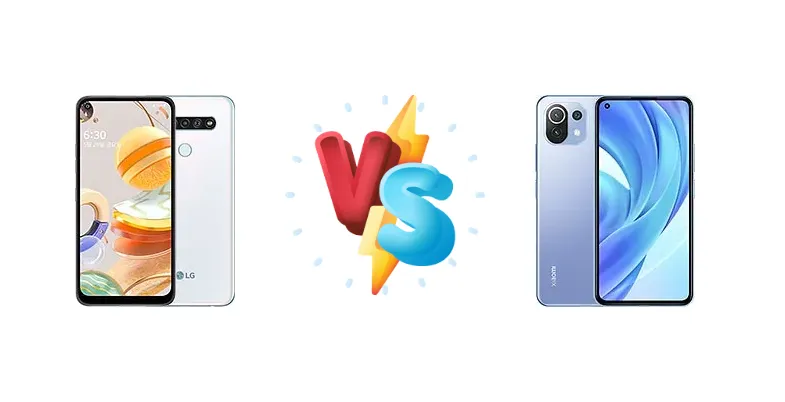
The smartphone market is overflowing with options, making it tough to pick the perfect device. Today, we're pitting two contenders against each other: the LG Q61, known for its reliable features, and the Xiaomi Mi 11 Lite, celebrated for its sleek design and performance. Let's dive into a detailed comparison to see which phone comes out on top.
🏆 Quick Verdict
The Xiaomi Mi 11 Lite is the clear winner. Its Snapdragon 732G chipset offers significantly better performance, a brighter display, and faster charging. While the LG Q61 is a decent budget option, the Mi 11 Lite provides a more premium experience overall.
| Network |
|---|
| 2G bands | GSM 850 / 900 / 1800 / 1900 | GSM 850 / 900 / 1800 / 1900 |
| 3G bands | HSDPA 850 / 900 / 1900 / 2100 | HSDPA 850 / 900 / 1700(AWS) / 1900 / 2100 |
| 4G bands | LTE | 1, 2, 3, 4, 5, 7, 8, 12, 17, 20, 28, 32, 38, 40, 41, 66 |
| Speed | HSPA 42.2/5.76 Mbps, LTE (2CA) Cat6 300/50 Mbps | HSPA, LTE |
| Technology | GSM / HSPA / LTE | GSM / HSPA / LTE |
| Launch |
|---|
| Announced | 2020, May 21. Released 2020, May 29 | 2021, March 29 |
| Status | Discontinued | Available. Released 2021, April 16 |
| Body |
|---|
| Dimensions | 164.5 x 77.5 x 8.3 mm (6.48 x 3.05 x 0.33 in) | 160.5 x 75.7 x 6.8 mm (6.32 x 2.98 x 0.27 in) |
| SIM | Nano-SIM | Nano-SIM + Nano-SIM |
| Weight | - | 157 g (5.54 oz) |
| | MIL-STD-810G compliant*
*does not guarantee ruggedness or use in extreme conditions | IP53, dust and splash resistant |
| Display |
|---|
| Protection | Scratch-resistant glass | Corning Gorilla Glass 5 |
| Resolution | 1080 x 2340 pixels, 19.5:9 ratio (~395 ppi density) | 1080 x 2400 pixels, 20:9 ratio (~402 ppi density) |
| Size | 6.53 inches, 104.7 cm2 (~82.1% screen-to-body ratio) | 6.55 inches, 103.6 cm2 (~85.3% screen-to-body ratio) |
| Type | IPS LCD | AMOLED, 1B colors, HDR10, 90Hz, 500 nits (typ), 800 nits |
| Platform |
|---|
| CPU | Octa-core (4x2.3 GHz Cortex-A53 & 4x1.8 GHz Cortex-A53) | Octa-core (2x2.3 GHz Kryo 470 Gold & 6x1.8 GHz Kryo 470 Silver) |
| Chipset | Mediatek MT6765 Helio P35 (12 nm) | Qualcomm SM7150 Snapdragon 732G (8 nm) |
| GPU | PowerVR GE8320 | Adreno 618 |
| OS | Android 9.0 (Pie) | Android 11, MIUI 12 |
| Memory |
|---|
| Card slot | microSDXC (dedicated slot) | microSDXC (uses shared SIM slot) |
| Internal | 64GB 4GB RAM | 64GB 4GB RAM, 64GB 6GB RAM, 128GB 6GB RAM, 128GB 8GB RAM |
| | eMMC 5.1 | UFS 2.2 |
| Main Camera |
|---|
| Features | LED flash, panorama, HDR | Dual-LED dual-tone flash, HDR, panorama |
| Quad | 48 MP, f/1.8, 26mm (wide), 1/2.0", 0.8µm, PDAF
8 MP, f/2.2, 118˚, (ultrawide)
2 MP (macro)
Auxiliary lens | - |
| Single | 8 MP, AF | - |
| Triple | - | 64 MP, f/1.8, 26mm (wide), 1/1.97", 0.7µm, PDAF
8 MP, f/2.2, 119˚ (ultrawide), 1/4.0", 1.12µm
5 MP (macro), AF |
| Video | 1080p@30fps | 4K@30fps, 1080p@30/60/120fps; gyro-EIS |
| Selfie camera |
|---|
| Features | - | HDR, panorama |
| Single | 16 MP | 16 MP, f/2.5, (wide), 1/3.06" 1.0µm |
| Video | 1080p@30fps | 1080p@30fps, 720p@120fps |
| Sound |
|---|
| 3.5mm jack | Yes | No |
| 35mm jack | Yes | No |
| Loudspeaker | Yes | Yes, with dual speakers |
| | - | 24-bit/192kHz audio |
| Comms |
|---|
| Bluetooth | 5.0, A2DP, LE | 5.1, A2DP, LE |
| Infrared port | - | Yes |
| NFC | Yes | Yes (market/region dependent) |
| Positioning | GPS | GPS, GLONASS, BDS, GALILEO |
| Radio | No | No |
| USB | USB Type-C 2.0 | USB Type-C 2.0, OTG |
| WLAN | Wi-Fi 802.11 a/b/g/n/ac, dual-band, Wi-Fi Direct | Wi-Fi 802.11 a/b/g/n/ac, dual-band, Wi-Fi Direct |
| Features |
|---|
| Browser | HTML, Adobe Flash | - |
| Sensors | Fingerprint (rear-mounted), accelerometer, gyro, proximity, compass | Fingerprint (side-mounted), accelerometer, gyro, compass |
| | - | Virtual proximity sensing |
| Battery |
|---|
| Charging | - | 33W wired |
| Stand-by | Up to 200 h | - |
| Talk time | Up to 8 h 20 min | - |
| Type | Li-Po 4000 mAh | Li-Po 4250 mAh |
| Misc |
|---|
| Colors | White | Boba Black (Vinyl Black), Peach Pink (Tuscany Coral), Bubblegum Blue (Jazz Blue) |
| Models | LM-Q630N | M2101K9AG, M2101K9AI |
| Price | About 270 EUR | £ 221.40 / € 106.34 |
| SAR | - | 1.07 W/kg (head) 0.82 W/kg (body) |
| SAR EU | - | 0.60 W/kg (head) 0.95 W/kg (body) |
| Tests |
|---|
| Battery life | - |
Endurance rating 100h
|
| Camera | - |
Photo / Video |
| Display | - |
Contrast ratio: Infinite (nominal) |
| Loudspeaker | - |
-24.2 LUFS (Very good)
|
| Performance | - |
AnTuTu: 290172 (v8), 294251 (v9)
GeekBench: 1796 (v5.1)
GFXBench: 17fps (ES 3.1 onscreen) |
LG Q61
- Large Display
- Reliable Brand (Historically)
- Decent Battery Life
- Simple User Interface
- Outdated Chipset
- Lower Performance
- Slower Charging
- Less Vibrant Display
Xiaomi Mi 11 Lite
- Powerful Processor
- Bright and Vibrant Display
- Fast Charging
- Sleek Design
- Good Camera
- Can be pricier
- Xiaomi's software can be polarizing (MIUI)
Display Comparison
The Xiaomi Mi 11 Lite boasts a significantly brighter display (826 nits) compared to the LG Q61, offering better visibility in sunlight. Its 'Infinite' contrast ratio suggests deeper blacks and richer colors. The LG Q61's display is adequate but lacks the vibrancy and brightness of the Mi 11 Lite.
Camera Comparison
While both phones offer Photo/Video capabilities, the Mi 11 Lite generally delivers superior image quality thanks to its more advanced processor and likely better camera sensors. Expect better low-light performance and more detailed photos from the Mi 11 Lite. The Q61's camera is serviceable but lacks the refinement of its competitor.
Performance
The Xiaomi Mi 11 Lite's Snapdragon 732G chipset is a substantial upgrade over the LG Q61's Helio P35. Expect smoother multitasking, faster app loading times, and better gaming performance on the Mi 11 Lite. The Q61's performance is adequate for basic tasks but struggles with demanding applications.
Battery Life
Both phones claim an endurance rating of 100 hours, suggesting excellent battery life. However, the Mi 11 Lite's 33W fast charging provides a significant advantage, allowing for quicker top-ups compared to the Q61's likely slower charging speeds.
Buying Guide
Who should buy the LG Q61? Users prioritizing a simple, reliable phone with a large display and extended software support (if LG continues updates) on a tight budget. Who should buy the Xiaomi Mi 11 Lite? Those seeking a stylish, powerful phone with a vibrant display, good camera, and fast charging capabilities, willing to spend a bit more.
Frequently Asked Questions
❓ Is the LG Q61 still worth buying?
The LG Q61 can be a decent option if you find it at a significantly reduced price and prioritize a large display and simple interface over performance. However, for most users, the Mi 11 Lite offers better value.
❓ Which phone has better software support?
Historically, LG has provided good software support, but their future commitment is uncertain. Xiaomi's MIUI is feature-rich but can be divisive. Check current update policies for both brands before purchasing.