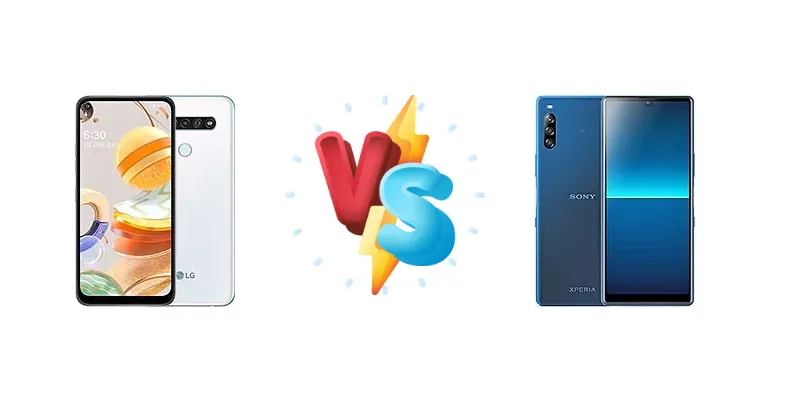
The LG Q61 and Sony Xperia L4 represent two approaches to the budget smartphone market. The Q61, with its slightly more powerful chipset, aims for a balance of features, while the Xperia L4 focuses on Sony’s established brand and inclusion of USB Power Delivery for charging. This comparison dissects their key differences to determine which offers the best value.
🏆 Quick Verdict
For the average user prioritizing responsiveness and occasional multitasking, the LG Q61 emerges as the better choice. Its Helio P35 chipset, with its higher clocked cores, provides a noticeable performance edge over the Xperia L4’s Helio P22, making everyday tasks smoother. However, the Xperia L4’s USB Power Delivery is a welcome addition for faster charging.
| Network |
|---|
| 2G bands | GSM 850 / 900 / 1800 / 1900 | GSM 850 / 900 / 1800 / 1900 |
| 3G bands | HSDPA 850 / 900 / 1900 / 2100 | HSDPA 850 / 900 / 1900 / 2100 |
| 4G bands | LTE | 1, 2, 3, 5, 7, 8, 20, 40 |
| Speed | HSPA 42.2/5.76 Mbps, LTE (2CA) Cat6 300/50 Mbps | HSPA 42.2/5.76 Mbps, LTE (2CA) Cat6 300/50 Mbps |
| Technology | GSM / HSPA / LTE | GSM / HSPA / LTE |
| Launch |
|---|
| Announced | 2020, May 21. Released 2020, May 29 | 2020, February 20. Released 2020, April 28 |
| Status | Discontinued | Discontinued |
| Body |
|---|
| Build | - | Glass front, plastic back, plastic frame |
| Dimensions | 164.5 x 77.5 x 8.3 mm (6.48 x 3.05 x 0.33 in) | 159 x 71 x 8.7 mm (6.26 x 2.80 x 0.34 in) |
| SIM | Nano-SIM | · Nano-SIM· Nano-SIM + Nano-SIM |
| Weight | - | 178 g (6.28 oz) |
| | MIL-STD-810G compliant*
*does not guarantee ruggedness or use in extreme conditions | - |
| Display |
|---|
| Protection | Scratch-resistant glass | - |
| Resolution | 1080 x 2340 pixels, 19.5:9 ratio (~395 ppi density) | 720 x 1680 pixels, 21:9 ratio (~295 ppi density) |
| Size | 6.53 inches, 104.7 cm2 (~82.1% screen-to-body ratio) | 6.2 inches, 89.8 cm2 (~79.5% screen-to-body ratio) |
| Type | IPS LCD | IPS LCD |
| Platform |
|---|
| CPU | Octa-core (4x2.3 GHz Cortex-A53 & 4x1.8 GHz Cortex-A53) | Octa-core 2.0 GHz Cortex-A53 |
| Chipset | Mediatek MT6765 Helio P35 (12 nm) | Mediatek MT6762 Helio P22 (12 nm) |
| GPU | PowerVR GE8320 | PowerVR GE8320 |
| OS | Android 9.0 (Pie) | Android 9.0 (Pie) |
| Memory |
|---|
| Card slot | microSDXC (dedicated slot) | microSDXC (uses shared SIM slot) |
| Internal | 64GB 4GB RAM | 64GB 3GB RAM |
| | eMMC 5.1 | eMMC 5.1 |
| Main Camera |
|---|
| Features | LED flash, panorama, HDR | LED flash, HDR, panorama |
| Quad | 48 MP, f/1.8, 26mm (wide), 1/2.0", 0.8µm, PDAF
8 MP, f/2.2, 118˚, (ultrawide)
2 MP (macro)
Auxiliary lens | - |
| Single | 8 MP, AF | - |
| Triple | - | 13 MP, f/2.0, 26mm (wide), 1/3.0", PDAF
5 MP, f/2.2, 17mm (ultrawide), 1/5.0", 1.12µm
Auxiliary lens |
| Video | 1080p@30fps | 1080p@30fps |
| Selfie camera |
|---|
| Single | 16 MP | 8 MP, f/2.0, 27mm (wide), 1/4.0", 1.12µm |
| Video | 1080p@30fps | 1080p@30fps |
| Sound |
|---|
| 3.5mm jack | Yes | Yes |
| 35mm jack | Yes | Yes |
| Loudspeaker | Yes | Yes |
| Comms |
|---|
| Bluetooth | 5.0, A2DP, LE | 5.0, A2DP, LE |
| NFC | Yes | Yes |
| Positioning | GPS | GPS, GLONASS |
| Radio | No | FM radio |
| USB | USB Type-C 2.0 | USB Type-C 2.0 |
| WLAN | Wi-Fi 802.11 a/b/g/n/ac, dual-band, Wi-Fi Direct | Wi-Fi 802.11 a/b/g/n, dual-band, Wi-Fi Direct |
| Features |
|---|
| Browser | HTML, Adobe Flash | - |
| Sensors | Fingerprint (rear-mounted), accelerometer, gyro, proximity, compass | Fingerprint (side-mounted), accelerometer, proximity, compass |
| Battery |
|---|
| Charging | - | USB Power Delivery |
| Stand-by | Up to 200 h | - |
| Talk time | Up to 8 h 20 min | - |
| Type | Li-Po 4000 mAh | Li-Ion 3580 mAh |
| Misc |
|---|
| Colors | White | Black, Blue |
| Models | LM-Q630N | XQ-AD52, XQ-AD51 |
| Price | About 270 EUR | About 200 EUR |
LG Q61
- More powerful Helio P35 chipset for smoother performance
- Higher clocked CPU cores for faster app loading
- Potentially better multitasking capabilities
- Likely lacks USB Power Delivery for faster charging
- May have a less refined software experience compared to Sony
Sony Xperia L4
- USB Power Delivery support for faster and versatile charging
- Sony’s brand reputation for audio and visual quality
- Potentially more optimized software experience
- Less powerful Helio P22 chipset
- Slower CPU performance compared to the LG Q61
- May struggle with demanding applications
Display Comparison
Neither device boasts a standout display. Both likely utilize IPS LCD panels, common in this price bracket. Without specific brightness data, it’s reasonable to assume both offer adequate outdoor visibility but won’t excel in direct sunlight. The focus here isn’t on display quality, but rather on the underlying performance that drives the UI displayed on them.
Camera Comparison
Without detailed camera specs beyond the chipsets, a direct comparison is limited. Both phones likely feature modest camera systems aimed at casual photography. The absence of information regarding sensor size or aperture makes it difficult to assess image quality. It’s safe to assume both will struggle in low-light conditions. The inclusion of a 2MP macro lens on either device is largely a marketing tactic, offering minimal practical benefit due to the small sensor size and lack of optical image stabilization.
Performance
The core difference lies in the chipsets. The LG Q61’s Mediatek Helio P35 features an octa-core configuration split into 4x2.3 GHz Cortex-A53 and 4x1.8 GHz Cortex-A53 cores. This contrasts with the Sony Xperia L4’s Helio P22, which utilizes a uniform octa-core 2.0 GHz Cortex-A53 setup. The higher clock speeds on the Q61’s prime cores translate to faster single-core performance, beneficial for app launch times and general responsiveness. While both are 12nm chips, the P35’s architecture provides a tangible advantage in CPU-bound tasks. The Xperia L4’s Helio P22, while efficient, is geared towards basic functionality and will show more strain under heavier loads.
Battery Life
Battery capacity is not provided for either device. However, the Sony Xperia L4’s inclusion of USB Power Delivery (USB-PD) is a significant advantage. USB-PD allows for faster charging speeds and compatibility with a wider range of chargers. While the LG Q61 likely charges via standard USB, the Xperia L4’s USB-PD support could translate to a quicker 0-100% charge time, even with a similarly sized battery. This is particularly useful for users who frequently need to top up their phone throughout the day.
Buying Guide
Buy the LG Q61 if you need a phone that feels more responsive for daily use, handles multitasking slightly better, and offers a more fluid experience with common apps. Buy the Sony Xperia L4 if you prioritize a brand with a strong audio/visual reputation and value the convenience of USB Power Delivery for faster and more versatile charging options, even if it means sacrificing some processing power.
Frequently Asked Questions
❓ Will the LG Q61 struggle with graphically intensive games like PUBG Mobile?
The Helio P35 in the LG Q61 can handle PUBG Mobile, but likely at lower graphics settings. Expect frame drops during intense firefights. It’s not a gaming phone, but it’s capable of casual gaming. The Xperia L4’s Helio P22 will likely require even lower settings and may exhibit more noticeable performance issues.
❓ How much faster is the charging on the Sony Xperia L4 with USB Power Delivery compared to standard USB charging?
The charging speed difference depends on the charger used with the Xperia L4. With a compatible USB-PD charger, it can potentially charge significantly faster – potentially reducing charging time by 30-50% compared to a standard 5W USB charger. The LG Q61 will be limited to standard USB charging speeds.
❓ Is the difference in CPU performance between the Helio P35 and Helio P22 noticeable in everyday tasks?
Yes, the difference is noticeable. The LG Q61 with the Helio P35 will feel snappier when opening apps, switching between them, and browsing the web. The Xperia L4’s Helio P22 will handle these tasks, but with a slight delay that can become apparent over time.