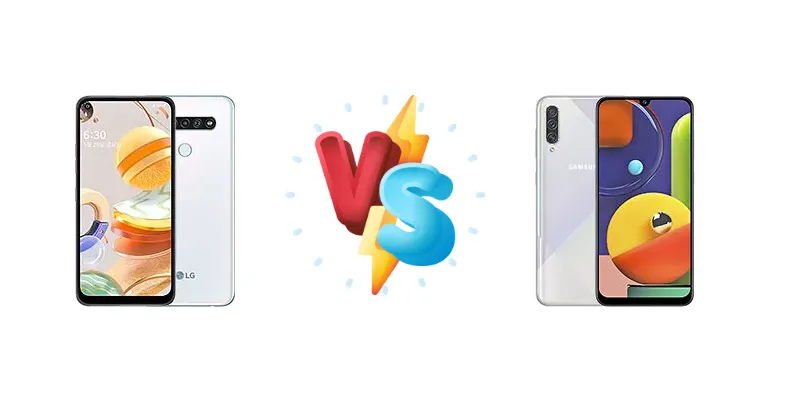
The Samsung Galaxy A50s and LG Q61 represent a similar segment of the smartphone market – affordable devices aiming to deliver a solid experience without breaking the bank. However, beneath the surface, significant differences in chipset architecture and manufacturing process dictate real-world performance and efficiency. This comparison dives deep into those differences to determine which phone offers the best value.
🏆 Quick Verdict
For the average user prioritizing responsiveness and sustained performance, the Samsung Galaxy A50s is the clear winner. Its Exynos 9611, built on a 10nm process, provides a noticeable advantage over the LG Q61’s MediaTek Helio P35, especially in multitasking and demanding applications. While the Q61 offers a competitive price, the A50s delivers a more refined user experience.
| Network |
|---|
| 2G bands | GSM 850 / 900 / 1800 / 1900 | GSM 850 / 900 / 1800 / 1900 |
| 3G bands | HSDPA 850 / 900 / 1900 / 2100 | HSDPA 850 / 900 / 1900 / 2100 |
| 4G bands | LTE | 1, 3, 5, 7, 8, 20, 28, 38, 40, 41 |
| Speed | HSPA 42.2/5.76 Mbps, LTE (2CA) Cat6 300/50 Mbps | HSPA, LTE |
| Technology | GSM / HSPA / LTE | GSM / HSPA / LTE |
| Launch |
|---|
| Announced | 2020, May 21. Released 2020, May 29 | 2019, August 22. Released 2019, September |
| Status | Discontinued | Discontinued |
| Body |
|---|
| Build | - | Glass front (Gorilla Glass 3), plastic back, plastic frame |
| Dimensions | 164.5 x 77.5 x 8.3 mm (6.48 x 3.05 x 0.33 in) | 158.5 x 74.5 x 7.7 mm (6.24 x 2.93 x 0.30 in) |
| SIM | Nano-SIM | · Nano-SIM· Nano-SIM + Nano-SIM |
| Weight | - | 169 g (5.96 oz) |
| | MIL-STD-810G compliant*
*does not guarantee ruggedness or use in extreme conditions | - |
| Display |
|---|
| Protection | Scratch-resistant glass | Corning Gorilla Glass 3 |
| Resolution | 1080 x 2340 pixels, 19.5:9 ratio (~395 ppi density) | 1080 x 2340 pixels, 19.5:9 ratio (~403 ppi density) |
| Size | 6.53 inches, 104.7 cm2 (~82.1% screen-to-body ratio) | 6.4 inches, 100.5 cm2 (~85.1% screen-to-body ratio) |
| Type | IPS LCD | Super AMOLED |
| Platform |
|---|
| CPU | Octa-core (4x2.3 GHz Cortex-A53 & 4x1.8 GHz Cortex-A53) | Octa-core (4x2.3 GHz Cortex-A73 & 4x1.7 GHz Cortex-A53) |
| Chipset | Mediatek MT6765 Helio P35 (12 nm) | Exynos 9611 (10 nm) |
| GPU | PowerVR GE8320 | Mali-G72 MP3 |
| OS | Android 9.0 (Pie) | Android 9.0 (Pie), upgradable to Android 11, One UI 3.1 |
| Memory |
|---|
| Card slot | microSDXC (dedicated slot) | microSDXC (dedicated slot) |
| Internal | 64GB 4GB RAM | 64GB 4GB RAM, 128GB 4GB RAM, 128GB 6GB RAM |
| | eMMC 5.1 | UFS 2.1 |
| Main Camera |
|---|
| Features | LED flash, panorama, HDR | LED flash, panorama, HDR |
| Quad | 48 MP, f/1.8, 26mm (wide), 1/2.0", 0.8µm, PDAF
8 MP, f/2.2, 118˚, (ultrawide)
2 MP (macro)
Auxiliary lens | - |
| Single | 8 MP, AF | - |
| Triple | - | 48 MP, f/2.0, 26mm (wide), 1/2.0", 0.8µm, PDAF
8 MP, f/2.2, 13mm (ultrawide), 1/4.0", 1.12µm
Auxiliary lens |
| Video | 1080p@30fps | 4K@30fps, 1080p@30fps |
| Selfie camera |
|---|
| Features | - | HDR |
| Single | 16 MP | 32 MP, f/2.0, 25mm (wide), 1/2.8", 0.8µm |
| Video | 1080p@30fps | 4K@30fps, 1080p@30fps |
| Sound |
|---|
| 3.5mm jack | Yes | Yes |
| 35mm jack | Yes | Yes |
| Loudspeaker | Yes | Yes |
| Comms |
|---|
| Bluetooth | 5.0, A2DP, LE | 5.0, A2DP, LE |
| NFC | Yes | Yes (market/region dependent) |
| Positioning | GPS | GPS, GLONASS, GALILEO, BDS |
| Radio | No | FM radio |
| USB | USB Type-C 2.0 | USB Type-C 2.0, OTG |
| WLAN | Wi-Fi 802.11 a/b/g/n/ac, dual-band, Wi-Fi Direct | Wi-Fi 802.11 a/b/g/n/ac, dual-band, Wi-Fi Direct |
| Features |
|---|
| Browser | HTML, Adobe Flash | - |
| Sensors | Fingerprint (rear-mounted), accelerometer, gyro, proximity, compass | Fingerprint (under display, optical), accelerometer, gyro, proximity, compass |
| | - | ANT+ |
| Battery |
|---|
| Charging | - | 15W wired |
| Stand-by | Up to 200 h | - |
| Talk time | Up to 8 h 20 min | - |
| Type | Li-Po 4000 mAh | Li-Po 4000 mAh, non-removable |
| Misc |
|---|
| Colors | White | Prism Crush Black, Prism Crush White, Prism Crush Green, Prism Crush Violet2 |
| Models | LM-Q630N | SM-A507F, SM-A507FN, SM-A5070 |
| Price | About 270 EUR | About 290 EUR |
| SAR EU | - | 0.43 W/kg (head) 1.55 W/kg (body) |
| Tests |
|---|
| Performance | - |
AnTuTu: 154761 (v7)
GeekBench: 5295 (v4.4)
GFXBench: 9.2fps (ES 3.1 onscreen) |
LG Q61
- More powerful Exynos 9611 chipset
- Faster 15W charging
- Potentially better camera image processing
- May be slightly more expensive
- Samsung’s software can be bloated
Samsung Galaxy A50s
- Lower price point
- Potentially longer battery life due to less powerful chipset
- Clean LG UI (depending on software version)
- Significantly slower performance
- Slower charging speeds (likely)
- Less efficient chipset
Display Comparison
Neither device boasts a particularly standout display. While specific panel details (like peak brightness in nits) are unavailable, the focus here is on the underlying performance. Both likely utilize IPS LCD panels, common in this price bracket. The real difference lies elsewhere. Bezels are likely comparable, given the similar target market. Color accuracy will depend on software calibration, but neither is expected to achieve professional-grade results.
Camera Comparison
Without detailed sensor specifications, a direct camera comparison is challenging. However, the A50s likely benefits from Samsung’s superior image processing algorithms. While both phones likely include a standard, multi-camera setup, the A50s’ chipset provides more processing power for features like scene optimization and low-light photography. The presence of a 2MP macro camera on both devices is largely a marketing tactic, offering limited practical benefit due to the small sensor size and lack of optical image stabilization (OIS).
Performance
The core difference between these phones is the chipset. The Samsung Galaxy A50s utilizes the Exynos 9611, fabricated on a 10nm process. This allows for higher transistor density and improved power efficiency compared to the LG Q61’s MediaTek Helio P35, which is built on a larger 12nm process. Crucially, the A50s employs Cortex-A73 cores in its CPU, offering significantly better single-core performance than the Cortex-A53 cores found in the Q61. While both have an octa-core configuration, the architectural advantage of the A50s translates to faster app loading times and smoother multitasking. The A50s will handle graphically intensive games with fewer stutters.
Battery Life
Battery capacity is not specified, but both phones likely feature batteries in the 4000-5000 mAh range, typical for this class. However, the Samsung Galaxy A50s gains a significant advantage with its 15W wired charging support. The LG Q61’s charging speed is unknown, but likely slower. This means the A50s can replenish its battery much faster, reducing downtime. The more efficient Exynos 9611 also contributes to better overall battery life, even with similar capacity.
Buying Guide
Buy the LG Q61 if you need a highly affordable device for basic tasks like calling, texting, and light social media use, and battery life is your absolute top priority. Buy the Samsung Galaxy A50s if you prefer a smoother, more responsive experience for everyday tasks, enjoy occasional gaming, and appreciate faster charging capabilities. The A50s is the better choice for users who want a phone that feels more future-proof.
Frequently Asked Questions
❓ Does the Exynos 9611 in the Galaxy A50s tend to overheat during prolonged gaming sessions?
While the Exynos 9611 isn't a flagship-level chip, its 10nm process and thermal design generally prevent significant overheating during typical gaming. Some throttling may occur during extended, demanding sessions, but it's unlikely to cause performance-crippling heat issues. The Helio P35 in the Q61 is less likely to overheat, but also offers significantly lower performance to begin with.
❓ Is the 2MP macro camera on either phone worth using for detailed close-up shots?
Generally, no. The 2MP macro cameras on both the LG Q61 and Samsung Galaxy A50s suffer from limited detail and dynamic range due to their small sensor size. They are primarily included for marketing purposes and rarely produce compelling results. You're better off using the main camera and cropping in.
❓ Can the Samsung Galaxy A50s reliably run PUBG Mobile at 60fps?
The Samsung Galaxy A50s can run PUBG Mobile, but achieving a consistent 60fps experience depends on the graphics settings. Lowering the settings to 'Balanced' or 'Smooth' is recommended for stable frame rates. The LG Q61 will struggle to maintain even 30fps with acceptable graphics quality.