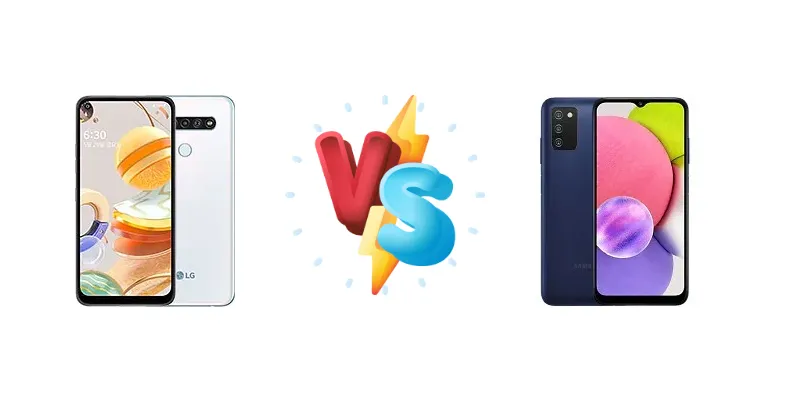
The LG Q61 and Samsung Galaxy A03s represent the lower end of the smartphone market, targeting users prioritizing affordability. Both devices share the same Mediatek Helio P35 chipset, making a direct comparison of their implementations – and other key differences – crucial for informed purchasing decisions. This analysis will dissect their displays, performance, battery life, and overall value proposition.
🏆 Quick Verdict
For the average user, the Samsung Galaxy A03s edges out the LG Q61. While both share the same processor, the A03s boasts a measured 488 nits of brightness and a 122-hour endurance rating, offering a slightly better user experience in terms of visibility and longevity. The LG Q61 isn't a bad phone, but the A03s provides a marginal, yet noticeable, advantage.
| Network |
|---|
| 2G bands | GSM 850 / 900 / 1800 / 1900 | GSM 850 / 900 / 1800 / 1900 |
| 3G bands | HSDPA 850 / 900 / 1900 / 2100 | HSDPA 850 / 900 / 2100 |
| 4G bands | LTE | 1, 3, 5, 7, 8, 20, 28, 38, 40, 41 |
| Speed | HSPA 42.2/5.76 Mbps, LTE (2CA) Cat6 300/50 Mbps | HSPA 42.2/5.76 Mbps, LTE Cat4 150/50 Mbps |
| Technology | GSM / HSPA / LTE | GSM / HSPA / LTE |
| | - | 2, 4, 5, 7, 12, 13, 14, 25, 26, 41, 66, 71 - SM-A037U |
| Launch |
|---|
| Announced | 2020, May 21. Released 2020, May 29 | 2021, August 18 |
| Status | Discontinued | Available. Released 2021, August 18 |
| Body |
|---|
| Build | - | Glass front, plastic frame, plastic back |
| Dimensions | 164.5 x 77.5 x 8.3 mm (6.48 x 3.05 x 0.33 in) | 164.2 x 75.9 x 9.1 mm (6.46 x 2.99 x 0.36 in) |
| SIM | Nano-SIM | Nano-SIM + Nano-SIM |
| Weight | - | 196 g (6.91 oz) |
| | MIL-STD-810G compliant*
*does not guarantee ruggedness or use in extreme conditions | - |
| Display |
|---|
| Protection | Scratch-resistant glass | - |
| Resolution | 1080 x 2340 pixels, 19.5:9 ratio (~395 ppi density) | 720 x 1600 pixels, 20:9 ratio (~270 ppi density) |
| Size | 6.53 inches, 104.7 cm2 (~82.1% screen-to-body ratio) | 6.5 inches, 102.0 cm2 (~81.8% screen-to-body ratio) |
| Type | IPS LCD | PLS LCD |
| Platform |
|---|
| CPU | Octa-core (4x2.3 GHz Cortex-A53 & 4x1.8 GHz Cortex-A53) | Octa-core (4x2.35 GHz Cortex-A53 & 4x1.8 GHz Cortex-A53) |
| Chipset | Mediatek MT6765 Helio P35 (12 nm) | Mediatek MT6765 Helio P35 (12 nm) |
| GPU | PowerVR GE8320 | PowerVR GE8320 |
| OS | Android 9.0 (Pie) | Android 11, upgradable to Android 13, One UI 5.1 Core |
| Memory |
|---|
| Card slot | microSDXC (dedicated slot) | microSDXC (dedicated slot) |
| Internal | 64GB 4GB RAM | 32GB 2GB RAM, 32GB 3GB RAM, 32GB 4GB RAM, 64GB 3GB RAM, 64GB 4GB RAM |
| | eMMC 5.1 | eMMC 5.1 |
| Main Camera |
|---|
| Features | LED flash, panorama, HDR | LED flash |
| Quad | 48 MP, f/1.8, 26mm (wide), 1/2.0", 0.8µm, PDAF
8 MP, f/2.2, 118˚, (ultrawide)
2 MP (macro)
Auxiliary lens | - |
| Single | 8 MP, AF | 5 MP, f/2.2 |
| Triple | - | 13 MP, f/2.2, (wide), AF
2 MP (macro)
Auxiliary lens |
| Video | 1080p@30fps | 1080p@30fps |
| Selfie camera |
|---|
| Single | 16 MP | 5 MP, f/2.2 |
| Video | 1080p@30fps | 1080p@30fps |
| Sound |
|---|
| 3.5mm jack | Yes | Yes |
| 35mm jack | Yes | Yes |
| Loudspeaker | Yes | Yes |
| Comms |
|---|
| Bluetooth | 5.0, A2DP, LE | 5.0, A2DP |
| NFC | Yes | Yes (market/region dependent) |
| Positioning | GPS | GPS, GLONASS, GALILEO, BDS |
| Radio | No | No |
| USB | USB Type-C 2.0 | USB Type-C 2.0 |
| WLAN | Wi-Fi 802.11 a/b/g/n/ac, dual-band, Wi-Fi Direct | Wi-Fi 802.11 b/g/n, Wi-Fi Direct |
| Features |
|---|
| Browser | HTML, Adobe Flash | - |
| Sensors | Fingerprint (rear-mounted), accelerometer, gyro, proximity, compass | Fingerprint (side-mounted), accelerometer, proximity |
| Battery |
|---|
| Charging | - | 15W wired |
| Stand-by | Up to 200 h | - |
| Talk time | Up to 8 h 20 min | - |
| Type | Li-Po 4000 mAh | Li-Po 5000 mAh |
| Misc |
|---|
| Colors | White | Black, Blue, White |
| Models | LM-Q630N | SM-A037F, SM-A037F/DS, SM-A037M, SM-A037G, SM-A037U, SM-S134DL, SM-A037W, SM-A037U1, SM-S135DL |
| Price | About 270 EUR | $ 65.65 / £ 82.99 / ₹ 10,800 |
| SAR EU | - | 0.36 W/kg (head) 1.09 W/kg (body) |
| Tests |
|---|
| Battery life | - |
Endurance rating 122h
|
| Camera | - |
Photo / Video |
| Display | - |
Contrast ratio: 1718:1 (nominal) |
| Loudspeaker | - |
-27.4 LUFS (Good)
|
| Performance | - |
AnTuTu: 103465 (v8), 101299 (v9)
GeekBench: 889 (v5.1)
GFXBench: 5.5fps (ES 3.1 onscreen) |
LG Q61
- Potentially lower price point
- Similar processor to A03s
- May offer a more compact form factor (unconfirmed)
- Lower display brightness (likely)
- Unspecified battery life
- Charging speed unknown
Samsung Galaxy A03s
- Brighter display (488 nits)
- Excellent battery life (122h endurance)
- 15W fast charging
- Slightly higher price (likely)
- Basic camera system
- 2MP macro camera is largely ineffective
Display Comparison
Both the LG Q61 and Samsung Galaxy A03s feature displays with a 1718:1 contrast ratio, suggesting similar panel characteristics. However, the Samsung Galaxy A03s distinguishes itself with a measured peak brightness of 488 nits, significantly improving visibility in bright sunlight compared to the LG Q61, whose brightness remains unspecified. This difference is crucial for outdoor usability. While both likely utilize LCD technology given their price points, the A03s’ higher brightness provides a more vibrant and readable experience.
Camera Comparison
Both the LG Q61 and Samsung Galaxy A03s are listed as having 'Photo / Video' capabilities, but lack specific details regarding sensor size, aperture, or image processing. Given their budget nature, it’s safe to assume both feature basic camera systems. The inclusion of a 2MP macro camera on the A03s is likely a marketing feature with limited practical benefit due to the small sensor size and lack of optical image stabilization (OIS). Without further information, it’s difficult to definitively assess camera quality, but expectations should be tempered.
Performance
Both devices are powered by the Mediatek MT6765 Helio P35 (12 nm) chipset, featuring an octa-core CPU configuration with 4x2.3 GHz Cortex-A53 and 4x1.8 GHz Cortex-A53 cores. The Samsung Galaxy A03s CPU clocks slightly higher at 2.35 GHz, but this difference is unlikely to translate into a noticeable performance gain in real-world usage. Both phones will handle basic tasks like web browsing, social media, and light app usage adequately, but will struggle with demanding games or multitasking. RAM configurations are not specified, but are likely similar, further minimizing performance disparities.
Battery Life
The Samsung Galaxy A03s boasts an endurance rating of 122 hours, indicating excellent battery life for its class. While the LG Q61’s battery capacity is not specified, the A03s’ endurance rating suggests superior power efficiency or a larger battery. The A03s also supports 15W wired charging, allowing for faster replenishment compared to the LG Q61, whose charging speed is unknown. This combination of long endurance and faster charging makes the A03s a more convenient option for users who rely heavily on their smartphones throughout the day.
Buying Guide
Buy the LG Q61 if you prioritize a potentially lower price point and are comfortable with a slightly dimmer display. Buy the Samsung Galaxy A03s if you value a brighter screen for outdoor use and longer battery life between charges, even if it means paying a small premium. Both are suitable for basic tasks, but the A03s offers a more polished experience.
Frequently Asked Questions
❓ Does the Mediatek Helio P35 in either phone struggle with popular games like PUBG Mobile?
Yes, the Helio P35 is an entry-level chipset. While it can run PUBG Mobile, expect low graphics settings and potential frame rate drops, especially during intense action. Neither phone is ideal for serious mobile gaming.
❓ Is the 122-hour endurance rating of the Samsung Galaxy A03s realistic for typical usage?
The 122-hour endurance rating is based on GSM Arena's testing methodology, which includes a mix of calls, web browsing, and video playback. Your actual battery life will vary depending on your usage patterns, but it indicates the A03s will comfortably last a full day with moderate use.
❓ Are software updates guaranteed for either the LG Q61 or Samsung Galaxy A03s?
Software update support for both devices is limited. LG has largely exited the smartphone market, meaning the Q61 is unlikely to receive further updates. Samsung typically provides a few years of security patches for its A-series phones, but major Android version updates are not guaranteed.
❓ How does the contrast ratio of 1718:1 affect the viewing experience on both phones?
A contrast ratio of 1718:1 is decent for LCD panels in this price range. It means there's a reasonable difference between the darkest blacks and brightest whites, resulting in a generally acceptable viewing experience, though not as vibrant as OLED displays.