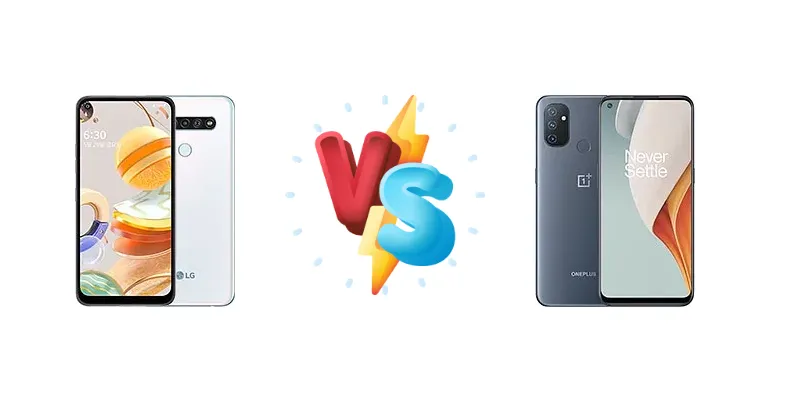
The sub-$150 smartphone market is fiercely competitive. The LG Q61, with its Mediatek Helio P35, and the OnePlus Nord N100, powered by the Qualcomm Snapdragon 460, represent two distinct approaches to delivering affordable mobile experiences. This comparison dissects their key differences to determine which device offers the best value for your money.
🏆 Quick Verdict
For the average user prioritizing a slightly smoother experience and faster charging, the OnePlus Nord N100 is the better choice. Its Snapdragon 460, built on an 11nm process, offers a modest performance advantage over the LG Q61’s Helio P35, and the 18W charging is a significant convenience. However, the Q61 remains a viable option for basic tasks.
| Network |
|---|
| 2G bands | GSM 850 / 900 / 1800 / 1900 | GSM 850 / 900 / 1800 / 1900 |
| 3G bands | HSDPA 850 / 900 / 1900 / 2100 | HSDPA 850 / 900 / 1700(AWS) / 1900 / 2100 |
| 4G bands | LTE | 1, 2, 3, 4, 5, 7, 8, 12, 17, 20, 28, 38, 40, 41 - International |
| Speed | HSPA 42.2/5.76 Mbps, LTE (2CA) Cat6 300/50 Mbps | HSPA 42.2/5.76 Mbps, LTE Cat13 400/50 Mbps |
| Technology | GSM / HSPA / LTE | GSM / CDMA / HSPA / LTE |
| | - | 1, 2, 3, 4, 5, 7, 8, 12, 13, 17, 20, 25, 26, 28, 38, 41, 66, 71 - USA |
| Launch |
|---|
| Announced | 2020, May 21. Released 2020, May 29 | 2020, October 26 |
| Status | Discontinued | Available. Released 2020, November 11 |
| Body |
|---|
| Build | - | Glass front (Gorilla Glass 3), plastic frame |
| Dimensions | 164.5 x 77.5 x 8.3 mm (6.48 x 3.05 x 0.33 in) | 164.9 x 75.1 x 8.5 mm (6.49 x 2.96 x 0.33 in) |
| SIM | Nano-SIM | Nano-SIM + Nano-SIM |
| Weight | - | 188 g (6.63 oz) |
| | MIL-STD-810G compliant*
*does not guarantee ruggedness or use in extreme conditions | - |
| Display |
|---|
| Protection | Scratch-resistant glass | Corning Gorilla Glass 3 |
| Resolution | 1080 x 2340 pixels, 19.5:9 ratio (~395 ppi density) | 720 x 1600 pixels, 20:9 ratio (~269 ppi density) |
| Size | 6.53 inches, 104.7 cm2 (~82.1% screen-to-body ratio) | 6.52 inches, 102.6 cm2 (~82.9% screen-to-body ratio) |
| Type | IPS LCD | IPS LCD, 90Hz |
| Platform |
|---|
| CPU | Octa-core (4x2.3 GHz Cortex-A53 & 4x1.8 GHz Cortex-A53) | Octa-core (4x1.8 GHz Kryo 240 & 4x1.6 GHz Kryo 240) |
| Chipset | Mediatek MT6765 Helio P35 (12 nm) | Qualcomm SM4250 Snapdragon 460 (11 nm) |
| GPU | PowerVR GE8320 | Adreno 610 |
| OS | Android 9.0 (Pie) | Android 10, OxygenOS 10.5.9 |
| Memory |
|---|
| Card slot | microSDXC (dedicated slot) | microSDXC |
| Internal | 64GB 4GB RAM | 64GB 4GB RAM |
| | eMMC 5.1 | UFS 2.1 |
| Main Camera |
|---|
| Features | LED flash, panorama, HDR | LED flash, HDR, panorama |
| Quad | 48 MP, f/1.8, 26mm (wide), 1/2.0", 0.8µm, PDAF
8 MP, f/2.2, 118˚, (ultrawide)
2 MP (macro)
Auxiliary lens | - |
| Single | 8 MP, AF | - |
| Triple | - | 13 MP, f/2.2, (wide), PDAF
2 MP (macro)
Auxiliary lens |
| Video | 1080p@30fps | 1080p@30fps, gyro-EIS |
| Selfie camera |
|---|
| Features | - | HDR |
| Single | 16 MP | 8 MP, f/2.0 |
| Video | 1080p@30fps | 1080p@30fps |
| Sound |
|---|
| 3.5mm jack | Yes | Yes |
| 35mm jack | Yes | Yes |
| Loudspeaker | Yes | Yes, with stereo speakers |
| Comms |
|---|
| Bluetooth | 5.0, A2DP, LE | 5.0, A2DP, LE |
| NFC | Yes | - |
| Positioning | GPS | GPS, GLONASS, GALILEO, BDS |
| Radio | No | FM radio |
| USB | USB Type-C 2.0 | USB Type-C 2.0, OTG |
| WLAN | Wi-Fi 802.11 a/b/g/n/ac, dual-band, Wi-Fi Direct | Wi-Fi 802.11 a/b/g/n/ac, dual-band, Wi-Fi Direct |
| Features |
|---|
| Browser | HTML, Adobe Flash | - |
| Sensors | Fingerprint (rear-mounted), accelerometer, gyro, proximity, compass | Fingerprint (rear-mounted), accelerometer, gyro, proximity, compass |
| Battery |
|---|
| Charging | - | 18W wired |
| Stand-by | Up to 200 h | - |
| Talk time | Up to 8 h 20 min | - |
| Type | Li-Po 4000 mAh | Li-Po 5000 mAh |
| Misc |
|---|
| Colors | White | Midnight Frost |
| Models | LM-Q630N | BE2013, BE2015, BE2011, BE2012 |
| Price | About 270 EUR | About 80 EUR |
| Pricing |
|---|
| 64GB 4GB RAM | - | $ 125.00 |
| RENEWED | - | $ 129.00 |
LG Q61
- Potentially longer software support (LG history)
- May be available at a slightly lower price point
- Reliable for basic communication tasks
- Older, less efficient Helio P35 chipset
- Likely slower charging speeds
- Potentially lower performance in demanding apps
OnePlus Nord N100
- More modern Snapdragon 460 chipset
- Faster 18W wired charging
- Smoother user experience and multitasking
- Potentially shorter software support (OnePlus budget line)
- May be slightly more expensive
- Camera performance is still limited by budget sensors
Display Comparison
Neither device boasts a standout display. Both likely utilize IPS LCD panels, common in this price bracket. The LG Q61’s display specifications are unavailable, but given its market positioning, it’s unlikely to surpass the Nord N100 in brightness or color accuracy. The Nord N100’s display is adequate for everyday use, but neither phone will impress users accustomed to OLED or high refresh rate panels. Bezels are expected to be noticeable on both.
Camera Comparison
Camera performance is likely to be similar, with both phones featuring budget-oriented sensors. Without specific sensor details for the LG Q61, it’s difficult to make a definitive statement. However, the Nord N100’s camera system is likely to offer slightly better image processing thanks to Qualcomm’s ISP. Expect acceptable results in good lighting conditions, but both phones will struggle in low light. The prevalence of 2MP macro/depth sensors on both devices suggests these are largely marketing features with limited practical benefit.
Performance
The core difference lies in the chipsets. The OnePlus Nord N100’s Qualcomm Snapdragon 460 (11nm) has a clear architectural advantage over the LG Q61’s Mediatek Helio P35 (12nm). The 11nm process generally translates to better power efficiency and thermal management. While both CPUs feature octa-core configurations, the Snapdragon 460’s Kryo 240 cores are more modern and efficient than the Cortex-A53 cores in the Helio P35. This will result in snappier app launches and smoother multitasking on the Nord N100. The Q61 will handle basic tasks, but will struggle with demanding applications.
Battery Life
Battery capacity is not specified for the LG Q61, but given its size and market segment, it’s likely comparable to the Nord N100’s. However, the Nord N100’s 18W wired charging is a significant advantage. While not exceptionally fast, it will substantially reduce charging times compared to the Q61, which likely supports only standard 10W charging. This difference in charging speed translates to a more convenient user experience, especially for those who frequently need to top up their battery.
Buying Guide
Buy the LG Q61 if you need a phone primarily for essential communication – calls, texts, and light social media – and prioritize a potentially longer software support lifespan from LG (though this is becoming less of a guarantee). Buy the OnePlus Nord N100 if you prefer a more responsive user experience, enjoy occasional mobile gaming, and value the convenience of faster 18W charging, even if it means potentially shorter software support.
Frequently Asked Questions
❓ Will the Snapdragon 460 in the Nord N100 handle popular games like PUBG Mobile?
The Snapdragon 460 can run PUBG Mobile, but expect to play at lower graphics settings (balanced or low) to maintain a stable frame rate. It’s not a gaming powerhouse, but it’s capable of providing a playable experience for casual gamers.
❓ How long will software updates be supported on the LG Q61?
LG’s smartphone support has become increasingly uncertain. While LG historically provided decent software updates, their exit from the mobile market casts doubt on long-term support for the Q61. Expect at most one major Android update, and security patches may cease entirely.
❓ Is the 64GB of storage on the Nord N100 enough, and can it be expanded?
64GB is a limited amount of storage, especially with modern app sizes. However, the Nord N100 does support microSD card expansion, allowing you to add up to 512GB of additional storage, mitigating this concern.
❓ What type of charging port do both phones use?
Both the LG Q61 and the OnePlus Nord N100 utilize a USB-C port for charging and data transfer. This is a welcome feature at this price point, offering compatibility with a wide range of cables and chargers.