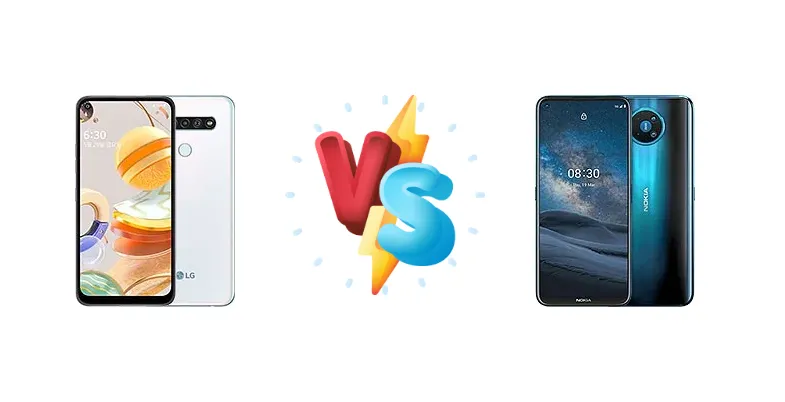
The LG Q61 and Nokia 8.3 5G represent different approaches to the mid-range smartphone market. The Q61, released in 2019, aimed for affordability, while the Nokia 8.3 5G, launched in 2020, brought 5G connectivity and a more powerful processor to a wider audience. This comparison dissects their key differences to help you determine which device best suits your needs.
🏆 Quick Verdict
For the average user, the Nokia 8.3 5G is the clear winner. Its Snapdragon 765G chipset delivers significantly better performance and future-proofs the device with 5G support. While the Q61 offers a lower entry price, the performance gap is substantial enough to justify the extra investment in the Nokia.
| Network |
|---|
| 2G bands | GSM 850 / 900 / 1800 / 1900 | GSM 850 / 900 / 1800 / 1900 |
| 3G bands | HSDPA 850 / 900 / 1900 / 2100 | HSDPA 850 / 900 / 1700(AWS) / 1900 / 2100 |
| 4G bands | LTE | 1, 2, 3, 4, 5, 7, 8, 12, 13, 17, 20, 28, 32, 38, 39, 40, 41, 66, 71 |
| 5G bands | - | 1, 2, 3, 5, 7, 8, 28, 38, 40, 41, 66, 71, 78 SA/NSA |
| Speed | HSPA 42.2/5.76 Mbps, LTE (2CA) Cat6 300/50 Mbps | HSPA 42.2/5.76 Mbps, LTE (4CA) Cat18 1200/150 Mbps, 5G 2.4/1.2 Gbps |
| Technology | GSM / HSPA / LTE | GSM / HSPA / LTE / 5G |
| Launch |
|---|
| Announced | 2020, May 21. Released 2020, May 29 | 2020, March 19. Released 2020, September 15 |
| Status | Discontinued | Discontinued |
| Body |
|---|
| Build | - | Glass front, plastic frame, glass back |
| Dimensions | 164.5 x 77.5 x 8.3 mm (6.48 x 3.05 x 0.33 in) | 171.9 x 78.6 x 9 mm (6.77 x 3.09 x 0.35 in) |
| SIM | Nano-SIM | · Nano-SIM· Nano-SIM + Nano-SIM |
| Weight | - | 220 g (7.76 oz) |
| | MIL-STD-810G compliant*
*does not guarantee ruggedness or use in extreme conditions | - |
| Display |
|---|
| Protection | Scratch-resistant glass | - |
| Resolution | 1080 x 2340 pixels, 19.5:9 ratio (~395 ppi density) | 1080 x 2400 pixels, 20:9 ratio (~386 ppi density) |
| Size | 6.53 inches, 104.7 cm2 (~82.1% screen-to-body ratio) | 6.81 inches, 112.0 cm2 (~82.9% screen-to-body ratio) |
| Type | IPS LCD | IPS LCD |
| Platform |
|---|
| CPU | Octa-core (4x2.3 GHz Cortex-A53 & 4x1.8 GHz Cortex-A53) | Octa-core (1x2.4 GHz Kryo 475 Prime & 1x2.2 GHz Kryo 475 Gold & 6x1.8 GHz Kryo 475 Silver) |
| Chipset | Mediatek MT6765 Helio P35 (12 nm) | Qualcomm SM7250 Snapdragon 765G 5G (7 nm) |
| GPU | PowerVR GE8320 | Adreno 620 |
| OS | Android 9.0 (Pie) | Android 10, upgradable to Android 12, Android One |
| Memory |
|---|
| Card slot | microSDXC (dedicated slot) | microSDXC (uses shared SIM slot) |
| Internal | 64GB 4GB RAM | 64GB 6GB RAM, 64GB 8GB RAM, 128GB 8GB RAM |
| | eMMC 5.1 | - |
| Main Camera |
|---|
| Features | LED flash, panorama, HDR | Zeiss optics, Dual-LED flash, panorama, HDR |
| Quad | 48 MP, f/1.8, 26mm (wide), 1/2.0", 0.8µm, PDAF
8 MP, f/2.2, 118˚, (ultrawide)
2 MP (macro)
Auxiliary lens | 64 MP, f/1.9, (wide), 1/1.72", 0.8µm, PDAF
12 MP, f/2.2, 120˚ (ultrawide), 1/2.43", 1.4µm, AF
2 MP (macro)
Auxiliary lens |
| Single | 8 MP, AF | - |
| Video | 1080p@30fps | 4K@30/60fps, 1080p@30/240fps, 720p@960fps, gyro-EIS |
| Selfie camera |
|---|
| Features | - | Zeiss optics, HDR |
| Single | 16 MP | 24 MP, f/2.0, (wide), 1/2.8", 0.9µm |
| Video | 1080p@30fps | 1080p@30fps |
| Sound |
|---|
| 3.5mm jack | Yes | Yes |
| 35mm jack | Yes | Yes |
| Loudspeaker | Yes | Yes |
| Comms |
|---|
| Bluetooth | 5.0, A2DP, LE | 5.0, A2DP, EDR, LE |
| NFC | Yes | Yes |
| Positioning | GPS | GPS, GLONASS, BDS |
| Radio | No | FM radio |
| USB | USB Type-C 2.0 | USB Type-C 2.0, OTG |
| WLAN | Wi-Fi 802.11 a/b/g/n/ac, dual-band, Wi-Fi Direct | Wi-Fi 802.11 a/b/g/n/ac, dual-band, Wi-Fi Direct |
| Features |
|---|
| Browser | HTML, Adobe Flash | - |
| Sensors | Fingerprint (rear-mounted), accelerometer, gyro, proximity, compass | Fingerprint (side-mounted), accelerometer, gyro, proximity, compass |
| Battery |
|---|
| Charging | - | 18W wired |
| Stand-by | Up to 200 h | - |
| Talk time | Up to 8 h 20 min | - |
| Type | Li-Po 4000 mAh | Li-Po 4500 mAh |
| Misc |
|---|
| Colors | White | Polar Night |
| Models | LM-Q630N | TA-1243, TA-1251 |
| Price | About 270 EUR | About 470 EUR |
| SAR | - | 0.96 W/kg (head) 1.41 W/kg (body) |
| SAR EU | - | 0.96 W/kg (head) 1.41 W/kg (body) |
LG Q61
- Lower price point makes it accessible.
- Simple and straightforward user experience.
- Potentially lighter and more compact design.
- Significantly weaker performance.
- Lacks 5G connectivity.
- Outdated chipset will struggle with modern apps.
Nokia 8.3 5G
- Much faster performance thanks to Snapdragon 765G.
- 5G connectivity for faster data speeds.
- Improved camera image processing.
- 18W fast charging.
- Higher price compared to the LG Q61.
- May be slightly larger and heavier.
Display Comparison
Neither device boasts a particularly standout display. While specific display specs (resolution, brightness) are not provided for the LG Q61, its market positioning suggests an LCD panel. The Nokia 8.3 5G also likely utilizes an LCD, but the focus here is on the chipset's impact on rendering graphics. The Q61's Helio P35 will struggle with demanding visual tasks, resulting in lower frame rates and potentially stuttering, while the Snapdragon 765G in the Nokia 8.3 5G will provide a much smoother experience.
Camera Comparison
Without detailed camera specifications, a direct comparison is limited. However, the Nokia 8.3 5G benefits from the Snapdragon 765G’s image signal processor (ISP), which offers superior image processing capabilities compared to the ISP found in the Helio P35. This means better dynamic range, noise reduction, and overall image quality. While both phones likely feature multiple rear cameras, the Nokia 8.3 5G’s ISP will extract more detail and produce more pleasing results, especially in challenging lighting conditions.
Performance
The core difference lies in the chipsets. The LG Q61’s Mediatek Helio P35 (12nm) uses a big.LITTLE architecture with Cortex-A53 cores clocked at 2.3GHz and 1.8GHz. This is a relatively dated design. In contrast, the Nokia 8.3 5G’s Qualcomm Snapdragon 765G (7nm) features Kryo 475 cores – a Prime core at 2.4GHz, a Gold core at 2.2GHz, and six Silver cores at 1.8GHz. The 7nm process node and more modern core design of the Snapdragon 765G translate to significantly higher performance and improved power efficiency. The Snapdragon 765G’s Adreno 620 GPU also vastly outperforms the Helio P35’s PowerVR GE8320, making the Nokia 8.3 5G the superior choice for gaming and graphically intensive applications.
Battery Life
Battery capacity isn't specified for either device. However, the Nokia 8.3 5G’s 18W wired charging is a notable advantage. The more efficient Snapdragon 765G chipset will also contribute to better battery life, even if the battery capacity is similar to the LG Q61. The Helio P35, being less efficient, will drain the battery faster under load, requiring more frequent charging.
Buying Guide
Buy the LG Q61 if you prioritize extreme affordability and basic smartphone functionality – checking email, light social media, and occasional web browsing. It's a suitable option for users on a very tight budget. Buy the Nokia 8.3 5G if you value performance, 5G connectivity, and a smoother user experience. It’s ideal for gamers, content creators, and those who want a phone that will remain responsive for years to come.
Frequently Asked Questions
❓ Will the Nokia 8.3 5G's Snapdragon 765G handle demanding games like PUBG Mobile smoothly?
Yes, the Snapdragon 765G is capable of running PUBG Mobile at high settings with stable frame rates. The Adreno 620 GPU provides sufficient graphical power for a smooth gaming experience, unlike the Helio P35 in the LG Q61 which would likely struggle with consistent performance.
❓ Is the 5G connectivity on the Nokia 8.3 5G worth the extra cost if 5G isn't widely available in my area?
Even if 5G coverage is limited now, the Nokia 8.3 5G is future-proofed for when 5G becomes more prevalent. The Snapdragon 765G also offers excellent 4G LTE performance, so you'll still benefit from faster data speeds compared to the LG Q61 even without 5G access.
❓ How much of a real-world performance difference will I notice between the Helio P35 and Snapdragon 765G in everyday tasks?
The difference will be very noticeable. The Snapdragon 765G will result in significantly faster app loading times, smoother multitasking, and a more responsive user interface. The Helio P35 will feel sluggish in comparison, especially when switching between apps or running multiple tasks simultaneously.