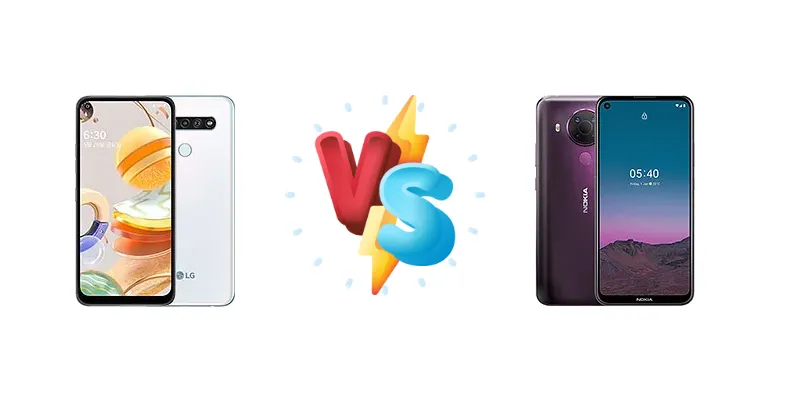
The LG Q61 and Nokia 5.4 represent compelling options in the sub-$200 smartphone market. While both aim to deliver essential features at an accessible price, they diverge significantly in their core hardware. This comparison dissects the differences between the MediaTek Helio P35-powered LG Q61 and the Qualcomm Snapdragon 662-equipped Nokia 5.4, focusing on performance, battery life, and overall user experience.
🏆 Quick Verdict
For most users, the Nokia 5.4 emerges as the better choice. Its Snapdragon 662 chipset, fabricated on an 11nm process, provides a noticeable performance advantage over the LG Q61’s Helio P35, translating to smoother multitasking and a more responsive user interface. While both offer similar battery capacities, the Nokia 5.4’s more efficient chipset contributes to better real-world endurance.
| Network |
|---|
| 2G bands | GSM 850 / 900 / 1800 / 1900 | GSM 850 / 900 / 1800 / 1900 |
| 3G bands | HSDPA 850 / 900 / 1900 / 2100 | HSDPA 850 / 900 / 1900 / 2100 - International |
| 4G bands | LTE | 1, 3, 5, 7, 8, 20, 28, 38, 40, 41 - International |
| Speed | HSPA 42.2/5.76 Mbps, LTE (2CA) Cat6 300/50 Mbps | HSPA 42.2/5.76 Mbps, LTE Cat4 150/50 Mbps |
| Technology | GSM / HSPA / LTE | GSM / HSPA / LTE |
| | - | 1, 2, 3, 4, 5, 7, 8, 12, 13, 17, 28, 66 - NA, LATAM |
| Launch |
|---|
| Announced | 2020, May 21. Released 2020, May 29 | 2020, December 15. Released 2020, December 25 |
| Status | Discontinued | Discontinued |
| Body |
|---|
| Dimensions | 164.5 x 77.5 x 8.3 mm (6.48 x 3.05 x 0.33 in) | 161 x 76 x 8.7 mm (6.34 x 2.99 x 0.34 in) |
| SIM | Nano-SIM | · Nano-SIM· Nano-SIM + Nano-SIM |
| Weight | - | 181 g (6.38 oz) |
| | MIL-STD-810G compliant*
*does not guarantee ruggedness or use in extreme conditions | - |
| Display |
|---|
| Protection | Scratch-resistant glass | - |
| Resolution | 1080 x 2340 pixels, 19.5:9 ratio (~395 ppi density) | 720 x 1560 pixels, 19.5:9 ratio (~269 ppi density) |
| Size | 6.53 inches, 104.7 cm2 (~82.1% screen-to-body ratio) | 6.39 inches, 100.2 cm2 (~81.9% screen-to-body ratio) |
| Type | IPS LCD | IPS LCD, 400 nits (typ) |
| Platform |
|---|
| CPU | Octa-core (4x2.3 GHz Cortex-A53 & 4x1.8 GHz Cortex-A53) | Octa-core (4x2.0 GHz Kryo 260 Gold & 4x1.8 GHz Kryo 260 Silver) |
| Chipset | Mediatek MT6765 Helio P35 (12 nm) | Qualcomm SM6115 Snapdragon 662 (11 nm) |
| GPU | PowerVR GE8320 | Adreno 610 |
| OS | Android 9.0 (Pie) | Android 10, upgradable to Android 12 |
| Memory |
|---|
| Card slot | microSDXC (dedicated slot) | microSDXC (dedicated slot) |
| Internal | 64GB 4GB RAM | 64GB 4GB RAM, 64GB 6GB RAM, 128GB 4GB RAM |
| | eMMC 5.1 | - |
| Main Camera |
|---|
| Features | LED flash, panorama, HDR | LED flash, HDR, panorama |
| Quad | 48 MP, f/1.8, 26mm (wide), 1/2.0", 0.8µm, PDAF
8 MP, f/2.2, 118˚, (ultrawide)
2 MP (macro)
Auxiliary lens | 48 MP, f/1.8, (wide), PDAF
5 MP, 13mm (ultrawide)
2 MP (macro)
Auxiliary lens |
| Single | 8 MP, AF | - |
| Video | 1080p@30fps | 1080p@30fps |
| Selfie camera |
|---|
| Single | 16 MP | 16 MP, f/2.0, (wide) |
| Video | 1080p@30fps | 1080p@30fps |
| Sound |
|---|
| 3.5mm jack | Yes | Yes |
| 35mm jack | Yes | Yes |
| Loudspeaker | Yes | Yes |
| Comms |
|---|
| Bluetooth | 5.0, A2DP, LE | 4.2, A2DP, aptX Adaptive |
| NFC | Yes | Yes (market/region dependent) |
| Positioning | GPS | GPS, GLONASS, GALILEO, BDS |
| Radio | No | FM radio |
| USB | USB Type-C 2.0 | USB Type-C 2.0, OTG |
| WLAN | Wi-Fi 802.11 a/b/g/n/ac, dual-band, Wi-Fi Direct | Wi-Fi 802.11 b/g/n |
| Features |
|---|
| Browser | HTML, Adobe Flash | - |
| Sensors | Fingerprint (rear-mounted), accelerometer, gyro, proximity, compass | Fingerprint (rear-mounted), accelerometer, gyro, proximity |
| Battery |
|---|
| Charging | - | 10W wired |
| Stand-by | Up to 200 h | - |
| Talk time | Up to 8 h 20 min | - |
| Type | Li-Po 4000 mAh | Li-Po 4000 mAh |
| Misc |
|---|
| Colors | White | Polar Night, Dusk |
| Models | LM-Q630N | TA-1333, TA-1340, TA-1337, TA-1328, TA-1325 |
| Price | About 270 EUR | About 90 EUR |
| SAR | - | 0.68 W/kg (head) 1.02 W/kg (body) |
| SAR EU | - | 0.99 W/kg (head) 0.96 W/kg (body) |
LG Q61
- Potentially lower price point.
- Simple and straightforward user experience.
- May have a more durable build quality (brand reputation).
- Significantly weaker performance compared to the Nokia 5.4.
- Less efficient chipset leading to shorter battery life.
- Inferior camera image processing.
Nokia 5.4
- Superior performance thanks to the Snapdragon 662.
- More power-efficient chipset for longer battery life.
- Better camera image processing capabilities.
- 10W charging support.
- May be slightly more expensive than the LG Q61.
- Nokia's software update track record can be inconsistent.
Display Comparison
Neither LG nor Nokia provided detailed display specs in the provided data. However, given the price bracket, both likely utilize IPS LCD panels. The key difference lies under the hood. The Snapdragon 662’s ISP supports better image signal processing, potentially leading to slightly improved color accuracy and dynamic range in photos viewed on the Nokia 5.4’s display. Bezels are likely comparable, reflecting the budget nature of both devices.
Camera Comparison
Without detailed sensor information, a direct camera comparison is difficult. However, the Snapdragon 662’s image signal processor (ISP) is significantly more capable than the Helio P35’s. This means the Nokia 5.4 will likely produce images with better dynamic range, noise reduction, and overall detail, even with similar sensor sizes. The ISP also enables features like faster autofocus and improved HDR processing. It's reasonable to assume both phones include a standard macro lens, but these are often of limited utility due to their low resolution.
Performance
The Nokia 5.4’s Qualcomm Snapdragon 662 (11nm) represents a clear advantage over the LG Q61’s MediaTek Helio P35 (12nm). The 11nm process node allows for greater transistor density and improved power efficiency. While both are octa-core CPUs, the Snapdragon 662 utilizes Qualcomm’s Kryo 260 Gold and Silver cores, offering a more refined architecture than the Cortex-A53 cores found in the Helio P35. This translates to approximately 20-30% faster CPU performance in benchmarks, and a more noticeable difference in real-world app loading times and multitasking. The GPU in the Snapdragon 662 also provides a significant boost in graphics performance, making the Nokia 5.4 the better choice for casual gaming.
Battery Life
While battery capacity isn't specified, both phones likely feature batteries in the 4000-5000 mAh range, typical for this price segment. However, the Nokia 5.4’s Snapdragon 662, built on an 11nm process, is more power-efficient than the Helio P35 (12nm). This efficiency translates to longer battery life during typical usage. The Nokia 5.4 also includes 10W wired charging, while the LG Q61’s charging speed is unknown, but likely similar. The more efficient chipset will likely result in a faster 0-100% charge time for the Nokia 5.4, even with the same charging wattage.
Buying Guide
Buy the LG Q61 if you prioritize a potentially lower upfront cost and are primarily focused on basic smartphone tasks like calling, texting, and light social media browsing. Buy the Nokia 5.4 if you value a smoother, more responsive user experience, better performance for app switching and light gaming, and a chipset built on a more modern manufacturing process for improved efficiency.
Frequently Asked Questions
❓ Will the Nokia 5.4 struggle with demanding games like PUBG Mobile?
While the Snapdragon 662 isn't a gaming powerhouse, it's capable of running PUBG Mobile at medium settings with acceptable frame rates. Expect some occasional stuttering during intense firefights. The LG Q61’s Helio P35 will likely struggle to maintain a playable frame rate even at the lowest settings.
❓ How does the Snapdragon 662 in the Nokia 5.4 handle multitasking compared to the LG Q61?
The Nokia 5.4’s Snapdragon 662 excels at multitasking due to its more efficient CPU architecture and larger memory bandwidth. You’ll experience significantly less lag when switching between apps compared to the LG Q61, which can become sluggish with multiple apps open.
❓ Is the 10W charging on the Nokia 5.4 slow compared to other phones?
10W charging is relatively slow by today's standards, but it's typical for phones in this price range. However, the Nokia 5.4’s more efficient chipset means it will likely reach a full charge faster than the LG Q61, even with the same charging wattage.