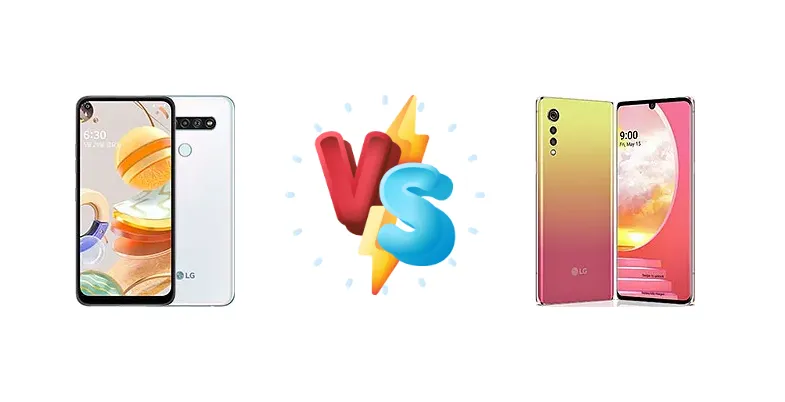
The LG Q61 and LG Velvet 5G represent distinct tiers within LG’s former smartphone lineup. The Q61 aimed for affordability and essential functionality, while the Velvet 5G targeted a more premium experience with 5G connectivity and a more powerful processor. This comparison dissects the key differences to help you determine which device best suits your needs and budget.
🏆 Quick Verdict
For most users, the LG Velvet 5G is the superior choice. Its Snapdragon 765G chipset delivers significantly faster performance, and the inclusion of 5G future-proofs the device. While the Q61 offers respectable battery life, the Velvet 5G’s faster charging and overall feature set justify the price difference.
| Network |
|---|
| 2G bands | GSM 850 / 900 / 1800 / 1900 | GSM 850 / 900 / 1800 / 1900 |
| 3G bands | HSDPA 850 / 900 / 1900 / 2100 | HSDPA 850 / 900 / 1900 / 2100 |
| 4G bands | LTE | 1, 2, 3, 4, 5, 7, 8, 12, 17, 20, 28, 32, 38, 39, 40, 41 |
| 5G bands | - | 1, 3, 28, 78 SA/NSA |
| Speed | HSPA 42.2/5.76 Mbps, LTE (2CA) Cat6 300/50 Mbps | HSPA 42.2/5.76 Mbps, LTE (5CA) Cat16 1000/75 Mbps, 5G 2Gbps |
| Technology | GSM / HSPA / LTE | GSM / HSPA / LTE / 5G |
| Launch |
|---|
| Announced | 2020, May 21. Released 2020, May 29 | 2020, May 07. Released 2020, May 15 |
| Status | Discontinued | Discontinued |
| Body |
|---|
| Build | - | Glass front, glass back, aluminum frame |
| Dimensions | 164.5 x 77.5 x 8.3 mm (6.48 x 3.05 x 0.33 in) | 167.2 x 74.1 x 7.9 mm (6.58 x 2.92 x 0.31 in) |
| SIM | Nano-SIM | Nano-SIM + Nano-SIM |
| Weight | - | 180 g (6.35 oz) |
| | MIL-STD-810G compliant*
*does not guarantee ruggedness or use in extreme conditions | IP68 dust/water resistant (up to 1.5m for 30 mins)
MIL-STD-810G compliant*
*does not guarantee ruggedness or use in extreme conditions |
| Display |
|---|
| Protection | Scratch-resistant glass | - |
| Resolution | 1080 x 2340 pixels, 19.5:9 ratio (~395 ppi density) | 1080 x 2460 pixels (~395 ppi density) |
| Size | 6.53 inches, 104.7 cm2 (~82.1% screen-to-body ratio) | 6.8 inches, 109.8 cm2 (~88.6% screen-to-body ratio) |
| Type | IPS LCD | P-OLED |
| Platform |
|---|
| CPU | Octa-core (4x2.3 GHz Cortex-A53 & 4x1.8 GHz Cortex-A53) | Octa-core (1x2.4 GHz Kryo 475 Prime & 1x2.2 GHz Kryo 475 Gold & 6x1.8 GHz Kryo 475 Silver) |
| Chipset | Mediatek MT6765 Helio P35 (12 nm) | Qualcomm SM7250 Snapdragon 765G 5G (7 nm) |
| GPU | PowerVR GE8320 | Adreno 620 |
| OS | Android 9.0 (Pie) | Android 10, upgradable to Android 13, LG UX |
| Memory |
|---|
| Card slot | microSDXC (dedicated slot) | microSDXC (uses shared SIM slot) |
| Internal | 64GB 4GB RAM | 128GB 6GB RAM, 128GB 8GB RAM |
| | eMMC 5.1 | UFS 2.1 |
| Main Camera |
|---|
| Features | LED flash, panorama, HDR | LED flash, panorama, HDR |
| Quad | 48 MP, f/1.8, 26mm (wide), 1/2.0", 0.8µm, PDAF
8 MP, f/2.2, 118˚, (ultrawide)
2 MP (macro)
Auxiliary lens | - |
| Single | 8 MP, AF | - |
| Triple | - | 48 MP, f/1.8, 26mm (wide), 1/2.0", 0.8µm, PDAF
8 MP, f/2.2, 120˚, 15mm (ultrawide), 1/4.0", 1.12µm
Auxiliary lens |
| Video | 1080p@30fps | 4K@30fps, 1080p@30/60fps, gyro-EIS |
| Selfie camera |
|---|
| Features | - | HDR |
| Single | 16 MP | 16 MP, f/1.9, 29mm (standard), 1/3.06, 1.0µm |
| Video | 1080p@30fps | 1080p@30fps |
| Sound |
|---|
| 3.5mm jack | Yes | Yes |
| 35mm jack | Yes | Yes |
| Loudspeaker | Yes | Yes, with stereo speakers |
| Comms |
|---|
| Bluetooth | 5.0, A2DP, LE | 5.1, A2DP, LE, aptX HD |
| NFC | Yes | Yes |
| Positioning | GPS | GPS (L1+L5), GLONASS, BDS, GALILEO, QZSS |
| Radio | No | FM radio (market/region dependent) |
| USB | USB Type-C 2.0 | USB Type-C, OTG |
| WLAN | Wi-Fi 802.11 a/b/g/n/ac, dual-band, Wi-Fi Direct | Wi-Fi 802.11 a/b/g/n/ac, dual-band, Wi-Fi Direct, DLNA |
| Features |
|---|
| Browser | HTML, Adobe Flash | - |
| Sensors | Fingerprint (rear-mounted), accelerometer, gyro, proximity, compass | Fingerprint (under display, optical), accelerometer, gyro, proximity, compass, barometer |
| Battery |
|---|
| Charging | - | 25W wired, PD3.0, QC4
9W wireless |
| Stand-by | Up to 200 h | - |
| Talk time | Up to 8 h 20 min | - |
| Type | Li-Po 4000 mAh | Li-Po 4300 mAh |
| Misc |
|---|
| Colors | White | Aurora White, Aurora Green, Aurora Gray, Illusion Sunset, Red, Pink |
| Models | LM-Q630N | LM-G900N, LM-G900EM, LM-G900, LM-G900TM |
| Price | About 270 EUR | About 470 EUR |
| SAR | - | 0.23 W/kg (head) 1.02 W/kg (body) |
| Tests |
|---|
| Battery life | - | Endurance rating 79h |
| Camera | - |
Photo / Video |
| Display | - |
Contrast ratio: Infinite (nominal) |
| Loudspeaker | - |
-23.5 LUFS (Very good) |
| Performance | - |
AnTuTu: 297372 (v8)
GeekBench: 1905 (v5.1)
GFXBench: 16fps (ES 3.1 onscreen) |
LG Q61
- Significantly lower price point
- Respectable battery endurance
- Functional for basic smartphone tasks
- Outdated Helio P35 processor
- Likely a lower-quality display
- Slower charging speeds (assumed)
LG Velvet 5G
- Faster Snapdragon 765G processor
- 5G connectivity for future-proofing
- Faster 25W wired and 9W wireless charging
- Higher price tag
- May not offer dramatically longer battery life
- Larger size and weight compared to the Q61 (likely)
Display Comparison
The LG Velvet 5G boasts a significantly brighter display, reaching a measured 617 nits, compared to an unspecified brightness for the Q61. This higher brightness translates to better visibility outdoors. While both displays are described as having an 'infinite' contrast ratio (a marketing term), the Velvet 5G’s panel likely benefits from the more advanced processing capabilities of its chipset for improved color accuracy and dynamic range. The Q61’s display, while functional, is likely a more basic LCD panel geared towards cost savings.
Camera Comparison
Both devices are listed as having photo/video capabilities, but detailed sensor information is lacking for the Q61. The Velvet 5G, being a more premium device, likely incorporates a more sophisticated camera system with a larger main sensor and potentially optical image stabilization (OIS). While the Q61 may suffice for casual snapshots, the Velvet 5G is expected to deliver superior image quality, especially in low-light conditions. The absence of specific camera specs for the Q61 suggests a focus on affordability over photographic prowess.
Performance
The core difference lies in the chipsets: the LG Q61 utilizes the Mediatek Helio P35, a 12nm processor with a Cortex-A53 based octa-core configuration. This is a budget-oriented chip designed for everyday tasks. The LG Velvet 5G, however, features the Qualcomm Snapdragon 765G, built on a more efficient 7nm process. The Snapdragon 765G’s Kryo CPU architecture (1x2.4 GHz Prime, 1x2.2 GHz Gold, 6x1.8 GHz Silver) offers a substantial performance uplift, particularly in demanding applications and multitasking. The 7nm node also contributes to better thermal management, reducing the likelihood of performance throttling under sustained load. This means the Velvet 5G will handle gaming and video editing far more effectively.
Battery Life
Both phones share an endurance rating of 79 hours, suggesting similar overall battery life under typical usage. However, the Velvet 5G offers a significant advantage in charging speed with its 25W wired charging support (PD3.0, QC4) and 9W wireless charging. The Q61’s charging specifications are not provided, implying a slower charging rate. The faster charging on the Velvet 5G minimizes downtime and provides greater convenience, even if the actual battery capacity isn’t dramatically different.
Buying Guide
Buy the LG Q61 if you prioritize a low price and reliable basic smartphone functionality, and 5G connectivity isn't a necessity. It’s ideal for users who primarily browse the web, use social media, and make calls. Buy the LG Velvet 5G if you want a smoother, faster experience, 5G capabilities, and faster charging, even if it means spending more. This phone is better suited for users who enjoy mobile gaming, streaming video, and taking photos.
Frequently Asked Questions
❓ Is the Snapdragon 765G in the Velvet 5G powerful enough for demanding games like PUBG or Call of Duty?
Yes, the Snapdragon 765G is a capable mid-range processor that can handle PUBG and Call of Duty at medium to high settings. While it won't match the performance of flagship Snapdragon 800-series chips, it provides a smooth and enjoyable gaming experience, especially considering the 7nm process helps with thermal throttling.
❓ Does the LG Velvet 5G support carrier aggregation for faster 5G speeds?
The Snapdragon 765G modem does support carrier aggregation, which allows it to combine multiple 5G channels for faster download and upload speeds. However, the actual speeds you experience will depend on your carrier's network infrastructure and the specific bands supported in your region.
❓ How does the Helio P35 in the Q61 handle multitasking with several apps open?
The Helio P35 is adequate for light multitasking, such as switching between messaging apps and web browsing. However, with numerous apps open simultaneously, you may experience noticeable slowdowns and app reloading due to its limited processing power and RAM capacity.
❓ Is the LG Velvet 5G still a good buy in [current year], considering newer phones are available?
The LG Velvet 5G remains a viable option, particularly if you can find it at a discounted price. Its 5G connectivity, capable processor, and fast charging still offer a good value proposition, although newer phones may offer improved features and performance.