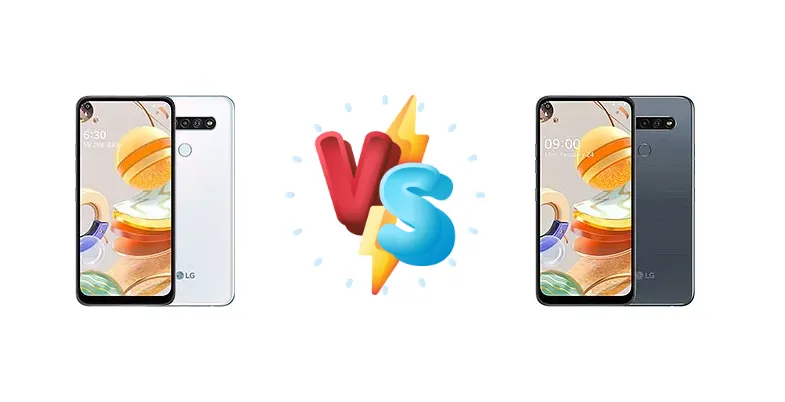
The LG Q61 and K61 represent LG's attempts to capture the budget smartphone market. Interestingly, both devices are built around the same MediaTek Helio P35 chipset, leading to a surprisingly close hardware match. This comparison will dissect the nuances between these two models, focusing on where potential differences in software, build quality, or market positioning might sway a buyer's decision.
🏆 Quick Verdict
For the average user, the LG K61 likely represents the better value. While both phones offer identical performance due to the Helio P35, the K61 often appears at a slightly lower price point, making it the more sensible choice for budget-conscious consumers. The Q61 may appeal to those who prefer its specific aesthetic or find it at a comparable price.
| Network |
|---|
| 2G bands | GSM 850 / 900 / 1800 / 1900 | GSM 850 / 900 / 1800 / 1900 |
| 3G bands | HSDPA 850 / 900 / 1900 / 2100 | HSDPA 850 / 900 / 1900 / 2100 |
| 4G bands | LTE | 1, 3, 5, 7, 8, 20, 28, 38, 39, 40 |
| Speed | HSPA 42.2/5.76 Mbps, LTE (2CA) Cat6 300/50 Mbps | HSPA 42.2/5.76 Mbps, LTE (2CA) Cat6 300/50 Mbps |
| Technology | GSM / HSPA / LTE | GSM / HSPA / LTE |
| Launch |
|---|
| Announced | 2020, May 21. Released 2020, May 29 | 2020, February 18. Released 2020, April 27 |
| Status | Discontinued | Discontinued |
| Body |
|---|
| Dimensions | 164.5 x 77.5 x 8.3 mm (6.48 x 3.05 x 0.33 in) | 164.5 x 77.5 x 8.4 mm (6.48 x 3.05 x 0.33 in) |
| SIM | Nano-SIM | · Nano-SIM· Nano-SIM + Nano-SIM |
| Weight | - | 191 g (6.74 oz) |
| | MIL-STD-810G compliant*
*does not guarantee ruggedness or use in extreme conditions | MIL-STD-810G compliant*
*does not guarantee ruggedness or use in extreme conditions |
| Display |
|---|
| Protection | Scratch-resistant glass | Scratch-resistant glass |
| Resolution | 1080 x 2340 pixels, 19.5:9 ratio (~395 ppi density) | 1080 x 2340 pixels, 19.5:9 ratio (~394 ppi density) |
| Size | 6.53 inches, 104.7 cm2 (~82.1% screen-to-body ratio) | 6.53 inches, 105.2 cm2 (~82.5% screen-to-body ratio) |
| Type | IPS LCD | IPS LCD |
| Platform |
|---|
| CPU | Octa-core (4x2.3 GHz Cortex-A53 & 4x1.8 GHz Cortex-A53) | Octa-core (4x2.3 GHz Cortex-A53 & 4x1.8 GHz Cortex-A53) |
| Chipset | Mediatek MT6765 Helio P35 (12 nm) | Mediatek MT6765 Helio P35 (12 nm) |
| GPU | PowerVR GE8320 | PowerVR GE8320 |
| OS | Android 9.0 (Pie) | Android 9.0 (Pie) |
| Memory |
|---|
| Card slot | microSDXC (dedicated slot) | microSDXC (dedicated slot) |
| Internal | 64GB 4GB RAM | 64GB 4GB RAM, 128GB 4GB RAM |
| | eMMC 5.1 | - |
| Main Camera |
|---|
| Features | LED flash, panorama, HDR | LED flash, panorama, HDR |
| Quad | 48 MP, f/1.8, 26mm (wide), 1/2.0", 0.8µm, PDAF
8 MP, f/2.2, 118˚, (ultrawide)
2 MP (macro)
Auxiliary lens | 48 MP, f/1.8, 26mm (wide), 1/2.0", 0.8µm, PDAF
8 MP, f/2.2, 118˚, (ultrawide)
2 MP (macro)
Auxiliary lens |
| Single | 8 MP, AF | - |
| Video | 1080p@30fps | 1080p@30fps |
| Selfie camera |
|---|
| Single | 16 MP | 16 MP |
| Video | 1080p@30fps | 1080p@30fps |
| Sound |
|---|
| 3.5mm jack | Yes | Yes |
| 35mm jack | Yes | Yes |
| Loudspeaker | Yes | Yes |
| Comms |
|---|
| Bluetooth | 5.0, A2DP, LE | 5.0, A2DP, LE |
| NFC | Yes | Yes |
| Positioning | GPS | GPS |
| Radio | No | No |
| USB | USB Type-C 2.0 | USB Type-C 2.0 |
| WLAN | Wi-Fi 802.11 a/b/g/n/ac, dual-band, Wi-Fi Direct | Wi-Fi 802.11 b/g/n, Wi-Fi Direct, DLNAorWi-Fi 802.11 a/b/g/n/ac, dual-band, Wi-Fi Direct, DNLA |
| Features |
|---|
| Browser | HTML, Adobe Flash | - |
| Sensors | Fingerprint (rear-mounted), accelerometer, gyro, proximity, compass | Fingerprint (rear-mounted), accelerometer, gyro, proximity, compass |
| Battery |
|---|
| Stand-by | Up to 200 h | - |
| Talk time | Up to 8 h 20 min | - |
| Type | Li-Po 4000 mAh | Li-Po 4000 mAh |
| Misc |
|---|
| Colors | White | Titanium, White, Blue |
| Models | LM-Q630N | LMQ630EAW, LM-Q630EAW, LM-Q630 |
| Price | About 270 EUR | About 300 EUR |
LG Q61
- Identical performance to K61 due to Helio P35
- Potential for slightly more refined software
- May have a more appealing aesthetic (subjective)
- Likely priced higher than the K61
- No performance advantage over the K61
- Limited upgrade path
LG K61
- Identical performance to Q61 due to Helio P35
- Generally more affordable than the Q61
- Good value for money
- Potentially less refined software experience
- No performance advantage over the Q61
- Limited upgrade path
Display Comparison
Both the LG Q61 and K61 utilize displays that, while adequate for their price point, don't push any boundaries. Given the lack of specific display specs beyond the chipset, we can infer they likely feature similar LCD panels with 720p+ resolutions. The user experience will be largely defined by color accuracy and brightness, which will likely be similar. Expect standard viewing angles and limited outdoor visibility. The absence of features like high refresh rates or HDR support is typical for this segment.
Camera Comparison
Camera performance is a potential area for differentiation, but the provided data is insufficient to draw firm conclusions. Both phones likely feature a multi-camera setup, but without sensor size or aperture information, it's difficult to assess image quality. The inclusion of a 2MP macro camera on either device is largely a marketing tactic, as these sensors typically produce low-quality images. Image processing algorithms will be the key differentiator, and any differences here are likely subtle. Expect acceptable results in good lighting conditions, but struggles in low light.
Performance
The core of both devices is the MediaTek Helio P35 (MT6765), a 12nm chipset featuring an octa-core CPU configuration with four cores clocked at 2.3 GHz and another four at 1.8 GHz. This means both phones will deliver virtually identical performance in CPU-bound tasks like web browsing, social media, and light gaming. The GPU performance will also be the same. Thermal management will likely be similar, meaning neither phone is suited for prolonged, demanding gaming sessions. RAM configurations, if differing, will be the primary factor influencing multitasking capabilities, but this information is not provided.
Battery Life
Battery life will depend on the capacity of the battery in each device, a specification not provided. However, given the power efficiency of the Helio P35, both phones should be capable of lasting a full day with moderate usage. Charging wattage is also unknown, but likely falls in the 10-15W range, resulting in relatively slow charging times. The 12nm process node of the Helio P35 contributes to reasonable power efficiency, but heavy users will still need to charge daily.
Buying Guide
Buy the LG Q61 if you prioritize a potentially more refined software experience, assuming LG dedicated slightly more resources to its development. Buy the LG K61 if you are strictly focused on getting the most performance per dollar, and are comfortable with a potentially more basic software implementation. Both are suitable for light tasks, but neither is a powerhouse.
Frequently Asked Questions
❓ Will the Helio P35 struggle with popular apps like TikTok or Instagram?
The Helio P35 is capable of running apps like TikTok and Instagram, but expect some lag or slowdowns when multitasking or using the apps extensively. It's not a high-performance chipset, so demanding tasks will be a challenge.
❓ Are software updates likely to be provided for either the Q61 or K61?
LG has a mixed track record with software updates for budget devices. It's unlikely that either the Q61 or K61 will receive major Android version updates beyond their initial release. Security patches may be provided for a limited time, but long-term support is not guaranteed.
❓ Can either of these phones handle basic mobile gaming?
Both phones can handle basic mobile gaming, but don't expect a smooth experience with graphically intensive titles. Games like Candy Crush or Angry Birds will run fine, but PUBG Mobile or Fortnite will likely require significant compromises in graphics settings and frame rates.