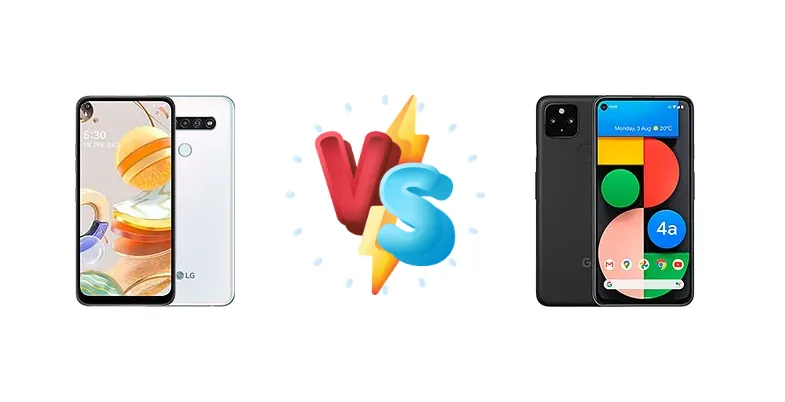
The Google Pixel 4a 5G and LG Q61 represent different approaches to the mid-range smartphone market. The Pixel 4a 5G brings flagship-adjacent features like 5G connectivity and Google’s renowned camera software, while the LG Q61 aims for affordability with a more basic feature set. This comparison dissects their core components to determine which device best suits your needs.
🏆 Quick Verdict
For most users, the Google Pixel 4a 5G is the superior choice. Its Snapdragon 765G chipset delivers significantly faster performance and 5G capabilities, coupled with a class-leading camera experience. While the LG Q61 offers a lower price point, the performance gap is substantial.
| Network |
|---|
| 2G bands | GSM 850 / 900 / 1800 / 1900 | GSM 850 / 900 / 1800 / 1900 |
| 3G bands | HSDPA 850 / 900 / 1900 / 2100 | HSDPA 850 / 900 / 1700(AWS) / 1900 / 2100 |
| 4G bands | LTE | 1, 2, 3, 4, 5, 7, 8, 12, 13, 14, 17, 18, 19, 20, 25, 26, 28, 29, 30, 32, 38, 39, 40, 41, 42, 46, 48, 66, 71 |
| 5G bands | - | 1, 2, 3, 5, 7, 8, 12, 28, 41, 66, 71, 77, 78 Sub6, mmWave (market dependant) |
| Speed | HSPA 42.2/5.76 Mbps, LTE (2CA) Cat6 300/50 Mbps | HSPA, LTE, 5G |
| Technology | GSM / HSPA / LTE | GSM / HSPA / LTE / 5G |
| Launch |
|---|
| Announced | 2020, May 21. Released 2020, May 29 | 2020, September 30 |
| Status | Discontinued | Available. Released 2020, November 05 |
| Body |
|---|
| Build | - | Glass front (Gorilla Glass 3), plastic back, plastic frame |
| Dimensions | 164.5 x 77.5 x 8.3 mm (6.48 x 3.05 x 0.33 in) | 153.9 x 74 x 8.2 mm (Sub-6) or 8.5 mm (Sub-6 and mmWave) |
| SIM | Nano-SIM | Nano-SIM + eSIM |
| Weight | - | 168 g (5G Sub-6); 171 g ( 5G Sub-6 and mmWave) (5.93 oz) |
| | MIL-STD-810G compliant*
*does not guarantee ruggedness or use in extreme conditions | - |
| Display |
|---|
| Protection | Scratch-resistant glass | Corning Gorilla Glass 3 |
| Resolution | 1080 x 2340 pixels, 19.5:9 ratio (~395 ppi density) | 1080 x 2340 pixels, 19.5:9 ratio (~413 ppi density) |
| Size | 6.53 inches, 104.7 cm2 (~82.1% screen-to-body ratio) | 6.2 inches, 95.7 cm2 (~84.1% screen-to-body ratio) |
| Type | IPS LCD | OLED, HDR |
| | - | Always-on display |
| Platform |
|---|
| CPU | Octa-core (4x2.3 GHz Cortex-A53 & 4x1.8 GHz Cortex-A53) | Octa-core (1x2.4 GHz Kryo 475 Prime & 1x2.2 GHz Kryo 475 Gold & 6x1.8 GHz Kryo 475 Silver) |
| Chipset | Mediatek MT6765 Helio P35 (12 nm) | Qualcomm SM7250 Snapdragon 765G 5G (7 nm) |
| GPU | PowerVR GE8320 | Adreno 620 |
| OS | Android 9.0 (Pie) | Android 11, upgradable to Android 14 |
| Memory |
|---|
| Card slot | microSDXC (dedicated slot) | No |
| Internal | 64GB 4GB RAM | 128GB 6GB RAM |
| | eMMC 5.1 | UFS 2.1 |
| Main Camera |
|---|
| Dual | - | 12.2 MP, f/1.7, 27mm (wide), 1/2.55", 1.4µm, dual pixel PDAF, OIS
16 MP, f/2.2, 107˚ (ultrawide), 1.0µm |
| Features | LED flash, panorama, HDR | LED flash, Pixel Shift, Auto-HDR, panorama |
| Quad | 48 MP, f/1.8, 26mm (wide), 1/2.0", 0.8µm, PDAF
8 MP, f/2.2, 118˚, (ultrawide)
2 MP (macro)
Auxiliary lens | - |
| Single | 8 MP, AF | - |
| Video | 1080p@30fps | 4K@30/60fps, 1080p@30/60/120/240fps; gyro-EIS |
| Selfie camera |
|---|
| Features | - | HDR |
| Single | 16 MP | 8 MP, f/2.0, 24mm (wide), 1/4.0", 1.12µm |
| Video | 1080p@30fps | 1080p@30fps |
| Sound |
|---|
| 3.5mm jack | Yes | Yes |
| 35mm jack | Yes | Yes |
| Loudspeaker | Yes | Yes, with stereo speakers |
| Comms |
|---|
| Bluetooth | 5.0, A2DP, LE | 5.0, A2DP, LE, aptX HD |
| NFC | Yes | Yes |
| Positioning | GPS | GPS, GLONASS, GALILEO, QZSS, BDS |
| Radio | No | No |
| USB | USB Type-C 2.0 | USB Type-C 3.1 |
| WLAN | Wi-Fi 802.11 a/b/g/n/ac, dual-band, Wi-Fi Direct | Wi-Fi 802.11 a/b/g/n/ac, dual-band, Wi-Fi Direct |
| Features |
|---|
| Browser | HTML, Adobe Flash | - |
| Sensors | Fingerprint (rear-mounted), accelerometer, gyro, proximity, compass | Fingerprint (rear-mounted), accelerometer, gyro, proximity, compass, barometer |
| Battery |
|---|
| Charging | - | 18W wired, PD2.0 |
| Stand-by | Up to 200 h | - |
| Talk time | Up to 8 h 20 min | - |
| Type | Li-Po 4000 mAh | Li-Po 3885 mAh |
| Misc |
|---|
| Colors | White | Just Black, Clearly White |
| Models | LM-Q630N | GD1YQ, G025I, G025E, G025H, G6QU3 |
| Price | About 270 EUR | About 140 EUR |
LG Q61
- Significantly faster performance with Snapdragon 765G
- 5G connectivity for faster data speeds
- Superior camera quality with Google’s software
- Faster charging with 18W PD2.0
- Higher price point than the LG Q61
- May not have expandable storage
Google Pixel 4a 5G
- More affordable price
- Potentially longer battery life due to less demanding chipset (depending on battery capacity)
- May offer expandable storage (market dependent)
- Simple and functional Android experience
- Substantially slower performance
- Lacks 5G connectivity
- Inferior camera quality
- Slower charging speeds
Display Comparison
Neither device boasts a cutting-edge display. While specific display specs for the LG Q61 are not provided, its market positioning suggests an LCD panel. The Pixel 4a 5G also utilizes an LCD, but the focus is on color accuracy and usability. The real differentiator lies in processing power impacting UI smoothness, not panel technology. Both likely feature similar resolutions, making the viewing experience comparable for everyday tasks.
Camera Comparison
The Pixel 4a 5G excels in camera performance due to Google’s computational photography prowess. While sensor sizes aren't specified, the Pixel’s image processing algorithms compensate for potentially smaller hardware. The Snapdragon 765G’s image signal processor (ISP) is far more capable than the one found in the Helio P35, enabling features like Night Sight and HDR+ that significantly improve image quality in challenging conditions. The LG Q61 will likely produce acceptable photos in good lighting, but will struggle in low-light scenarios and lack the dynamic range of the Pixel.
Performance
The performance disparity is the most significant difference. The LG Q61’s Mediatek Helio P35 (12nm) utilizes older Cortex-A53 cores, resulting in noticeably slower performance compared to the Google Pixel 4a 5G’s Qualcomm Snapdragon 765G (7nm). The Snapdragon 765G’s Kryo 475 cores – particularly the prime and gold cores – offer a substantial uplift in CPU and GPU performance. The 7nm process node further enhances efficiency, leading to better thermal management and sustained performance during demanding tasks. This translates to faster app loading times, smoother multitasking, and a more responsive user experience on the Pixel 4a 5G. The 5G modem integrated into the Snapdragon 765G is also a key advantage.
Battery Life
Battery capacity isn't specified for either device. However, the Snapdragon 765G’s 7nm process contributes to better power efficiency, potentially offsetting a smaller battery capacity on the Pixel 4a 5G. Furthermore, the Pixel 4a 5G supports 18W wired charging with PD2.0, allowing for faster charging speeds compared to the LG Q61, which likely has slower charging capabilities. This means less downtime and more usable time on the Pixel 4a 5G.
Buying Guide
Buy the LG Q61 if you prioritize extreme affordability and basic smartphone functionality, and 5G connectivity isn't a requirement. You'll get a functional device for essential tasks. Buy the Google Pixel 4a 5G if you value performance, a superior camera, 5G connectivity, and a smoother software experience, even if it means spending a bit more. It's the better long-term investment.
Frequently Asked Questions
❓ Will the Helio P35 in the LG Q61 struggle with modern mobile games?
Yes, the Helio P35 is a relatively weak chipset and will likely struggle with graphically demanding games. You'll likely need to lower graphics settings significantly, and even then, expect frame rate drops and stuttering. The Pixel 4a 5G’s Snapdragon 765G offers a much smoother gaming experience.
❓ Does the Pixel 4a 5G's 5G connectivity actually make a noticeable difference in everyday use?
The benefit of 5G depends on your carrier coverage and data plan. If you live in an area with strong 5G coverage and have a compatible plan, you'll experience significantly faster download and upload speeds, especially for large files and streaming. However, if 5G coverage is limited, the difference may be minimal.
❓ Is the LG Q61 a good option for someone who primarily uses their phone for calls, texts, and basic social media?
Yes, the LG Q61 is perfectly adequate for basic tasks like calls, texts, and social media. Its Helio P35 chipset can handle these functions without issue. However, if you anticipate using your phone for more demanding tasks, the Pixel 4a 5G is a better investment.