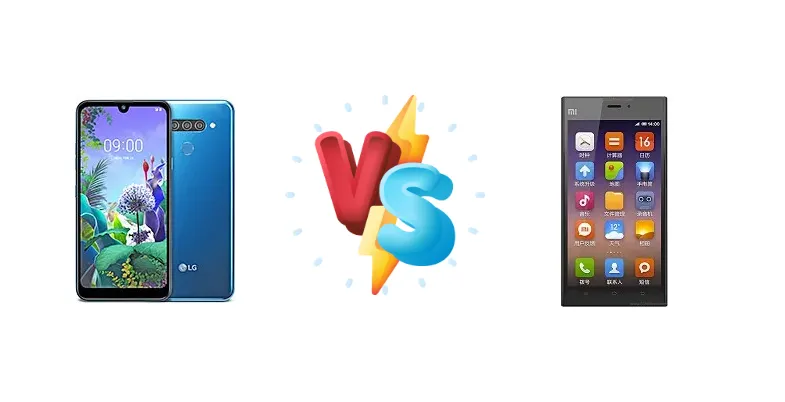
The smartphone landscape has dramatically shifted since the Xiaomi Mi 3 debuted in 2013. Now, we revisit this former flagship to see how it fares against the more recent LG Q60, a device representing the modern budget smartphone segment. This comparison isn't about raw specs; it's about understanding how architectural differences and age impact real-world usability.
🏆 Quick Verdict
For the average user in 2024, the Xiaomi Mi 3 surprisingly holds its own, and even edges out the LG Q60. While the Q60 benefits from a newer manufacturing process, the Snapdragon 800’s superior CPU architecture and available Quick Charge 2.0 support provide a smoother, more responsive experience, especially for demanding tasks.
| Network |
|---|
| 2G bands | GSM 850 / 900 / 1800 / 1900 | GSM 850 / 900 / 1800 / 1900 |
| 3G bands | HSDPA 850 / 900 / 1900 / 2100 | HSDPA 850 / 900 / 1900 / 2100 |
| 4G bands | 1, 3, 7, 8, 20, 38 | - |
| Speed | HSPA 42.2/5.76 Mbps, LTE (2CA) Cat6 300/75 Mbps | HSPA 42.2/5.76 Mbps |
| Technology | GSM / HSPA / LTE | GSM / HSPA |
| Launch |
|---|
| Announced | 2019, February. Released 2019, May | 2013, September. Released 2013, December |
| Status | Discontinued | Discontinued |
| Body |
|---|
| Build | - | Glass front (Gorilla Glass 3), plastic back, plastic frame |
| Dimensions | 161.3 x 77 x 8.7 mm (6.35 x 3.03 x 0.34 in) | 144 x 73.6 x 8.1 mm (5.67 x 2.90 x 0.32 in) |
| SIM | · Nano-SIM· Nano-SIM + Nano-SIM | Mini-SIM |
| Weight | 172 g (6.07 oz) | 145 g (5.11 oz) |
| | MIL-STD-810G compliant*
*does not guarantee ruggedness or use in extreme conditions | - |
| Display |
|---|
| Protection | - | Corning Gorilla Glass 3 |
| Resolution | 720 x 1520 pixels, 19:9 ratio (~269 ppi density) | 1080 x 1920 pixels, 16:9 ratio (~441 ppi density) |
| Size | 6.26 inches, 97.8 cm2 (~78.8% screen-to-body ratio) | 5.0 inches, 68.9 cm2 (~65.0% screen-to-body ratio) |
| Type | IPS LCD | IPS LCD |
| Platform |
|---|
| CPU | Octa-core 2.0 GHz Cortex-A53 | Quad-core 2.3 GHz Krait 400 |
| Chipset | Mediatek MT6762 Helio P22 (12 nm) | Qualcomm MSM8274AB Snapdragon 800 (28 nm) |
| GPU | PowerVR GE8320 | Adreno 330 |
| OS | Android 9.0 (Pie), LG UX 7 | Android 4.3 (Jelly Bean), upgradable to 6.0 (Marshmallow), MIUI 5 |
| Memory |
|---|
| Card slot | microSDXC (dedicated slot) | No |
| Internal | 64GB 3GB RAM | 16GB 2GB RAM, 64GB 2GB RAM |
| | eMMC 5.1 | eMMC 4.5 |
| Main Camera |
|---|
| Features | LED flash, panorama, HDR | Dual-LED flash, HDR |
| Single | - | 13 MP, f/2.2, 28mm (wide), AF |
| Triple | 16 MP, f/2.0, 26mm (wide), PDAF
5 MP, f/2.2, 13mm (ultrawide)
Auxiliary lens | - |
| Video | 1080p@30fps | 1080p@30fps, HDR |
| Selfie camera |
|---|
| Single | 13 MP, 1/3.1", 1.12µm | 2 MP, f/2.2 |
| Video | 1080p@30fps | 1080p@30fps |
| Sound |
|---|
| 3.5mm jack | Yes | Yes |
| 35mm jack | Yes | Yes |
| Loudspeaker | Yes | Yes |
| Comms |
|---|
| Bluetooth | 5.0, A2DP, LE | 4.0, A2DP |
| NFC | Yes | Yes |
| Positioning | GPS, GLONASS | GPS, GLONASS |
| Radio | No | FM radio |
| USB | microUSB 2.0 | microUSB 2.0, OTG |
| WLAN | Wi-Fi 802.11 a/b/g/n/ac, dual-band, Wi-Fi Direct, DLNA | Wi-Fi 802.11 a/b/g/n, dual-band, Wi-Fi Direct, hotspot |
| Features |
|---|
| Sensors | Fingerprint (rear-mounted), accelerometer, proximity, compass | Accelerometer, gyro, proximity, compass, barometer |
| Battery |
|---|
| Charging | - | 18W wired, QC2 |
| Music play | - | Up to 50 h |
| Stand-by | - | Up to 500 h |
| Talk time | - | Up to 25 h |
| Type | Li-Ion 3500 mAh, non-removable | Li-Ion 3050 mAh, non-removable |
| Misc |
|---|
| Colors | New Moroccan Blue, Aurora Black | White, Gray, Black, Yellow, Pink, Blue, Gold, Green |
| Models | LMX525EAW, LMX525BAW, LM-X525 | - |
| Price | About 230 EUR | About 200 EUR |
| Tests |
|---|
| Audio quality | - |
Noise -91.5dB / Crosstalk -44.2dB |
| Battery life | - | Endurance rating 66h |
| Camera | - |
Photo / Video |
| Display | - |
Contrast ratio: 907 (nominal), 2.001 (sunlight) |
| Loudspeaker | - |
Voice 69dB / Noise 66dB / Ring 75dB |
LG Q60
- More modern manufacturing process (12nm)
- Potentially better color accuracy
- Guaranteed software support (though limited)
- Weaker CPU performance
- Slower charging speeds
- Less capable chipset overall
Xiaomi Mi 3
- Superior CPU architecture (Krait 400)
- Faster charging with Quick Charge 2.0
- Potentially better camera hardware
- Older chipset and manufacturing process (28nm)
- Limited software support and potential security vulnerabilities
- Potential for screen burn-in or discoloration
Display Comparison
Both the LG Q60 and Xiaomi Mi 3 share a contrast ratio of 907 (nominal) and 2001 (sunlight), suggesting similar outdoor visibility. However, the Mi 3’s display technology is unknown, while the Q60 likely utilizes an IPS LCD. The Q60’s newer manufacturing likely results in slightly better color accuracy and viewing angles, but the difference is unlikely to be significant. The Mi 3’s age means potential for screen burn-in or discoloration should be considered.
Camera Comparison
Both devices offer photo and video capabilities, but detailed camera specs are lacking. Given the Mi 3’s flagship status, it likely featured a more sophisticated image signal processor (ISP) and potentially a larger sensor than the Q60. However, image processing algorithms have improved significantly since 2013, potentially giving the Q60 an edge in certain scenarios. Without specific sensor size or aperture information, a definitive camera comparison is impossible, but the Mi 3 likely holds an advantage in image quality due to its original hardware capabilities.
Performance
The core difference lies in the chipsets. The Xiaomi Mi 3’s Qualcomm Snapdragon 800 (28nm) features a quad-core 2.3 GHz Krait 400 CPU, an architecture designed for high single-core performance. The LG Q60’s MediaTek Helio P22 (12nm) utilizes an octa-core 2.0 GHz Cortex-A53 CPU, prioritizing efficiency over raw power. While the P22 has more cores, the Krait 400’s superior IPC (Instructions Per Clock) gives the Mi 3 a significant advantage in CPU-bound tasks. The older 28nm process of the Snapdragon 800 will generate more heat, but the Mi 3’s thermal design was adequate for its time. The Q60’s 12nm process offers better efficiency, but the weaker CPU struggles with multitasking and demanding apps.
Battery Life
Both phones boast an endurance rating of 66 hours, indicating similar battery life under typical usage. However, the Mi 3’s 18W wired charging with Quick Charge 2.0 support is a significant advantage over the Q60’s unspecified charging speed. Quick Charge 2.0 allows for faster charging times, reducing downtime. While the Q60’s more efficient chipset might slightly offset the Mi 3’s faster charging, the convenience of Quick Charge is a notable benefit.
Buying Guide
Buy the LG Q60 if you prioritize a guaranteed, modern software experience with potential for updates (though limited) and are primarily focused on basic smartphone tasks like calling, texting, and light social media. Buy the Xiaomi Mi 3 if you value raw performance for the price, are comfortable with potentially limited software support, and enjoy tinkering with older devices. The Mi 3 is a compelling option for those seeking a surprisingly capable device on an extremely tight budget.
Frequently Asked Questions
❓ Is the Xiaomi Mi 3 still secure to use in 2024, given its age?
Security is a major concern with older devices. The Xiaomi Mi 3 likely no longer receives security updates, making it vulnerable to exploits. Using it for sensitive tasks like online banking is strongly discouraged. Consider using a custom ROM with active security updates if you choose to use it.
❓ Will the Snapdragon 800 in the Mi 3 struggle with modern apps?
While the Snapdragon 800 is surprisingly capable, it will struggle with some of the most demanding modern apps and games. Expect reduced frame rates and potential lag in graphically intensive titles. However, for everyday tasks like browsing, social media, and video playback, it should perform adequately.
❓ Does the LG Q60 offer a significantly better software experience than the Mi 3?
The LG Q60 benefits from a more recent Android version and potentially some software updates, offering a more polished and secure experience out of the box. However, LG’s software support for the Q60 is limited, and it won’t receive updates for as long as more current devices.
❓ What kind of battery life can I realistically expect from the Xiaomi Mi 3 today?
The battery in the Mi 3 has likely degraded over time. While it originally had a 66-hour endurance rating, expect significantly less – potentially 30-40 hours with moderate use. Battery replacement is an option, but finding a compatible battery may be challenging.