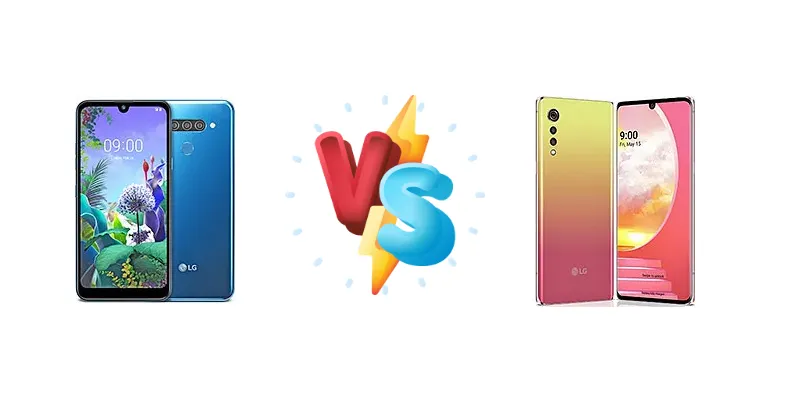
The LG Q60 represented a solid budget offering in its time, but the LG Velvet 5G arrived as a more ambitious mid-range contender with 5G connectivity and a significantly upgraded chipset. This comparison dissects the core differences between these two LG devices, helping you determine if the Velvet 5G’s advancements justify the higher investment.
🏆 Quick Verdict
For most users, the LG Velvet 5G is the superior choice. Its Snapdragon 765G chipset delivers substantially better performance, and the inclusion of 5G future-proofs the device. While the Q60 remains a viable option for basic tasks, the Velvet 5G offers a more compelling overall experience.
| Network |
|---|
| 2G bands | GSM 850 / 900 / 1800 / 1900 | GSM 850 / 900 / 1800 / 1900 |
| 3G bands | HSDPA 850 / 900 / 1900 / 2100 | HSDPA 850 / 900 / 1900 / 2100 |
| 4G bands | 1, 3, 7, 8, 20, 38 | 1, 2, 3, 4, 5, 7, 8, 12, 17, 20, 28, 32, 38, 39, 40, 41 |
| 5G bands | - | 1, 3, 28, 78 SA/NSA |
| Speed | HSPA 42.2/5.76 Mbps, LTE (2CA) Cat6 300/75 Mbps | HSPA 42.2/5.76 Mbps, LTE (5CA) Cat16 1000/75 Mbps, 5G 2Gbps |
| Technology | GSM / HSPA / LTE | GSM / HSPA / LTE / 5G |
| Launch |
|---|
| Announced | 2019, February. Released 2019, May | 2020, May 07. Released 2020, May 15 |
| Status | Discontinued | Discontinued |
| Body |
|---|
| Build | - | Glass front, glass back, aluminum frame |
| Dimensions | 161.3 x 77 x 8.7 mm (6.35 x 3.03 x 0.34 in) | 167.2 x 74.1 x 7.9 mm (6.58 x 2.92 x 0.31 in) |
| SIM | · Nano-SIM· Nano-SIM + Nano-SIM | Nano-SIM + Nano-SIM |
| Weight | 172 g (6.07 oz) | 180 g (6.35 oz) |
| | MIL-STD-810G compliant*
*does not guarantee ruggedness or use in extreme conditions | IP68 dust/water resistant (up to 1.5m for 30 mins)
MIL-STD-810G compliant*
*does not guarantee ruggedness or use in extreme conditions |
| Display |
|---|
| Resolution | 720 x 1520 pixels, 19:9 ratio (~269 ppi density) | 1080 x 2460 pixels (~395 ppi density) |
| Size | 6.26 inches, 97.8 cm2 (~78.8% screen-to-body ratio) | 6.8 inches, 109.8 cm2 (~88.6% screen-to-body ratio) |
| Type | IPS LCD | P-OLED |
| Platform |
|---|
| CPU | Octa-core 2.0 GHz Cortex-A53 | Octa-core (1x2.4 GHz Kryo 475 Prime & 1x2.2 GHz Kryo 475 Gold & 6x1.8 GHz Kryo 475 Silver) |
| Chipset | Mediatek MT6762 Helio P22 (12 nm) | Qualcomm SM7250 Snapdragon 765G 5G (7 nm) |
| GPU | PowerVR GE8320 | Adreno 620 |
| OS | Android 9.0 (Pie), LG UX 7 | Android 10, upgradable to Android 13, LG UX |
| Memory |
|---|
| Card slot | microSDXC (dedicated slot) | microSDXC (uses shared SIM slot) |
| Internal | 64GB 3GB RAM | 128GB 6GB RAM, 128GB 8GB RAM |
| | eMMC 5.1 | UFS 2.1 |
| Main Camera |
|---|
| Features | LED flash, panorama, HDR | LED flash, panorama, HDR |
| Triple | 16 MP, f/2.0, 26mm (wide), PDAF
5 MP, f/2.2, 13mm (ultrawide)
Auxiliary lens | 48 MP, f/1.8, 26mm (wide), 1/2.0", 0.8µm, PDAF
8 MP, f/2.2, 120˚, 15mm (ultrawide), 1/4.0", 1.12µm
Auxiliary lens |
| Video | 1080p@30fps | 4K@30fps, 1080p@30/60fps, gyro-EIS |
| Selfie camera |
|---|
| Features | - | HDR |
| Single | 13 MP, 1/3.1", 1.12µm | 16 MP, f/1.9, 29mm (standard), 1/3.06, 1.0µm |
| Video | 1080p@30fps | 1080p@30fps |
| Sound |
|---|
| 3.5mm jack | Yes | Yes |
| 35mm jack | Yes | Yes |
| Loudspeaker | Yes | Yes, with stereo speakers |
| Comms |
|---|
| Bluetooth | 5.0, A2DP, LE | 5.1, A2DP, LE, aptX HD |
| NFC | Yes | Yes |
| Positioning | GPS, GLONASS | GPS (L1+L5), GLONASS, BDS, GALILEO, QZSS |
| Radio | No | FM radio (market/region dependent) |
| USB | microUSB 2.0 | USB Type-C, OTG |
| WLAN | Wi-Fi 802.11 a/b/g/n/ac, dual-band, Wi-Fi Direct, DLNA | Wi-Fi 802.11 a/b/g/n/ac, dual-band, Wi-Fi Direct, DLNA |
| Features |
|---|
| Sensors | Fingerprint (rear-mounted), accelerometer, proximity, compass | Fingerprint (under display, optical), accelerometer, gyro, proximity, compass, barometer |
| Battery |
|---|
| Charging | - | 25W wired, PD3.0, QC4
9W wireless |
| Type | Li-Ion 3500 mAh, non-removable | Li-Po 4300 mAh |
| Misc |
|---|
| Colors | New Moroccan Blue, Aurora Black | Aurora White, Aurora Green, Aurora Gray, Illusion Sunset, Red, Pink |
| Models | LMX525EAW, LMX525BAW, LM-X525 | LM-G900N, LM-G900EM, LM-G900, LM-G900TM |
| Price | About 230 EUR | About 470 EUR |
| SAR | - | 0.23 W/kg (head) 1.02 W/kg (body) |
| Tests |
|---|
| Battery life | - | Endurance rating 79h |
| Camera | - |
Photo / Video |
| Display | - |
Contrast ratio: Infinite (nominal) |
| Loudspeaker | - |
-23.5 LUFS (Very good) |
| Performance | - |
AnTuTu: 297372 (v8)
GeekBench: 1905 (v5.1)
GFXBench: 16fps (ES 3.1 onscreen) |
LG Q60
- Extremely affordable price point
- Decent battery life for basic usage
- Lightweight and compact design
- Weak performance with Helio P22 chipset
- Limited camera capabilities
- No 5G connectivity
LG Velvet 5G
- Significantly faster performance with Snapdragon 765G
- 5G connectivity for future-proofed data speeds
- Faster charging with 25W wired and 9W wireless
- Higher price compared to the Q60
- May experience some thermal throttling under heavy load
- Larger size and weight than the Q60
Display Comparison
The LG Velvet 5G boasts a significantly brighter display, reaching 617 nits measured, compared to an unspecified brightness for the Q60. This higher peak brightness translates to better visibility outdoors. While both displays are described as having an 'infinite' contrast ratio (a common marketing term), the Velvet’s panel likely benefits from the more powerful image processing capabilities of the Snapdragon 765G, resulting in more vibrant and accurate colors. The Q60’s display, being on a budget device, likely uses a less sophisticated panel technology, potentially impacting viewing angles and color reproduction.
Camera Comparison
Both phones feature photo and video capabilities, but the Velvet 5G’s camera system benefits from the superior image signal processor (ISP) within the Snapdragon 765G. While specific sensor details are missing, the Velvet 5G’s ISP enables features like improved low-light performance, faster autofocus, and more sophisticated image processing algorithms. The Q60’s Helio P22 chipset lacks the processing power to deliver comparable image quality. It's reasonable to assume the Velvet 5G also has a more advanced camera module overall, potentially including optical image stabilization (OIS) which is absent on most phones in the Q60's price bracket.
Performance
The core difference lies in the chipsets: the LG Q60 utilizes the Mediatek Helio P22, a 12nm process chip with Cortex-A53 cores clocked at 2.0 GHz. The Velvet 5G, however, is powered by the Qualcomm Snapdragon 765G, built on a more efficient 7nm process. This translates to a substantial performance leap. The Snapdragon 765G’s Kryo 475 CPU architecture (with Prime, Gold, and Silver cores) is far more capable than the Helio P22’s homogenous Cortex-A53 setup, offering better multitasking and responsiveness. The 7nm process also contributes to improved thermal management, reducing the likelihood of performance throttling during sustained workloads. The Velvet 5G is demonstrably better suited for gaming and demanding applications.
Battery Life
Both devices share an endurance rating of 79 hours, suggesting similar overall battery life despite the Velvet 5G’s more powerful components. This is likely due to the Snapdragon 765G’s 7nm efficiency offsetting its increased performance. However, the Velvet 5G offers significantly faster charging capabilities with 25W wired charging (supporting PD3.0 and QC4) and 9W wireless charging, compared to the Q60’s unspecified charging speed. This means the Velvet 5G can be topped up much more quickly, minimizing downtime.
Buying Guide
Buy the LG Q60 if you prioritize extreme affordability and only need a phone for essential communication and light tasks. It’s a good fit for first-time smartphone users or those on a very tight budget. Buy the LG Velvet 5G if you want a smoother, faster experience, 5G connectivity for faster data speeds, and a more capable camera system. It’s ideal for users who stream video, play mobile games, or rely on their phone for productivity.
Frequently Asked Questions
❓ Does the Snapdragon 765G in the Velvet 5G get noticeably warmer than the Helio P22 in the Q60 during extended gaming sessions?
Yes, the Snapdragon 765G will generate more heat under load due to its higher performance. However, the 7nm process and the Velvet 5G’s thermal design should mitigate significant throttling. The Q60’s Helio P22 will remain cooler, but at the cost of significantly reduced gaming performance.
❓ Is the 5G connectivity on the Velvet 5G actually useful if I don't live in an area with widespread 5G coverage?
Even without immediate 5G access, the Velvet 5G’s 5G modem offers future-proofing. It also supports sub-6GHz 5G, which has broader coverage than mmWave. Furthermore, the modem often provides improved 4G LTE performance even in areas without 5G.
❓ How much faster is the charging speed on the Velvet 5G compared to the Q60?
The Velvet 5G supports 25W wired charging with PD3.0 and QC4, allowing for a full charge in approximately 1 hour and 30 minutes (estimated). The Q60’s charging speed is unspecified but is likely significantly slower, potentially taking over 3 hours for a full charge.