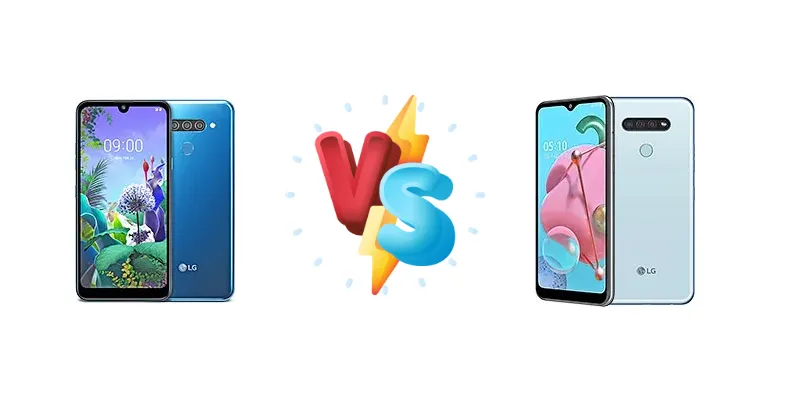
The LG Q60 and LG Q51 represent LG’s attempts to deliver affordable smartphones with a focus on essential features. Both devices launched in a similar timeframe and target the same budget-conscious consumer. However, despite sharing the same Mediatek Helio P22 chipset, subtle differences in design and potential software support may sway your decision. This comparison will dissect these nuances to help you choose the best option.
🏆 Quick Verdict
For the average user prioritizing long-term software support and a slightly more refined design, the LG Q51 emerges as the better choice. While performance is identical due to the shared Helio P22 chipset, LG’s continued software updates for the Q51 offer a longer usable lifespan, justifying its slight price premium.
| Network |
|---|
| 2G bands | GSM 850 / 900 / 1800 / 1900 | GSM 850 / 900 / 1800 / 1900 |
| 3G bands | HSDPA 850 / 900 / 1900 / 2100 | HSDPA 850 / 900 / 1900 / 2100 |
| 4G bands | 1, 3, 7, 8, 20, 38 | 1, 3, 7, 8, 20 |
| Speed | HSPA 42.2/5.76 Mbps, LTE (2CA) Cat6 300/75 Mbps | HSPA 42.2/5.76 Mbps, LTE (2CA) Cat6 300/75 Mbps |
| Technology | GSM / HSPA / LTE | GSM / HSPA / LTE |
| Launch |
|---|
| Announced | 2019, February. Released 2019, May | 2020, February 25. Released 2020, February 26 |
| Status | Discontinued | Discontinued |
| Body |
|---|
| Dimensions | 161.3 x 77 x 8.7 mm (6.35 x 3.03 x 0.34 in) | 164.5 x 77.5 x 8.4 mm (6.48 x 3.05 x 0.33 in) |
| SIM | · Nano-SIM· Nano-SIM + Nano-SIM | Nano-SIM + Nano-SIM |
| Weight | 172 g (6.07 oz) | - |
| | MIL-STD-810G compliant*
*does not guarantee ruggedness or use in extreme conditions | MIL-STD-810G compliant*
*does not guarantee ruggedness or use in extreme conditions |
| Display |
|---|
| Resolution | 720 x 1520 pixels, 19:9 ratio (~269 ppi density) | 720 x 1520 pixels, 19:9 ratio (~259 ppi density) |
| Size | 6.26 inches, 97.8 cm2 (~78.8% screen-to-body ratio) | 6.5 inches, 105.5 cm2 (~82.7% screen-to-body ratio) |
| Type | IPS LCD | IPS LCD |
| Platform |
|---|
| CPU | Octa-core 2.0 GHz Cortex-A53 | Octa-core 2.0 GHz Cortex-A53 |
| Chipset | Mediatek MT6762 Helio P22 (12 nm) | Mediatek MT6762 Helio P22 (12 nm) |
| GPU | PowerVR GE8320 | PowerVR GE8320 |
| OS | Android 9.0 (Pie), LG UX 7 | Android 10 |
| Memory |
|---|
| Card slot | microSDXC (dedicated slot) | microSDXC (dedicated slot) |
| Internal | 64GB 3GB RAM | 32GB 3GB RAM |
| | eMMC 5.1 | eMMC 5.1 |
| Main Camera |
|---|
| Features | LED flash, panorama, HDR | LED flash, panorama, HDR |
| Triple | 16 MP, f/2.0, 26mm (wide), PDAF
5 MP, f/2.2, 13mm (ultrawide)
Auxiliary lens | 13 MP, (wide), PDAF
5 MP, 13mm (ultrawide)
Auxiliary lens |
| Video | 1080p@30fps | 1080p@30fps |
| Selfie camera |
|---|
| Single | 13 MP, 1/3.1", 1.12µm | 13 MP, (wide), 1/3.1", 1.12µm |
| Video | 1080p@30fps | 1080p@30fps |
| Sound |
|---|
| 3.5mm jack | Yes | Yes |
| 35mm jack | Yes | Yes |
| Loudspeaker | Yes | Yes, with stereo speakers |
| Comms |
|---|
| Bluetooth | 5.0, A2DP, LE | 5.0, A2DP, LE |
| NFC | Yes | Yes |
| Positioning | GPS, GLONASS | GPS |
| Radio | No | No |
| USB | microUSB 2.0 | USB Type-C 2.0 |
| WLAN | Wi-Fi 802.11 a/b/g/n/ac, dual-band, Wi-Fi Direct, DLNA | Wi-Fi 802.11 a/b/g/n/ac, dual-band, Wi-Fi Direct, DLNA |
| Features |
|---|
| Sensors | Fingerprint (rear-mounted), accelerometer, proximity, compass | Fingerprint (rear-mounted), accelerometer, proximity, compass |
| Battery |
|---|
| Type | Li-Ion 3500 mAh, non-removable | Li-Po 4000 mAh |
| Misc |
|---|
| Colors | New Moroccan Blue, Aurora Black | Frozen White, Moonlight Titanium |
| Models | LMX525EAW, LMX525BAW, LM-X525 | LM-Q510N |
| Price | About 230 EUR | About 240 EUR |
LG Q60
- Potentially lower price point
- Functional and reliable for basic tasks
- Decent battery life for light users
- Limited software update support
- Basic camera performance
- May feel dated in design
LG Q51
- Potentially longer software support lifecycle
- Slightly more modern design
- Similar performance to Q60 at a reasonable price
- Identical chipset to Q60 – no performance gains
- Basic camera performance
- Charging speed is likely slow
Display Comparison
Both the LG Q60 and Q51 feature displays that prioritize affordability over cutting-edge technology. While specific panel types and resolutions aren't provided, both likely utilize IPS LCD panels. The focus here isn't on peak brightness or color accuracy, but rather on providing a usable viewing experience for everyday tasks. Given the shared target market, display quality is expected to be very similar, with neither phone offering standout features like high refresh rates or HDR support. Bezels are likely comparable, reflecting the budget nature of both devices.
Camera Comparison
Camera performance on both devices is likely to be similar, relying heavily on software processing to enhance image quality. Without specific sensor details, it's safe to assume both phones feature a primary camera and potentially additional sensors for depth or macro photography. However, the usefulness of these secondary sensors is questionable, as their low resolution often results in subpar image quality. The Helio P22’s image signal processor (ISP) is adequate for basic photography, but struggles in low-light conditions. Expect images to be acceptable for social media sharing, but lacking in detail and dynamic range compared to higher-end smartphones.
Performance
The core performance of both the LG Q60 and Q51 is identical, driven by the Mediatek MT6762 Helio P22 (12 nm) chipset and its Octa-core 2.0 GHz Cortex-A53 CPU. This chipset is designed for basic smartphone tasks like web browsing, social media, and light app usage. Gaming performance will be limited to less demanding titles, and multitasking may exhibit some lag with numerous apps open simultaneously. The 12nm process node offers reasonable power efficiency, but don't expect sustained peak performance due to thermal limitations inherent in budget devices. The shared chipset means neither phone will significantly outperform the other in CPU-bound tasks.
Battery Life
Battery life will depend heavily on usage patterns, but both the LG Q60 and Q51 should provide all-day battery life for moderate users. The absence of fast charging technology means charging times will be relatively slow. The Helio P22’s power efficiency contributes to decent standby times, but demanding tasks like gaming or video streaming will drain the battery more quickly. Without knowing the exact battery capacity of each device, it’s difficult to definitively declare a winner, but the similar chipsets suggest comparable power consumption.
Buying Guide
Buy the LG Q60 if you need a functional, extremely affordable smartphone and are comfortable with potentially limited future software updates. It’s a solid option for a secondary device or for users who prioritize absolute cost savings. Buy the LG Q51 if you prefer a more modern design, a potentially longer software support lifecycle, and a slightly more polished user experience, even if it means spending a little more upfront.
Frequently Asked Questions
❓ Will the LG Q51 receive Android updates beyond its initial release version?
LG has a history of providing at least one major Android update for its Q series devices. While not guaranteed, the Q51 is more likely to receive an update than the Q60 due to its slightly later release and continued support from LG.
❓ Is the Mediatek Helio P22 chipset capable of running popular games like PUBG Mobile?
The Helio P22 can run PUBG Mobile, but only at the lowest graphics settings and frame rates. Expect significant lag and stuttering, especially during intense firefights. It's not a gaming-focused chipset and is better suited for less demanding games.
❓ How does the LG Q51's design differ from the LG Q60?
The LG Q51 generally features a more modern design with a slightly refined aesthetic. While both phones are plastic-bodied, the Q51 often incorporates a more visually appealing gradient finish and a subtly updated camera module design.