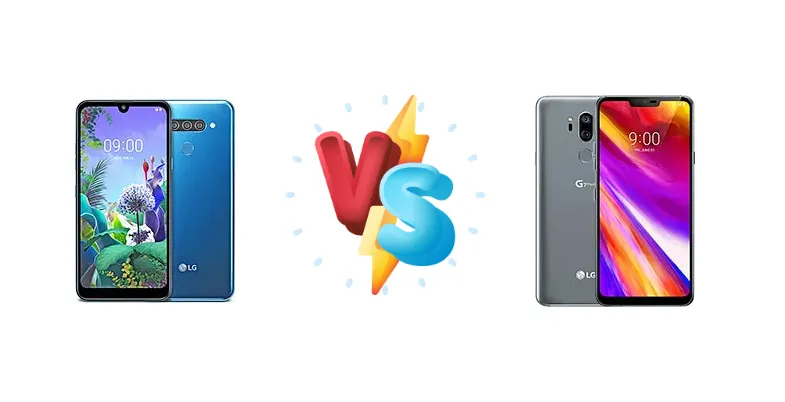
The LG G7 ThinQ, released as a 2018 flagship, represents a peak in LG's smartphone engineering. The LG Q60, launched later, targets the budget-conscious market. This comparison dissects the core differences between these two devices, helping you determine if the G7's premium features justify its likely higher price, or if the Q60's affordability is a better fit.
🏆 Quick Verdict
For most users, the LG G7 ThinQ is the superior choice. Its Snapdragon 845 chipset provides a dramatically faster and smoother experience than the Q60’s Helio P22, especially for demanding tasks like gaming and video editing. While the Q60 offers value, the G7’s performance and faster charging are worth the investment.
| Network |
|---|
| 2G bands | GSM 850 / 900 / 1800 / 1900 | GSM 850 / 900 / 1800 / 1900 |
| 3G bands | HSDPA 850 / 900 / 1900 / 2100 | HSDPA 850 / 900 / 1900 / 2100 - Global |
| 4G bands | 1, 3, 7, 8, 20, 38 | 1, 3, 4, 5, 7, 8, 12, 17, 20, 28, 32, 38, 40, 42, 46 - Global |
| Speed | HSPA 42.2/5.76 Mbps, LTE (2CA) Cat6 300/75 Mbps | HSPA 42.2/5.76 Mbps, LTE (3CA) Cat16 1024/150 Mbps or Cat15 800/150 Mbps (region dependant) |
| Technology | GSM / HSPA / LTE | GSM / CDMA / HSPA / LTE |
| | - | 1, 3, 5, 7, 8, 28, 38, 39, 40, 41 - G710EMW, G710EAW1,2,3,4,5,7,8,12,13,17,20,25,29,30,38,41,46,66 - G710AWM |
| Launch |
|---|
| Announced | 2019, February. Released 2019, May | 2018, May 02. Released 2018, June 01 |
| Status | Discontinued | Discontinued |
| Body |
|---|
| Build | - | Glass front (Gorilla Glass 5), glass back (Gorilla Glass 5), aluminum frame |
| Dimensions | 161.3 x 77 x 8.7 mm (6.35 x 3.03 x 0.34 in) | 153.2 x 71.9 x 7.9 mm (6.03 x 2.83 x 0.31 in) |
| SIM | · Nano-SIM· Nano-SIM + Nano-SIM | · Nano-SIM· Nano-SIM + Nano-SIM |
| Weight | 172 g (6.07 oz) | 162 g (5.71 oz) |
| | MIL-STD-810G compliant*
*does not guarantee ruggedness or use in extreme conditions | IP68 dust/water resistant (up to 1.5m for 30 min)
MIL-STD-810G compliant*
*does not guarantee ruggedness or use in extreme conditions |
| Display |
|---|
| Protection | - | Corning Gorilla Glass 5 |
| Resolution | 720 x 1520 pixels, 19:9 ratio (~269 ppi density) | 1440 x 3120 pixels, 19.5:9 ratio (~564 ppi density) |
| Size | 6.26 inches, 97.8 cm2 (~78.8% screen-to-body ratio) | 6.1 inches, 91.0 cm2 (~82.6% screen-to-body ratio) |
| Type | IPS LCD | IPS LCD, HDR10 |
| | - | Always-on display |
| Platform |
|---|
| CPU | Octa-core 2.0 GHz Cortex-A53 | Octa-core (4x2.8 GHz Kryo 385 Gold & 4x1.7 GHz Kryo 385 Silver) |
| Chipset | Mediatek MT6762 Helio P22 (12 nm) | Qualcomm SDM845 Snapdragon 845 (10 nm) |
| GPU | PowerVR GE8320 | Adreno 630 |
| OS | Android 9.0 (Pie), LG UX 7 | Android 8.0 (Oreo), upgradable to Android 10 |
| Memory |
|---|
| Card slot | microSDXC (dedicated slot) | microSDXC (dedicated slot) - single-SIM modelmicroSDXC (uses shared SIM slot) - dual-SIM model |
| Internal | 64GB 3GB RAM | 64GB 4GB RAM, 128GB 6GB RAM |
| | eMMC 5.1 | UFS 2.1 |
| Main Camera |
|---|
| Dual | - | 16 MP, f/1.6, 30mm (standard), 1/3.1", 1.0µm, PDAF, OIS
16 MP, f/1.9, 16mm (ultrawide), 1/3.1", no AF |
| Features | LED flash, panorama, HDR | Laser AF, LED flash, HDR, panorama |
| Triple | 16 MP, f/2.0, 26mm (wide), PDAF
5 MP, f/2.2, 13mm (ultrawide)
Auxiliary lens | - |
| Video | 1080p@30fps | 4K@30/60fps, 1080p@30/60fps, 720p@240fps, HDR, 24-bit/192kHz stereo sound rec. |
| Selfie camera |
|---|
| Single | 13 MP, 1/3.1", 1.12µm | 8 MP, f/1.9, 26mm (wide) |
| Video | 1080p@30fps | 1080p@60fps |
| Sound |
|---|
| 3.5mm jack | Yes | Yes |
| 35mm jack | Yes | Yes |
| Loudspeaker | Yes | Yes |
| | - | 32-bit/192kHz audio |
| Comms |
|---|
| Bluetooth | 5.0, A2DP, LE | 5.0, A2DP, LE, aptX HD |
| NFC | Yes | Yes |
| Positioning | GPS, GLONASS | GPS, GLONASS, BDS |
| Radio | No | FM radio |
| USB | microUSB 2.0 | USB Type-C 3.1, OTG |
| WLAN | Wi-Fi 802.11 a/b/g/n/ac, dual-band, Wi-Fi Direct, DLNA | Wi-Fi 802.11 a/b/g/n/ac, dual-band, Wi-Fi Direct, DLNA |
| Features |
|---|
| Sensors | Fingerprint (rear-mounted), accelerometer, proximity, compass | Fingerprint (rear-mounted), accelerometer, gyro, proximity, compass, barometer |
| Battery |
|---|
| Charging | - | 18W wired, QC3
Wireless (USA) |
| Type | Li-Ion 3500 mAh, non-removable | Li-Po 3000 mAh, non-removable |
| Misc |
|---|
| Colors | New Moroccan Blue, Aurora Black | New Platinum Gray, New Aurora Black, New Moroccan Blue, Raspberry Rose |
| Models | LMX525EAW, LMX525BAW, LM-X525 | LM-G710, LM-G710N, LM-G710VM, G710, SM-G710, LM-G710V |
| Price | About 230 EUR | About 370 EUR |
| SAR EU | - | 0.24 W/kg (head) 1.47 W/kg (body) |
| Tests |
|---|
| Audio quality | - |
Noise -94.0dB / Crosstalk -93.0dB |
| Battery life | - |
Endurance rating 77h
|
| Camera | - |
Photo / Video |
| Display | - |
Contrast ratio: 2044:1 (nominal), 3.978 (sunlight) |
| Loudspeaker | - |
-24.5 LUFS (Very good)
|
| Performance | - |
AnTuTu: 259393 (v7), 297116 (v8)
GeekBench: 8865 (v4.4), 2047 (v5.1)
GFXBench: 18fps (ES 3.1 onscreen) |
LG Q60
- Extremely affordable price point.
- Decent battery endurance (77h).
- Functional for basic smartphone tasks.
- Weak performance due to Helio P22 chipset.
- Likely lower-quality display.
- Limited camera capabilities.
LG G7 ThinQ
- Flagship-level performance with Snapdragon 845.
- Fast charging (18W QC3).
- Superior camera system (likely).
- Higher price compared to the Q60.
- Battery life, while good, isn't exceptional.
- Older device, may not receive future software updates.
Display Comparison
Both the LG Q60 and G7 ThinQ share a contrast ratio of 2044:1 (nominal) and 3.978 (sunlight), suggesting similar outdoor visibility. However, the G7 likely benefits from a higher peak brightness and potentially better color calibration expected of a flagship device. The Q60’s display, while adequate, is likely constructed with cost-saving materials, potentially impacting color accuracy and viewing angles. The G7’s display technology, while not explicitly stated, would have been a higher-tier IPS LCD panel compared to the Q60.
Camera Comparison
Both phones are listed as having Photo/Video capabilities, but details are sparse. The G7 ThinQ, as a flagship, likely features a more sophisticated camera system with a larger sensor, optical image stabilization (OIS), and advanced image processing algorithms. While the Q60 may offer acceptable image quality in good lighting conditions, it will likely fall short in low-light scenarios and lack the dynamic range of the G7. The G7’s video recording capabilities would also be superior, potentially including features like 4K recording and advanced stabilization.
Performance
The performance gap between these devices is substantial. The LG G7 ThinQ’s Qualcomm Snapdragon 845 (10nm) is a flagship-level chipset featuring an octa-core CPU with Kryo 385 Gold (2.8 GHz) and Silver (1.7 GHz) cores. This architecture allows for efficient task allocation and high sustained performance. In contrast, the LG Q60 utilizes the MediaTek Helio P22 (12nm) with an octa-core 2.0 GHz Cortex-A53 CPU. The P22 is designed for entry-level smartphones and will struggle with demanding applications and multitasking. The 10nm process node of the Snapdragon 845 also contributes to better thermal efficiency, reducing throttling during prolonged use.
Battery Life
Both devices share an endurance rating of 77 hours, suggesting similar overall battery life under typical usage. However, the G7 ThinQ’s 18W Quick Charge 3.0 support provides significantly faster charging speeds compared to the Q60, which lacks any mention of fast charging. This means the G7 can replenish its battery much quicker, minimizing downtime. While the mAh capacity isn’t specified for either device, the G7’s more efficient chipset likely contributes to comparable battery life despite potentially having a smaller battery.
Buying Guide
Buy the LG Q60 if you prioritize extreme affordability and basic smartphone functionality – calls, texts, light social media, and occasional photos. It’s ideal for first-time smartphone users or those on a very tight budget. Buy the LG G7 ThinQ if you value performance, faster charging, and a more responsive user experience. It’s the better choice for gamers, content creators, and anyone who wants a phone that can handle demanding applications without slowdown.
Frequently Asked Questions
❓ Is the LG Q60 suitable for playing demanding games like PUBG Mobile?
The LG Q60’s MediaTek Helio P22 chipset is not well-suited for demanding games like PUBG Mobile. You’ll likely experience significant lag, low frame rates, and graphical compromises even on the lowest settings. The Snapdragon 845 in the G7 ThinQ provides a much smoother and more enjoyable gaming experience.
❓ Does the LG G7 ThinQ still receive software updates?
As an older device released in 2018, the LG G7 ThinQ’s software update support is limited. While it likely received updates to Android 10 or 11, it’s unlikely to receive further major Android version updates. Security patches may also be infrequent. The Q60, being a later release, might have slightly better ongoing support, but neither phone is guaranteed long-term updates.
❓ How much faster is the Snapdragon 845 in the G7 ThinQ compared to the Helio P22 in the Q60 in real-world use?
The Snapdragon 845 is *significantly* faster – roughly 2-3 times the performance in CPU-intensive tasks and even more in GPU-intensive tasks. This translates to noticeably quicker app loading times, smoother multitasking, and a far more responsive user interface on the G7 ThinQ. The Helio P22 will struggle with even moderately demanding apps.