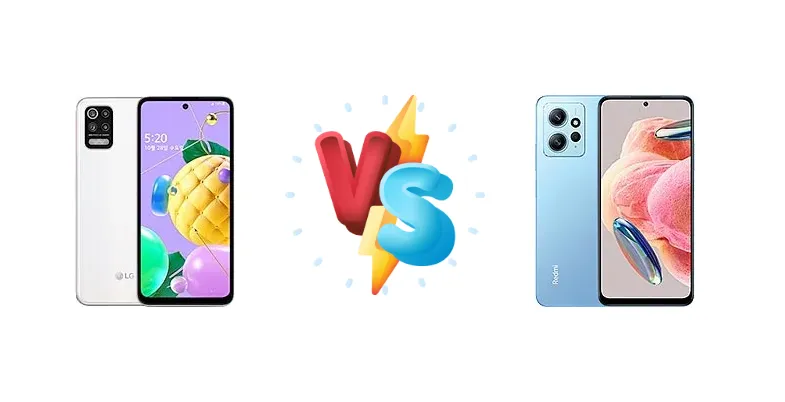
The LG Q52 and Xiaomi Redmi Note 12 4G represent two distinct approaches to the budget smartphone market. The Q52, while older, offers a familiar LG experience, while the Redmi Note 12 4G brings Qualcomm's Snapdragon series to a lower price point. This comparison dives deep into their specifications to determine which device delivers the best value.
🏆 Quick Verdict
For the average user, the Xiaomi Redmi Note 12 4G is the clear winner. Its Snapdragon 685 chipset, built on a more efficient 6nm process, provides a substantial performance advantage over the LG Q52’s Helio P35, making it better suited for multitasking and modern applications. While both offer similar battery endurance ratings, the Redmi Note 12 4G’s 33W charging is a significant convenience.
| Network |
|---|
| 2G bands | GSM 850 / 900 / 1800 / 1900 | GSM 850 / 900 / 1800 / 1900 |
| 3G bands | HSDPA 850 / 900 / 1900 / 2100 | HSDPA 850 / 900 / 2100 |
| 4G bands | LTE | 1, 3, 5, 7, 8, 20, 28, 38, 40, 41 |
| Speed | HSPA, LTE | HSPA, LTE, 5G |
| Technology | GSM / HSPA / LTE | GSM / HSPA / LTE |
| Launch |
|---|
| Announced | 2020, September 26. Released 2020, October 26 | 2023, March 23 |
| Status | Discontinued | Available. Released 2023, March 30 |
| Body |
|---|
| Build | - | Glass front (Gorilla Glass 3), plastic frame, plastic back |
| Dimensions | 165 x 76.7 x 8.4 mm (6.50 x 3.02 x 0.33 in) | 165.7 x 76 x 7.9 mm (6.52 x 2.99 x 0.31 in) |
| SIM | Nano-SIM + Nano-SIM | Nano-SIM + Nano-SIM |
| Weight | 186 g (6.56 oz) | 183.5 g (6.49 oz) |
| | MIL-STD-810G compliant*
*does not guarantee ruggedness or use in extreme conditions | IP53, dust and splash resistant |
| Display |
|---|
| Protection | - | Corning Gorilla Glass 3 |
| Resolution | 720 x 1600 pixels, 20:9 ratio (~266 ppi density) | 1080 x 2400 pixels, 20:9 ratio (~395 ppi density) |
| Size | 6.6 inches, 105.2 cm2 (~83.1% screen-to-body ratio) | 6.67 inches, 107.4 cm2 (~85.3% screen-to-body ratio) |
| Type | IPS LCD | AMOLED, 120Hz, 450 nits (typ), 700 nits (HBM), 1200 nits (peak) |
| Platform |
|---|
| CPU | Octa-core (4x2.3 GHz Cortex-A53 & 4x1.8 GHz Cortex-A53) | Octa-core (4x2.8 GHz Cortex-A73 & 4x1.9 GHz Cortex-A53) |
| Chipset | Mediatek MT6765 Helio P35 (12 nm) | Qualcomm SM6225 Snapdragon 685 (6 nm) |
| GPU | PowerVR GE8320 | Adreno 610 |
| OS | Android 10 | Android 13, upgradable to Android 14, HyperOS |
| Memory |
|---|
| Card slot | microSDXC | microSDXC (dedicated slot) |
| Internal | 64GB 4GB RAM | 64GB 4GB RAM, 64GB 6GB RAM, 128GB 4GB RAM, 128GB 6GB RAM, 128GB 8GB RAM, 256GB 8GB RAM |
| | eMMC 5.1 | UFS 2.2 |
| Main Camera |
|---|
| Features | Dual-LED flash, panorama, HDR | LED flash, HDR, panorama |
| Quad | 48 MP, f/1.8, (wide), 1/2.0", 0.8µm, PDAF
5 MP, f/2.2, 115˚ (ultrawide), 1/5.0", 1.12µm
2 MP (macro)
Auxiliary lens | - |
| Triple | - | 50 MP, f/1.8, (wide), 1/2.76", 0.64µm, PDAF
8 MP, f/2.2, 120˚ (ultrawide), 1/4.0", 1.12µm
2 MP (macro) |
| Video | 1080p@30fps | 1080p@30fps |
| Selfie camera |
|---|
| Features | - | HDR |
| Single | 13 MP, (wide), 1/3.1", 1.12µm | 13 MP, f/2.5, (wide), 1/3.0" |
| Video | 1080p@30fps | 1080p@30fps |
| Sound |
|---|
| 3.5mm jack | Yes | Yes |
| 35mm jack | Yes | Yes |
| Loudspeaker | Yes | Yes |
| Comms |
|---|
| Bluetooth | 5.0, A2DP, LE | 5.0, A2DP, LE |
| Infrared port | - | Yes |
| NFC | Yes | Yes (market/region dependent) |
| Positioning | GPS | GPS, GLONASS, GALILEO |
| Radio | No | Unspecified |
| USB | USB Type-C 3.1 | USB Type-C 2.0, OTG |
| WLAN | Wi-Fi 802.11 a/b/g/n/ac, dual-band, Wi-Fi Direct | Wi-Fi 802.11 a/b/g/n/ac, dual-band |
| Features |
|---|
| Sensors | Fingerprint (side-mounted), accelerometer, proximity, compass | Fingerprint (side-mounted), accelerometer, gyro, proximity, compass |
| Battery |
|---|
| Charging | - | 33W wired |
| Type | Li-Po 4000 mAh | Li-Po 5000 mAh |
| Misc |
|---|
| Colors | Silky White, Silky Red | Onyx Gray, Mint Green, Ice Blue |
| Models | LM-Q520N | 23021RAAEG, 23021RAA2Y, 23027RAD4I, 23028RA60L |
| Price | About 240 EUR | £ 189.99 / € 107.98 / ₹ 9,998 |
| SAR | - | 1.09 W/kg (head) 0.89 W/kg (body) |
| SAR EU | - | 0.90 W/kg (head) 0.99 W/kg (body) |
| Tests |
|---|
| Battery life | - |
Endurance rating 117h
|
| Camera | - |
Photo / Video |
| Display | - |
Contrast ratio: Infinite (nominal) |
| Loudspeaker | - |
-27.9 LUFS (Good)
|
| Performance | - |
AnTuTu: 319219 (v9)
GeekBench: 1797 (v5.1), 1341 (v6)
GFXBench: 7.5fps (ES 3.1 onscreen) |
LG Q52
- Potentially lower price point (depending on availability)
- Simple and straightforward user interface
- Reliable brand reputation (LG, despite exiting the smartphone market)
- Significantly weaker performance compared to the Redmi Note 12 4G
- Less efficient chipset (Helio P35)
- Likely slower charging speeds
Xiaomi Redmi Note 12 4G
- Faster and more efficient Snapdragon 685 chipset
- 33W fast charging
- Brighter display for better outdoor visibility
- Xiaomi’s MIUI software can be polarizing
- Potential for bloatware
- Build quality may be less premium than some competitors
Display Comparison
The Xiaomi Redmi Note 12 4G boasts a significantly brighter display, reaching a measured 744 nits, compared to the LG Q52’s unspecified brightness. This higher peak brightness translates to better visibility outdoors. While both displays are described as having an infinite contrast ratio (typical for LCD/IPS panels), the Redmi Note 12 4G’s superior brightness is a key advantage. Details regarding panel technology (IPS vs. TFT) and color accuracy are missing for both devices, but given the price point, expectations should be tempered. Bezels are likely comparable, focusing on maximizing screen real estate within the budget constraints.
Camera Comparison
Both devices offer photo and video capabilities, but detailed camera specifications are limited. Without information on sensor size, aperture, or image processing algorithms, a direct comparison is difficult. However, the Redmi Note 12 4G likely benefits from Qualcomm’s image signal processor (ISP), which generally provides better image quality and faster processing speeds. The LG Q52’s camera system is likely more basic, relying on MediaTek’s ISP. The presence of a 2MP macro camera on the Redmi Note 12 4G is unlikely to be a significant selling point, as these sensors typically produce low-quality images. Focusing on the main sensor performance is crucial, and the Redmi Note 12 4G likely has an edge due to its more advanced chipset.
Performance
The performance gap between these two devices is substantial. The Redmi Note 12 4G’s Qualcomm Snapdragon 685, fabricated on a 6nm process, is a significant upgrade over the LG Q52’s MediaTek Helio P35 (12nm). The Snapdragon 685 features a more modern CPU architecture – 4x2.8 GHz Cortex-A73 cores alongside 4x1.9 GHz Cortex-A53 cores – compared to the Q52’s 4x2.3 GHz Cortex-A53 and 4x1.8 GHz Cortex-A53 configuration. The Cortex-A73 cores in the Snapdragon 685 offer a noticeable performance boost in single-core tasks and overall responsiveness. The 6nm process also contributes to better thermal efficiency, reducing the likelihood of performance throttling under sustained load. While both phones likely feature similar RAM configurations, the Snapdragon 685’s superior processing power will result in a smoother user experience.
Battery Life
Both the LG Q52 and Xiaomi Redmi Note 12 4G achieve an endurance rating of 117 hours, suggesting comparable battery life under similar usage conditions. However, the Redmi Note 12 4G’s 33W wired charging is a significant advantage over the LG Q52’s unspecified charging speed. 33W charging allows for a much faster 0-100% charge time, reducing downtime and increasing convenience. While battery capacity isn’t specified for either device, the Snapdragon 685’s 6nm process contributes to better power efficiency, potentially offsetting any minor capacity differences.
Buying Guide
Buy the LG Q52 if you prioritize a simple, straightforward user experience and are on an extremely tight budget, and don't require demanding performance. Buy the Xiaomi Redmi Note 12 4G if you value faster performance for apps and games, quicker charging, and a brighter, more modern display. The Redmi Note 12 4G is the better choice for users who want a phone that will remain usable for longer.
Frequently Asked Questions
❓ Is the Snapdragon 685 in the Redmi Note 12 4G capable of handling demanding games like PUBG Mobile?
The Snapdragon 685 is capable of running PUBG Mobile, but you'll likely need to lower the graphics settings to medium or low to achieve a smooth frame rate. While it's not a gaming powerhouse, it offers a significantly better gaming experience than the Helio P35 in the LG Q52.
❓ Does the Redmi Note 12 4G support VoLTE and VoWiFi for improved call quality?
Yes, the Xiaomi Redmi Note 12 4G generally supports VoLTE (Voice over LTE) and VoWiFi (Voice over Wi-Fi) depending on carrier compatibility. This ensures higher quality calls and seamless handover between cellular and Wi-Fi networks. Check with your specific carrier to confirm compatibility.
❓ How does the software experience differ between the LG Q52 and the Redmi Note 12 4G?
The LG Q52 runs a relatively clean and stock version of Android, offering a simpler user experience. The Redmi Note 12 4G runs Xiaomi’s MIUI, which is heavily customized and includes numerous features, but can also come with pre-installed bloatware. MIUI’s interface is different and may require some getting used to.