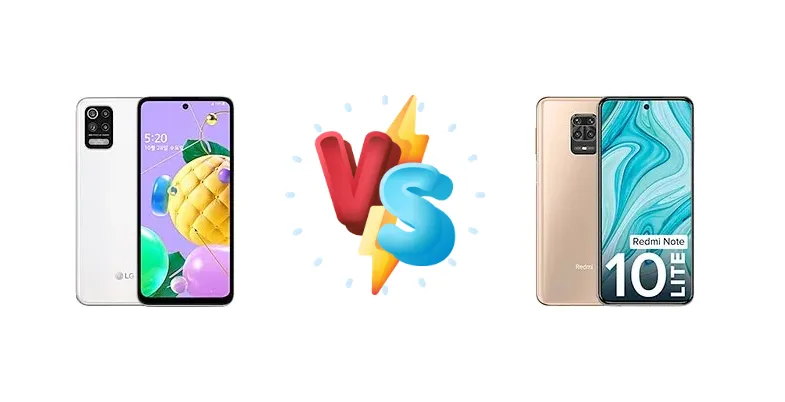
The LG Q52 and Xiaomi Redmi Note 10 Lite represent two distinct approaches to the budget smartphone market. The Q52, leveraging Mediatek's Helio P35, aims for affordability, while the Redmi Note 10 Lite, powered by Qualcomm's Snapdragon 720G, targets a more performance-oriented experience within the same price bracket. This comparison dissects their key differences to determine which device delivers the best value.
🏆 Quick Verdict
For the average user prioritizing responsiveness and future-proofing, the Xiaomi Redmi Note 10 Lite is the clear winner. Its Snapdragon 720G chipset, built on a more efficient 8nm process, offers significantly better performance and supports faster charging, making it a more compelling long-term investment despite a similar price point.
| Network |
|---|
| 2G bands | GSM 850 / 900 / 1800 / 1900 | GSM 850 / 900 / 1800 / 1900 |
| 3G bands | HSDPA 850 / 900 / 1900 / 2100 | HSDPA 850 / 900 / 1700(AWS) / 1900 / 2100 |
| 4G bands | LTE | 1, 2, 3, 4, 5, 7, 8, 20, 28, 38, 40, 41 |
| Speed | HSPA, LTE | HSPA, LTE |
| Technology | GSM / HSPA / LTE | GSM / HSPA / LTE |
| Launch |
|---|
| Announced | 2020, September 26. Released 2020, October 26 | 2021, October 01 |
| Status | Discontinued | Available. Released 2021, October 02 |
| Body |
|---|
| Build | - | Glass front (Gorilla Glass 5), glass back (Gorilla Glass 5), plastic frame |
| Dimensions | 165 x 76.7 x 8.4 mm (6.50 x 3.02 x 0.33 in) | 165.8 x 76.7 x 8.8 mm (6.53 x 3.02 x 0.35 in) |
| SIM | Nano-SIM + Nano-SIM | Nano-SIM + Nano-SIM |
| Weight | 186 g (6.56 oz) | 209 g (7.37 oz) |
| | MIL-STD-810G compliant*
*does not guarantee ruggedness or use in extreme conditions | Water-repellent coating |
| Display |
|---|
| Protection | - | Corning Gorilla Glass 5 |
| Resolution | 720 x 1600 pixels, 20:9 ratio (~266 ppi density) | 1080 x 2400 pixels, 20:9 ratio (~395 ppi density) |
| Size | 6.6 inches, 105.2 cm2 (~83.1% screen-to-body ratio) | 6.67 inches, 107.4 cm2 (~84.5% screen-to-body ratio) |
| Type | IPS LCD | IPS LCD |
| Platform |
|---|
| CPU | Octa-core (4x2.3 GHz Cortex-A53 & 4x1.8 GHz Cortex-A53) | Octa-core (2x2.3 GHz Kryo 465 Gold & 6x1.8 GHz Kryo 465 Silver) |
| Chipset | Mediatek MT6765 Helio P35 (12 nm) | Qualcomm SM7125 Snapdragon 720G (8 nm) |
| GPU | PowerVR GE8320 | Adreno 618 |
| OS | Android 10 | Android 10, MIUI 11 |
| Memory |
|---|
| Card slot | microSDXC | microSDXC (dedicated slot) |
| Internal | 64GB 4GB RAM | 64GB 4GB RAM, 64GB 6GB RAM, 128GB 4GB RAM, 128GB 6GB RAM |
| | eMMC 5.1 | - |
| Main Camera |
|---|
| Features | Dual-LED flash, panorama, HDR | LED flash, HDR, panorama |
| Quad | 48 MP, f/1.8, (wide), 1/2.0", 0.8µm, PDAF
5 MP, f/2.2, 115˚ (ultrawide), 1/5.0", 1.12µm
2 MP (macro)
Auxiliary lens | 48 MP, f/1.9, 26mm (wide), 0.8µm, PDAF
8 MP, f/2.2, 119˚ (ultrawide), 1/4.0", 1.12µm
5 MP (macro), AF
Auxiliary lens |
| Single | - | 16 MP, f/2.5, (wide), 1/3.06", 1.0µm |
| Video | 1080p@30fps | 4K@30fps, 1080p@30/60/120fps, 720p@960fps, gyro-EIS |
| Selfie camera |
|---|
| Features | - | HDR, panorama |
| Single | 13 MP, (wide), 1/3.1", 1.12µm | 16 MP, f/2.5, (wide), 1/3.06", 1.0µm |
| Video | 1080p@30fps | 1080p@30fps |
| Sound |
|---|
| 3.5mm jack | Yes | Yes |
| 35mm jack | Yes | Yes |
| Loudspeaker | Yes | Yes |
| Comms |
|---|
| Bluetooth | 5.0, A2DP, LE | 5.0, A2DP, LE |
| Infrared port | - | Yes |
| NFC | Yes | Yes |
| Positioning | GPS | GPS, GLONASS, GALILEO, BDS, NavIC |
| Radio | No | FM radio, recording |
| USB | USB Type-C 3.1 | USB Type-C 2.0 |
| WLAN | Wi-Fi 802.11 a/b/g/n/ac, dual-band, Wi-Fi Direct | Wi-Fi 802.11 a/b/g/n/ac, dual-band, Wi-Fi Direct |
| Features |
|---|
| Sensors | Fingerprint (side-mounted), accelerometer, proximity, compass | Fingerprint (side-mounted), accelerometer, gyro, proximity, compass |
| Battery |
|---|
| Charging | - | 18W wired |
| Type | Li-Po 4000 mAh | Li-Po 5020 mAh |
| Misc |
|---|
| Colors | Silky White, Silky Red | Aurora Blue, Glacier White, Interstellar Black, Champagne Gold |
| Models | LM-Q520N | M2002F4LG |
| Price | About 240 EUR | About 200 EUR |
| SAR | - | 1.17 W/kg (head) 0.86 W/kg (body) |
| SAR EU | - | 1.01 W/kg (head) 1.39 W/kg (body) |
LG Q52
- Potentially lower price point
- Simple and user-friendly interface (typical of LG)
- Reliable for basic tasks
- Significantly weaker performance
- Less efficient chipset (Helio P35)
- Slower charging speeds (likely)
Xiaomi Redmi Note 10 Lite
- Superior performance with Snapdragon 720G
- Faster 18W wired charging
- More efficient 8nm process
- May be slightly more expensive
- Xiaomi’s MIUI software can be polarizing
- Potential for bloatware
Display Comparison
Neither device boasts a standout display. While specific display specs (resolution, panel type) are missing for the LG Q52, its market positioning suggests an LCD panel. The Redmi Note 10 Lite also utilizes an LCD. The key difference lies under the hood: the Snapdragon 720G's ISP supports better image processing for display output, potentially resulting in slightly more vibrant colors. However, both are likely to offer similar viewing angles and brightness levels, making this a minor distinction.
Camera Comparison
Without detailed camera specs for the LG Q52, a direct comparison is limited. However, the Redmi Note 10 Lite likely holds an advantage due to the Snapdragon 720G’s superior image signal processor (ISP). The ISP handles noise reduction, dynamic range, and color accuracy. While both phones likely feature multiple rear cameras, the Redmi Note 10 Lite’s ISP will extract more detail and produce better images, especially in challenging lighting conditions. The presence of a dedicated ISP on the Snapdragon chipset is a key differentiator.
Performance
The performance gap between these two devices is substantial. The Xiaomi Redmi Note 10 Lite’s Qualcomm Snapdragon 720G, fabricated on an 8nm process, is a significant upgrade over the LG Q52’s Mediatek Helio P35 (12nm). The Snapdragon 720G features Kryo 465 Gold and Silver cores, offering a more balanced and efficient architecture compared to the Q52’s homogenous Cortex-A53 setup. This translates to faster app loading times, smoother multitasking, and a more enjoyable gaming experience on the Redmi Note 10 Lite. The 8nm process also contributes to better thermal management, reducing the likelihood of performance throttling during sustained use.
Battery Life
The Redmi Note 10 Lite’s 18W wired charging is a clear advantage over the LG Q52, which likely supports slower charging speeds (specifics unavailable). While battery capacity isn’t specified for the Q52, the Snapdragon 720G’s 8nm efficiency means the Redmi Note 10 Lite will likely achieve comparable or better battery life despite potentially having a similar capacity. The faster charging also minimizes downtime, allowing users to quickly top up their device when needed.
Buying Guide
Buy the LG Q52 if you prioritize a simple, reliable experience and are primarily focused on basic tasks like calling, texting, and light social media use. Its lower price point may be attractive for first-time smartphone users or those on a very tight budget. Buy the Xiaomi Redmi Note 10 Lite if you value smoother multitasking, occasional gaming, and faster charging. The Snapdragon 720G provides a noticeable performance boost, making it ideal for users who demand more from their smartphone.
Frequently Asked Questions
❓ Will the Redmi Note 10 Lite handle demanding games like PUBG Mobile smoothly?
The Snapdragon 720G is capable of running PUBG Mobile at medium to high settings with stable frame rates. While it won't deliver a flagship-level gaming experience, it provides a significantly smoother and more enjoyable gaming experience compared to the Helio P35 in the LG Q52.
❓ Is the difference in performance between the Helio P35 and Snapdragon 720G noticeable in everyday tasks?
Yes, the difference is quite noticeable. The Snapdragon 720G offers faster app launch times, smoother scrolling, and quicker multitasking. Even simple tasks like opening the camera or switching between apps will feel more responsive on the Redmi Note 10 Lite.
❓ Does the Redmi Note 10 Lite support fast software updates?
Xiaomi's update track record is mixed. While they generally provide updates, the speed and frequency can vary. It's unlikely to receive the same level of long-term support as some other brands, but it will receive security patches and feature updates for a reasonable period.