
LG Q52 vs. Samsung Galaxy S21 Ultra 5G: A Tale of Two Androids
| Phones Images | |||||
|---|---|---|---|---|---|
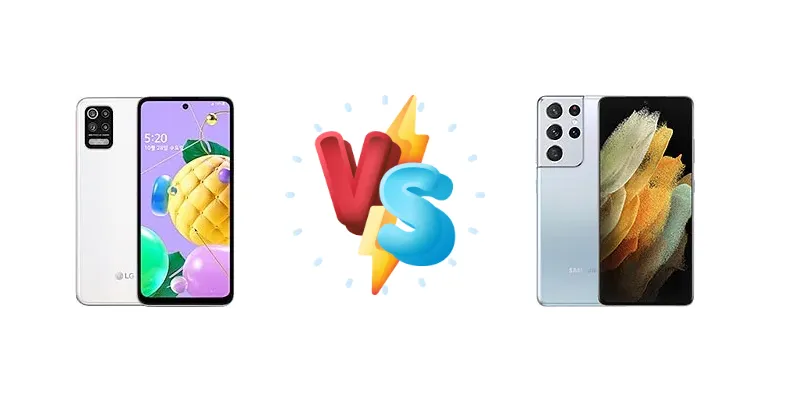
|
🏆 Quick Verdict
For the average user prioritizing value, the LG Q52 offers a functional Android experience at a fraction of the cost. However, the Samsung Galaxy S21 Ultra 5G is the clear winner for those demanding top-tier performance, a superior camera system, and a premium display experience, justifying its significantly higher price tag.
| PHONES | ||
|---|---|---|
| Phone Names | LG Q52 | Samsung Galaxy S21 Ultra 5G |
| Network | ||
|---|---|---|
| 2G bands | GSM 850 / 900 / 1800 / 1900 | GSM 850 / 900 / 1800 / 1900 |
| 3G bands | HSDPA 850 / 900 / 1900 / 2100 | HSDPA 850 / 900 / 1700(AWS) / 1900 / 2100 |
| 4G bands | LTE | 1, 2, 3, 4, 5, 7, 8, 12, 13, 14, 18, 19, 20, 25, 26, 28, 30, 38, 39, 40, 41, 46, 48, 66, 71 - SM-G998U1 |
| 5G bands | - | 2, 5, 25, 41, 66, 71, 260, 261 SA/NSA/Sub6/mmWave - SM-G998U1 |
| Speed | HSPA, LTE | HSPA 42.2/5.76 Mbps, LTE (7CA) Cat20 2000/200 Mbps, 5G (5+ Gbps DL) |
| Technology | GSM / HSPA / LTE | GSM / CDMA / HSPA / EVDO / LTE / 5G |
| - | 1, 3, 5, 7, 8, 20, 28, 38, 40, 41, 66, 77, 78 SA/NSA/Sub6 - SM-G998B | |
| Launch | ||
|---|---|---|
| Announced | 2020, September 26. Released 2020, October 26 | 2021, January 14 |
| Status | Discontinued | Available. Released 2021, January 29 |
| Body | ||
|---|---|---|
| Build | - | Glass front (Gorilla Glass Victus), glass back (Gorilla Glass Victus), aluminum frame |
| Dimensions | 165 x 76.7 x 8.4 mm (6.50 x 3.02 x 0.33 in) | 165.1 x 75.6 x 8.9 mm (6.5 x 2.98 x 0.35 in) |
| SIM | Nano-SIM + Nano-SIM | · Nano-SIM + eSIM· Nano-SIM + Nano-SIM + eSIM (max 2 at a time) |
| Weight | 186 g (6.56 oz) | 227 g (Sub6), 229 g (mmWave) (8.01 oz) |
| MIL-STD-810G compliant* *does not guarantee ruggedness or use in extreme conditions | IP68 dust/water resistant (up to 1.5m for 30 min) Stylus support | |
| Display | ||
|---|---|---|
| Protection | - | Corning Gorilla Glass Victus |
| Resolution | 720 x 1600 pixels, 20:9 ratio (~266 ppi density) | 1440 x 3200 pixels, 20:9 ratio (~515 ppi density) |
| Size | 6.6 inches, 105.2 cm2 (~83.1% screen-to-body ratio) | 6.8 inches, 112.1 cm2 (~89.8% screen-to-body ratio) |
| Type | IPS LCD | Dynamic AMOLED 2X, 120Hz, HDR10+, 1500 nits (peak) |
| - | Always-on display | |
| Platform | ||
|---|---|---|
| CPU | Octa-core (4x2.3 GHz Cortex-A53 & 4x1.8 GHz Cortex-A53) | Octa-core (1x2.9 GHz Cortex-X1 & 3x2.80 GHz Cortex-A78 & 4x2.2 GHz Cortex-A55) - InternationalOcta-core (1x2.84 GHz Cortex-X1 & 3x2.42 GHz Cortex-A78 & 4x1.80 GHz Cortex-A55) - USA/China |
| Chipset | Mediatek MT6765 Helio P35 (12 nm) | Exynos 2100 (5 nm) - InternationalQualcomm SM8350 Snapdragon 888 5G (5 nm) - USA/China |
| GPU | PowerVR GE8320 | Mali-G78 MP14 - InternationalAdreno 660 - USA/China |
| OS | Android 10 | Android 11, up to 4 major Android upgrades, One UI 6.1 |
| Memory | ||
|---|---|---|
| Card slot | microSDXC | No |
| Internal | 64GB 4GB RAM | 128GB 8GB RAM, 128GB 12GB RAM, 256GB 12GB RAM, 256GB 16GB RAM, 512GB 12GB RAM, 512GB 16GB RAM |
| eMMC 5.1 | UFS 3.1 | |
| Main Camera | ||
|---|---|---|
| Features | Dual-LED flash, panorama, HDR | Laser AF, LED flash, auto-HDR, panorama |
| Quad | 48 MP, f/1.8, (wide), 1/2.0", 0.8µm, PDAF 5 MP, f/2.2, 115˚ (ultrawide), 1/5.0", 1.12µm 2 MP (macro) Auxiliary lens | 108 MP, f/1.8, 24mm (wide), 1/1.33", 0.8µm, PDAF, OIS 10 MP, f/2.4, 72mm (telephoto), 1/3.24", 1.22µm, dual pixel PDAF, OIS, 3x optical zoom 10 MP, f/4.9, 240mm (periscope telephoto), 1/3.24", 1.22µm, dual pixel PDAF, OIS, 10x optical zoom 12 MP, f/2.2, 13mm (ultrawide), 1/2.55", 1.4µm, dual pixel PDAF, Super Steady video |
| Video | 1080p@30fps | 8K@24fps, 4K@30/60fps, 1080p@30/60/120/240fps, HDR10+, stereo sound rec., gyro-EIS |
| Selfie camera | ||
|---|---|---|
| Features | - | HDR |
| Single | 13 MP, (wide), 1/3.1", 1.12µm | 40 MP, f/2.2, 26mm (wide), 1/2.8", 0.7µm, PDAF |
| Video | 1080p@30fps | 4K@30/60fps, 1080p@30fps |
| Sound | ||
|---|---|---|
| 3.5mm jack | Yes | No |
| 35mm jack | Yes | No |
| Loudspeaker | Yes | Yes, with stereo speakers |
| - | 32-bit/384kHz audio Tuned by AKG | |
| Comms | ||
|---|---|---|
| Bluetooth | 5.0, A2DP, LE | 5.2, A2DP, LE |
| NFC | Yes | Yes |
| Positioning | GPS | GPS, GLONASS, BDS, GALILEO |
| Radio | No | FM radio (Snapdragon model only; market/operator dependent) |
| USB | USB Type-C 3.1 | USB Type-C 3.2, OTG |
| WLAN | Wi-Fi 802.11 a/b/g/n/ac, dual-band, Wi-Fi Direct | Wi-Fi 802.11 a/b/g/n/ac/6e, dual-band, Wi-Fi Direct |
| Features | ||
|---|---|---|
| Sensors | Fingerprint (side-mounted), accelerometer, proximity, compass | Fingerprint (under display, ultrasonic), accelerometer, gyro, proximity, compass, barometer |
| - | Samsung DeX, Samsung Wireless DeX (desktop experience support) Bixby natural language commands and dictation Samsung Pay (Visa, MasterCard certified) Ultra Wideband (UWB) support | |
| Battery | ||
|---|---|---|
| Charging | - | 25W wired, PD3.0 15W wireless (Qi) 4.5W reverse wireless |
| Type | Li-Po 4000 mAh | Li-Ion 5000 mAh |
| Misc | ||
|---|---|---|
| Colors | Silky White, Silky Red | Phantom Black, Phantom Silver, Phantom Titanium, Phantom Navy, Phantom Brown, Navy |
| Models | LM-Q520N | SM-G998B, SM-G998B/DS, SM-G998U, SM-G998U1, SM-G998W, SM-G998N, SM-G9980 |
| Price | About 240 EUR | $ 240.01 / C$ 353.20 / £ 202.99 / € 264.99 |
| SAR | - | 0.77 W/kg (head) 1.02 W/kg (body) |
| SAR EU | - | 0.71 W/kg (head) 1.58 W/kg (body) |
| Pricing | ||
|---|---|---|
| 128GB 12GB RAM | - | $ 384.99 |
| 256GB 12GB RAM | - | $ 998.00 |
| 512GB 12GB RAM | - | $ 1,179.99 |
| RENEWED | - | $ 459.00 |
| Tests | ||
|---|---|---|
| Battery life | - | Endurance rating 114h |
| Camera | - | Photo / Video |
| Display | - | Contrast ratio: Infinite (nominal) |
| Loudspeaker | - | -25.5 LUFS (Very good) |
| Performance | - | AnTuTu: 657150 (v8) GeekBench: 3518 (v5.1) GFXBench: 33fps (ES 3.1 onscreen) |
LG Q52
- Significantly lower price point
- Functional and reliable for basic tasks
- Acceptable battery life
- Outdated processor and limited performance
- Inferior camera system
- Basic display quality
Samsung Galaxy S21 Ultra 5G
- Exceptional performance with Snapdragon 888 or Exynos 2100
- Best-in-class camera system
- Stunning display with high brightness and contrast
- Very high price
- Can be overkill for basic users
- Potential for thermal throttling under extreme load
Display Comparison
The Samsung Galaxy S21 Ultra 5G boasts a significantly more advanced display, reaching a measured peak brightness of 1023 nits, compared to the LG Q52’s unspecified brightness. While the Q52 likely offers adequate visibility, the S21 Ultra’s panel delivers a far more vibrant and readable experience, especially outdoors. The S21 Ultra’s contrast ratio is listed as 'Infinite (nominal)', suggesting a true black level achievable with its OLED technology, a feature absent in the Q52. The S21 Ultra likely utilizes an adaptive refresh rate (LTPO) for smoother scrolling and improved power efficiency, a feature not found on the Q52.
Camera Comparison
The Samsung Galaxy S21 Ultra 5G is a camera powerhouse, though specific sensor details are omitted in the provided data. It’s safe to assume it features a multi-camera system with a large primary sensor, optical image stabilization (OIS), and advanced image processing algorithms. The LG Q52’s camera capabilities are likely more modest, focusing on basic photography needs. The inclusion of a 2MP macro camera on the Q52 is a common budget feature, but its utility is limited by the small sensor size and lack of OIS. The S21 Ultra’s video recording capabilities will far surpass the Q52, offering higher resolutions, frame rates, and stabilization.
Performance
The performance gap between these devices is substantial. The LG Q52’s MediaTek Helio P35, with its Cortex-A53 cores, is designed for efficiency, not speed. In contrast, the S21 Ultra’s Exynos 2100 (International) or Snapdragon 888 5G (USA/China), both built on a 5nm process, features a powerful Cortex-X1 prime core alongside Cortex-A78 and A55 cores. This translates to significantly faster app loading times, smoother multitasking, and superior gaming performance on the S21 Ultra. The 5nm fabrication process also contributes to better thermal management, reducing throttling during sustained workloads. The S21 Ultra’s 12GB of RAM (available in multiple storage configurations) further enhances multitasking capabilities compared to the Q52’s unspecified RAM.
Battery Life
Both devices share an endurance rating of 114 hours, suggesting comparable battery life under similar usage scenarios. However, the S21 Ultra’s 25W wired charging with Power Delivery 3.0 (PD3.0) and 15W wireless charging offer significantly faster and more convenient charging options than the Q52’s unspecified charging capabilities. The S21 Ultra also includes 4.5W reverse wireless charging, allowing it to charge other devices, a feature absent on the Q52. While the battery capacity isn’t specified for either device, the S21 Ultra’s more efficient chipset and display technology likely contribute to its overall endurance.
Buying Guide
Buy the LG Q52 if you need a reliable, affordable smartphone for basic tasks like calling, texting, social media, and light web browsing. It’s ideal for users on a tight budget or those who don’t require advanced features. Buy the Samsung Galaxy S21 Ultra 5G if you prioritize a best-in-class camera, blazing-fast performance for gaming and demanding applications, a stunning display, and features like 5G connectivity and wireless charging – and are willing to pay a premium for it.