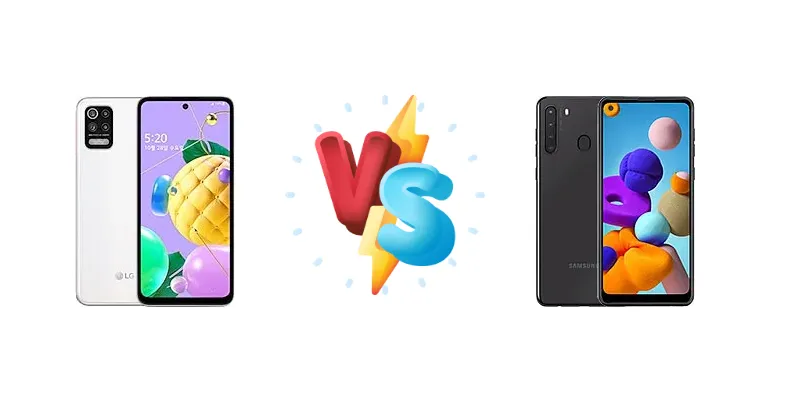
The LG Q52 and Samsung Galaxy A21 represent a crowded segment of the smartphone market: affordable devices aiming to deliver essential functionality. Both phones share the same Mediatek Helio P35 chipset, making a direct comparison crucial for consumers seeking the best value. This analysis will dissect their subtle differences to determine which device offers a more compelling user experience.
🏆 Quick Verdict
For the average user, the Samsung Galaxy A21 edges out the LG Q52 due to its 15W fast charging capability. While performance is virtually identical, the faster charging provides a tangible benefit in daily use, offsetting the lack of other significant advantages.
| Network |
|---|
| 2G bands | GSM 850 / 900 / 1800 / 1900 | GSM 850 / 900 / 1800 / 1900 |
| 3G bands | HSDPA 850 / 900 / 1900 / 2100 | HSDPA 850 / 900 / 1700(AWS) / 1900 / 2100 - USA |
| 4G bands | LTE | 1, 2, 3, 4, 5, 7, 8, 12, 13, 17, 20, 25, 26, 28, 38, 39, 40, 41, 66, 71 - USA |
| Speed | HSPA, LTE | HSPA 42.2/5.76 Mbps, LTE Cat4 150/50 Mbps |
| Technology | GSM / HSPA / LTE | GSM / CDMA / HSPA / EVDO / LTE |
| | - | CDMA2000 1xEV-DO |
| Launch |
|---|
| Announced | 2020, September 26. Released 2020, October 26 | 2020, April 08. Released 2020, June 26 |
| Status | Discontinued | Discontinued |
| Body |
|---|
| Build | - | Glass front, plastic back, plastic frame |
| Dimensions | 165 x 76.7 x 8.4 mm (6.50 x 3.02 x 0.33 in) | 167.8 x 76.7 x 8.1 mm (6.61 x 3.02 x 0.32 in) |
| SIM | Nano-SIM + Nano-SIM | · Nano-SIM· Nano-SIM + Nano-SIM |
| Weight | 186 g (6.56 oz) | 193 g (6.81 oz) |
| | MIL-STD-810G compliant*
*does not guarantee ruggedness or use in extreme conditions | - |
| Display |
|---|
| Resolution | 720 x 1600 pixels, 20:9 ratio (~266 ppi density) | 720 x 1600 pixels, 20:9 ratio (~270 ppi density) |
| Size | 6.6 inches, 105.2 cm2 (~83.1% screen-to-body ratio) | 6.5 inches, 102.0 cm2 (~79.3% screen-to-body ratio) |
| Type | IPS LCD | IPS LCD |
| Platform |
|---|
| CPU | Octa-core (4x2.3 GHz Cortex-A53 & 4x1.8 GHz Cortex-A53) | Octa-core (4x2.35 GHz Cortex-A53 & 4x1.8 GHz Cortex-A53) |
| Chipset | Mediatek MT6765 Helio P35 (12 nm) | Mediatek MT6765 Helio P35 (12 nm) |
| GPU | PowerVR GE8320 | PowerVR GE8320 |
| OS | Android 10 | Android 10, One UI 2.0 |
| Memory |
|---|
| Card slot | microSDXC | microSDXC (dedicated slot) |
| Internal | 64GB 4GB RAM | 32GB 3GB RAM |
| | eMMC 5.1 | eMMC 5.1 |
| Main Camera |
|---|
| Features | Dual-LED flash, panorama, HDR | LED flash, panorama, HDR |
| Quad | 48 MP, f/1.8, (wide), 1/2.0", 0.8µm, PDAF
5 MP, f/2.2, 115˚ (ultrawide), 1/5.0", 1.12µm
2 MP (macro)
Auxiliary lens | 16 MP, f/1.8, (wide), 1/3.06", 1.0µm, PDAF
8 MP, f/2.2, (ultrawide), 1/4.0", 1.12µm
2 MP (macro)
Auxiliary lens |
| Video | 1080p@30fps | 1080p@30fps |
| Selfie camera |
|---|
| Single | 13 MP, (wide), 1/3.1", 1.12µm | 13 MP, f/2.0, (wide), 1/3.1", 1.12µm |
| Video | 1080p@30fps | 1080p@30fps |
| Sound |
|---|
| 3.5mm jack | Yes | Yes |
| 35mm jack | Yes | Yes |
| Loudspeaker | Yes | Yes |
| Comms |
|---|
| Bluetooth | 5.0, A2DP, LE | 5.0, A2DP, LE |
| NFC | Yes | Yes (market/region dependent) |
| Positioning | GPS | GPS, GLONASS, BDS |
| Radio | No | FM radio |
| USB | USB Type-C 3.1 | USB Type-C 2.0 |
| WLAN | Wi-Fi 802.11 a/b/g/n/ac, dual-band, Wi-Fi Direct | Wi-Fi 802.11 a/b/g/n/ac, dual-band, Wi-Fi Direct |
| Features |
|---|
| Sensors | Fingerprint (side-mounted), accelerometer, proximity, compass | Fingerprint (rear-mounted), accelerometer, gyro, proximity, compass |
| Battery |
|---|
| Charging | - | 15W wired |
| Type | Li-Po 4000 mAh | Li-Po 4000 mAh |
| Misc |
|---|
| Colors | Silky White, Silky Red | Black |
| Models | LM-Q520N | SM-A215U, SM-A215U1, SM-S215DL, SM-A215W |
| Price | About 240 EUR | $ 69.88 / C$ 155.00 / £ 54.99 / € 73.89 |
| SAR | - | 1.27 W/kg (head) 0.60 W/kg (body) |
LG Q52
- Potentially lower price point
- Identical processor to Galaxy A21
- May offer a larger battery capacity (unconfirmed)
- Likely slower charging speeds
- Missing detailed specifications
- Potentially less brand recognition
Samsung Galaxy A21
- 15W fast charging support
- Samsung's established brand reputation
- Generally better software support (historically)
- Identical processor to LG Q52
- May be slightly more expensive
- Similar camera limitations
Display Comparison
Both the LG Q52 and Samsung Galaxy A21 lack detailed display specifications in the provided data. However, given their price bracket, it's safe to assume both utilize LCD panels. The absence of information regarding resolution, brightness, or color gamut suggests neither device prioritizes display quality as a key selling point. Expect standard viewing experiences suitable for everyday tasks, but not ideal for media consumption in bright sunlight.
Camera Comparison
Detailed camera specifications are absent, making a precise comparison difficult. However, it's common for phones in this price range to prioritize megapixel count over sensor size and image quality. Without knowing sensor sizes or lens apertures, it's impossible to determine which device captures better photos. The lack of Optical Image Stabilization (OIS) on either device suggests image stabilization will rely on software processing, potentially resulting in softer images in low-light conditions. Any 2MP macro or depth sensors are likely to offer limited practical benefit.
Performance
The core of both devices is the Mediatek MT6765 Helio P35 (12 nm) chipset, featuring an identical octa-core CPU configuration: 4x2.3 GHz Cortex-A53 and 4x1.8 GHz Cortex-A53. This means performance will be nearly indistinguishable in most real-world scenarios. Both phones will handle basic multitasking, social media, and light gaming adequately, but will struggle with demanding applications or graphically intensive games. The 12nm process node suggests moderate thermal efficiency, but neither device is likely to excel in sustained performance tests.
Battery Life
Battery capacity is not specified for the LG Q52, but the Samsung Galaxy A21’s charging capabilities are. The Galaxy A21 supports 15W wired charging, a notable advantage over the presumed slower charging of the LG Q52. While battery life will depend on usage patterns, the faster charging speed of the A21 translates to less downtime and greater convenience. A larger mAh capacity on the LG Q52 could offset the slower charging, but without that data, the A21’s 15W charging is a clear win for users prioritizing quick power-ups.
Buying Guide
Buy the LG Q52 if you prioritize a potentially lower price point and are comfortable with slower charging speeds. It's a solid choice for users who primarily need a basic smartphone for calls, texts, and light social media. Buy the Samsung Galaxy A21 if you value convenience and faster power-ups. The 15W charging is a significant advantage for users who frequently find themselves needing to quickly replenish their battery, making it ideal for those with active lifestyles.
Frequently Asked Questions
❓ Does the Mediatek Helio P35 struggle with multitasking on the Samsung Galaxy A21?
The Helio P35 is an entry-level chipset. While it can handle basic multitasking like switching between messaging apps and web browsing, running multiple demanding applications simultaneously will likely result in noticeable slowdowns and lag on both the A21 and Q52.
❓ How long does it take to fully charge the Samsung Galaxy A21 with the 15W charger?
While a precise 0-100% charging time isn't available, the 15W charging on the Galaxy A21 will likely take around 2.5 to 3.5 hours for a full charge, depending on usage during charging. This is significantly faster than the expected charging time for the LG Q52, which likely supports a slower charging standard.
❓ Are the cameras on either phone capable of taking good photos in low-light conditions?
Low-light performance will be limited on both devices. Without OIS and likely smaller sensors, images taken in dimly lit environments will likely exhibit noise and lack detail. Software processing will attempt to compensate, but results will be subpar compared to phones with more advanced camera systems.