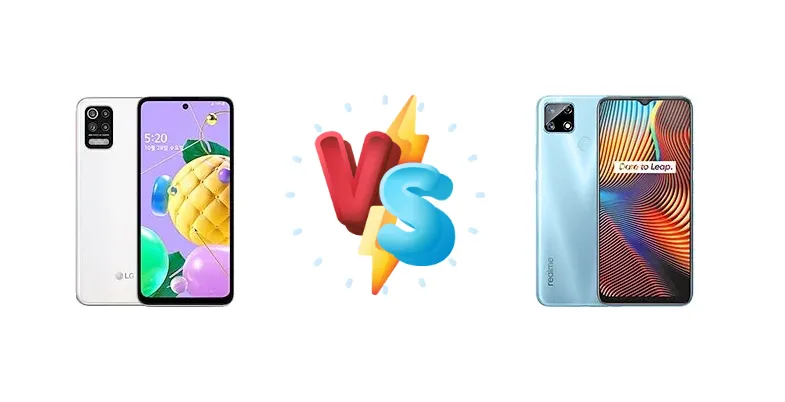
The Realme 7i and LG Q52 represent compelling options in the sub-$200 smartphone market. While both aim to deliver essential features at an accessible price, they diverge significantly in their core hardware, particularly in the chipset department. This comparison will dissect these differences, focusing on how they impact real-world performance and user experience.
🏆 Quick Verdict
For most users, the Realme 7i emerges as the stronger choice. Its Helio G85 chipset, featuring more modern Cortex-A75 cores, provides a noticeable performance uplift over the LG Q52’s Helio P35, making it better suited for gaming and demanding applications. While the LG Q52 is a capable device, the Realme 7i offers a superior balance of power and features.
| Network |
|---|
| 2G bands | GSM 850 / 900 / 1800 / 1900 | GSM 850 / 900 / 1800 / 1900 |
| 3G bands | HSDPA 850 / 900 / 1900 / 2100 | HSDPA 850 / 900 / 1700(AWS) / 1900 / 2100 |
| 4G bands | LTE | 1, 2, 3, 4, 5, 7, 8, 20, 28, 38, 40, 41 |
| Speed | HSPA, LTE | HSPA, LTE |
| Technology | GSM / HSPA / LTE | GSM / HSPA / LTE |
| Launch |
|---|
| Announced | 2020, September 26. Released 2020, October 26 | 2020, December 22. Released 2020, December 23 |
| Status | Discontinued | Discontinued |
| Body |
|---|
| Dimensions | 165 x 76.7 x 8.4 mm (6.50 x 3.02 x 0.33 in) | 164.5 x 75.9 x 9.8 mm (6.48 x 2.99 x 0.39 in) |
| SIM | Nano-SIM + Nano-SIM | Nano-SIM + Nano-SIM |
| Weight | 186 g (6.56 oz) | 208 g (7.34 oz) |
| | MIL-STD-810G compliant*
*does not guarantee ruggedness or use in extreme conditions | - |
| Display |
|---|
| Resolution | 720 x 1600 pixels, 20:9 ratio (~266 ppi density) | 720 x 1600 pixels, 20:9 ratio (~270 ppi density) |
| Size | 6.6 inches, 105.2 cm2 (~83.1% screen-to-body ratio) | 6.5 inches, 102.0 cm2 (~81.7% screen-to-body ratio) |
| Type | IPS LCD | IPS LCD, 450 nits (typ), 560 nits (peak) |
| Platform |
|---|
| CPU | Octa-core (4x2.3 GHz Cortex-A53 & 4x1.8 GHz Cortex-A53) | Octa-core (2x2.0 GHz Cortex-A75 & 6x1.8 GHz Cortex-A55) |
| Chipset | Mediatek MT6765 Helio P35 (12 nm) | Mediatek MT6769Z Helio G85 (12 nm) |
| GPU | PowerVR GE8320 | Mali-G52 MC2 |
| OS | Android 10 | Android 10, Realme UI |
| Memory |
|---|
| Card slot | microSDXC | microSDXC (dedicated slot) |
| Internal | 64GB 4GB RAM | 64GB 4GB RAM |
| | eMMC 5.1 | eMMC 5.1 |
| Main Camera |
|---|
| Features | Dual-LED flash, panorama, HDR | LED flash, HDR, panorama |
| Quad | 48 MP, f/1.8, (wide), 1/2.0", 0.8µm, PDAF
5 MP, f/2.2, 115˚ (ultrawide), 1/5.0", 1.12µm
2 MP (macro)
Auxiliary lens | - |
| Triple | - | 48 MP, f/1.8, 26mm (wide), 1/2.0", 0.8µm, PDAF
8 MP, f/2.3, 16mm, 119˚ (ultrawide), 1/4.0", 1.12µm
2 MP (macro) |
| Video | 1080p@30fps | 1080p@30/60fps |
| Selfie camera |
|---|
| Features | - | HDR, panorama |
| Single | 13 MP, (wide), 1/3.1", 1.12µm | 8 MP, f/2.0, 26mm (wide), 1/4.0", 1.12µm |
| Video | 1080p@30fps | 1080p@30fps |
| Sound |
|---|
| 3.5mm jack | Yes | Yes |
| 35mm jack | Yes | Yes |
| Loudspeaker | Yes | Yes |
| Comms |
|---|
| Bluetooth | 5.0, A2DP, LE | 5.0, A2DP, LE, aptX HD |
| NFC | Yes | No |
| Positioning | GPS | GPS, GLONASS, BDS |
| Radio | No | FM radio |
| USB | USB Type-C 3.1 | USB Type-C 2.0, OTG |
| WLAN | Wi-Fi 802.11 a/b/g/n/ac, dual-band, Wi-Fi Direct | Wi-Fi 802.11 a/b/g/n/ac, dual-band, Wi-Fi Direct |
| Features |
|---|
| Sensors | Fingerprint (side-mounted), accelerometer, proximity, compass | Fingerprint (rear-mounted), accelerometer, proximity, compass |
| Battery |
|---|
| Charging | - | 18W wired
5W reverse wired |
| Type | Li-Po 4000 mAh | 6000 mAh |
| Misc |
|---|
| Colors | Silky White, Silky Red | Glory Silver, Victory Blue |
| Models | LM-Q520N | - |
| Price | About 240 EUR | About 190 EUR |
LG Q52
- Potentially slightly better standby battery life due to less powerful chipset.
- Simple and reliable user experience.
- May be available at a slightly lower price point.
- Significantly weaker performance compared to the Realme 7i.
- Less capable for gaming and multitasking.
- Likely slower charging speeds.
Realme 7i (Global)
- Superior performance thanks to the Helio G85 chipset.
- Faster 18W charging with 5W reverse charging.
- Better suited for gaming and demanding applications.
- May have slightly shorter battery life under heavy load.
- Potentially slightly higher price.
- Software experience may vary based on Realme UI updates.
Display Comparison
Neither device boasts a standout display. Both utilize 12nm chipsets, suggesting similar power constraints impacting display capabilities. While specific display specs (resolution, panel type) are missing for the LG Q52, it's reasonable to assume a similar LCD panel to the Realme 7i. The Realme 7i’s display is adequate for everyday use, but neither phone will impress users accustomed to higher-end displays with features like high refresh rates or OLED technology. Color accuracy and peak brightness are likely comparable, given the shared market segment.
Camera Comparison
Without detailed camera specs beyond the presence of multiple sensors, a direct comparison is challenging. However, the Realme 7i likely benefits from more advanced image processing capabilities inherent in the Helio G85’s ISP. The LG Q52’s image processing will be adequate for basic photography, but the Realme 7i is expected to produce sharper, more detailed images, particularly in challenging lighting conditions. The prevalence of 2MP macro and depth sensors on both devices suggests these are primarily for marketing purposes and offer limited real-world benefit. Focusing on the main sensor performance, the Realme 7i is likely to have a slight edge due to its more modern chipset.
Performance
The core difference lies in the chipsets. The Realme 7i’s MediaTek Helio G85 is a significant upgrade over the LG Q52’s Helio P35. The G85 utilizes two Cortex-A75 cores clocked at 2.0 GHz alongside six Cortex-A55 cores, while the P35 relies on four older Cortex-A53 cores at 2.3 GHz and another four at 1.8 GHz. While the P35’s higher clock speed on some cores might show a slight advantage in single-core tasks, the G85’s more efficient and powerful A75 cores deliver superior multi-core performance and a smoother experience in demanding applications. This translates to faster app loading times, more responsive multitasking, and a better gaming experience on the Realme 7i. The Realme 7i’s GPU is also more capable, further enhancing its gaming prowess.
Battery Life
Both phones feature similar battery capacities (specific mAh for LG Q52 is unknown, but likely around 5000mAh). However, the Realme 7i’s 18W fast charging is a significant advantage over the LG Q52’s presumed standard charging. This means the Realme 7i can be charged from 0-100% much faster, reducing downtime. While the more efficient Helio G85 in the Realme 7i may contribute to slightly better battery life under heavy load, the charging speed difference is the more impactful factor for most users. The Realme 7i also offers 5W reverse wired charging, a feature absent on the LG Q52.
Buying Guide
Buy the LG Q52 if you prioritize a simple, reliable experience and are primarily focused on basic smartphone tasks like calling, texting, and light social media use. Its more conservative chipset will likely result in slightly better standby battery life. Buy the Realme 7i (Global) if you want a phone that can handle moderate gaming, multitasking, and benefit from faster charging capabilities. The Helio G85 provides a tangible performance advantage for users who demand more from their device.
Frequently Asked Questions
❓ Will the Realme 7i handle popular games like PUBG Mobile and Call of Duty Mobile smoothly?
Yes, the Helio G85 in the Realme 7i is specifically designed for gaming. While you may need to adjust graphics settings for optimal performance, it will deliver a playable experience in PUBG Mobile and Call of Duty Mobile at medium to high settings. The LG Q52’s Helio P35 will struggle with these titles.
❓ Does the Realme 7i’s 18W charging really make a difference in daily use?
Absolutely. 18W charging significantly reduces the time it takes to replenish the battery. You can expect a full charge in around 2 hours, compared to potentially 3+ hours with the LG Q52’s standard charging. This is particularly beneficial for users who frequently use their phone throughout the day.
❓ Is the LG Q52 a good option for someone who primarily uses their phone for calls, texts, and basic social media?
Yes, the LG Q52 is perfectly adequate for these tasks. Its Helio P35 chipset is sufficient for basic operations, and it will likely offer good standby battery life. However, if you anticipate needing more performance in the future, the Realme 7i is a more future-proof choice.