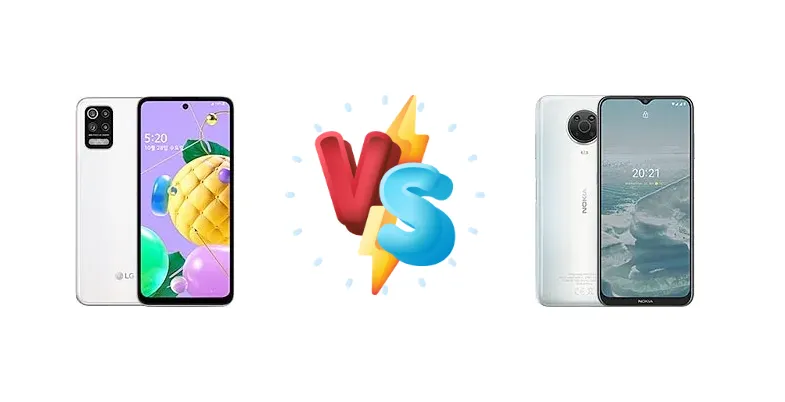
The LG Q52 and Nokia G20 represent the lower end of the smartphone market, targeting users prioritizing affordability. Both devices utilize Mediatek's Helio series of chipsets, but a closer look reveals a nuanced difference in performance and features. This comparison dissects these differences to help you determine which phone best suits your needs.
🏆 Quick Verdict
For the average user, the Nokia G20 offers slightly better overall value due to its inclusion of 10W charging, a feature absent on the LG Q52. While performance is nearly identical, the G20's charging capability and potentially longer software support edge it ahead.
| Network |
|---|
| 2G bands | GSM 850 / 900 / 1800 / 1900 | GSM 850 / 900 / 1800 / 1900 |
| 3G bands | HSDPA 850 / 900 / 1900 / 2100 | HSDPA 850 / 900 / 1900 / 2100 - International |
| 4G bands | LTE | 1, 3, 5, 7, 8, 20, 28, 38, 40, 41 - International |
| Speed | HSPA, LTE | HSPA 42.2/5.76 Mbps, LTE Cat4 150/50 Mbps |
| Technology | GSM / HSPA / LTE | GSM / HSPA / LTE |
| | - | 1, 2, 3, 4, 5, 7, 8, 12, 17, 28, 66 - LATAM |
| Launch |
|---|
| Announced | 2020, September 26. Released 2020, October 26 | 2021, April 08 |
| Status | Discontinued | Available. Released 2021, May 17 |
| Body |
|---|
| Dimensions | 165 x 76.7 x 8.4 mm (6.50 x 3.02 x 0.33 in) | 164.9 x 76 x 9.2 mm (6.49 x 2.99 x 0.36 in) |
| SIM | Nano-SIM + Nano-SIM | · Nano-SIM· Nano-SIM + Nano-SIM |
| Weight | 186 g (6.56 oz) | 197 g (6.95 oz) |
| | MIL-STD-810G compliant*
*does not guarantee ruggedness or use in extreme conditions | Splash protection |
| Display |
|---|
| Resolution | 720 x 1600 pixels, 20:9 ratio (~266 ppi density) | 720 x 1600 pixels, 20:9 ratio (~269 ppi density) |
| Size | 6.6 inches, 105.2 cm2 (~83.1% screen-to-body ratio) | 6.52 inches, 102.6 cm2 (~81.9% screen-to-body ratio) |
| Type | IPS LCD | IPS LCD |
| Platform |
|---|
| CPU | Octa-core (4x2.3 GHz Cortex-A53 & 4x1.8 GHz Cortex-A53) | Octa-core (4x2.3 GHz Cortex-A53 & 4x1.8 GHz Cortex-A53) |
| Chipset | Mediatek MT6765 Helio P35 (12 nm) | Mediatek MT6765G Helio G35 (12 nm) |
| GPU | PowerVR GE8320 | PowerVR GE8320 |
| OS | Android 10 | Android 11, upgradable to Android 13 |
| Memory |
|---|
| Card slot | microSDXC | microSDXC (dedicated slot) |
| Internal | 64GB 4GB RAM | 64GB 4GB RAM, 128GB 4GB RAM |
| | eMMC 5.1 | - |
| Main Camera |
|---|
| Features | Dual-LED flash, panorama, HDR | LED flash, HDR, panorama |
| Quad | 48 MP, f/1.8, (wide), 1/2.0", 0.8µm, PDAF
5 MP, f/2.2, 115˚ (ultrawide), 1/5.0", 1.12µm
2 MP (macro)
Auxiliary lens | 48 MP, f/1.8, (wide), PDAF
5 MP, (ultrawide)
2 MP (macro)
Auxiliary lens |
| Single | - | 8 MP, (wide) |
| Video | 1080p@30fps | 1080p@30fps |
| Selfie camera |
|---|
| Single | 13 MP, (wide), 1/3.1", 1.12µm | 8 MP, (wide) |
| Video | 1080p@30fps | 1080p@30fps |
| Sound |
|---|
| 3.5mm jack | Yes | Yes |
| 35mm jack | Yes | Yes |
| Loudspeaker | Yes | Yes |
| Comms |
|---|
| Bluetooth | 5.0, A2DP, LE | 5.0, A2DP, LE |
| NFC | Yes | Yes (market/region dependent) |
| Positioning | GPS | GPS, GLONASS, BDS |
| Radio | No | FM radio |
| USB | USB Type-C 3.1 | USB Type-C 2.0, OTG |
| WLAN | Wi-Fi 802.11 a/b/g/n/ac, dual-band, Wi-Fi Direct | Wi-Fi 802.11 b/g/n |
| Features |
|---|
| Sensors | Fingerprint (side-mounted), accelerometer, proximity, compass | Fingerprint (side-mounted), accelerometer, gyro, proximity |
| Battery |
|---|
| Charging | - | 10W wired |
| Type | Li-Po 4000 mAh | Li-Po 5050 mAh |
| Misc |
|---|
| Colors | Silky White, Silky Red | Glacier, Night |
| Models | LM-Q520N | TA-1336, TA-1343, TA-1347, TA-1372, TA-1365 |
| Price | About 240 EUR | About 90 EUR |
| SAR | - | 1.01 W/kg (head) 1.02 W/kg (body) |
| SAR EU | - | 0.49 W/kg (head) 1.13 W/kg (body) |
LG Q52
- Potentially cleaner software experience (regional dependent)
- Slightly more compact form factor (likely)
- May be available at a lower price point
- No specified charging support – very slow charging
- Battery capacity unknown – potentially smaller than G20
- Helio P35 – marginally less optimized for gaming
Nokia G20
- 5000mAh battery – excellent battery life
- 10W wired charging – convenient charging option
- Helio G35 – slightly optimized for gaming
- Software updates may be slower than some competitors
- Larger form factor – less pocketable
- Build quality may feel less premium
Display Comparison
Neither LG nor Nokia provide detailed display specifications beyond resolution. Both likely utilize IPS LCD panels, common in this price bracket. Without knowing peak brightness or color gamut coverage, it's safe to assume display quality is comparable and focused on basic usability rather than media consumption. Bezels are likely substantial on both devices, reflecting their budget positioning.
Camera Comparison
Camera details are sparse for both devices. It's highly probable both feature a multi-camera setup with a primary sensor and supporting lenses (depth, macro). Without knowing sensor sizes or apertures, it’s difficult to assess image quality. The Nokia G20’s inclusion of a dedicated night mode, even if basic, suggests some software optimization for low-light photography. The LG Q52’s camera performance will likely rely heavily on software processing. Given the price point, expect limited dynamic range and detail in challenging lighting conditions. Avoid placing significant weight on the presence of 2MP macro lenses, as their image quality is typically subpar.
Performance
Both the LG Q52 and Nokia G20 are powered by Mediatek’s Helio series, but with a key distinction: the Q52 uses the Helio P35, while the G20 employs the Helio G35. Both chipsets feature an octa-core CPU configuration with the same core arrangement (4x2.3 GHz Cortex-A53 & 4x1.8 GHz Cortex-A53). The 'G' in Helio G35 signifies a slight focus on gaming, with potentially optimized GPU drivers. However, the core architecture and clock speeds are identical, suggesting real-world performance differences will be minimal for everyday tasks. Both phones will struggle with demanding games, but are adequate for social media, messaging, and basic web browsing. The lack of information on RAM speed (LPDDR3 vs LPDDR4) further complicates a definitive performance assessment.
Battery Life
Battery capacity is not specified for the LG Q52, but the Nokia G20 packs a substantial 5000mAh battery. The Nokia G20 also supports 10W wired charging, a crucial advantage over the LG Q52, which lacks any specified charging support. This means the LG Q52 will likely rely on significantly slower charging speeds, potentially taking several hours to fully charge. The larger battery capacity of the G20, combined with the efficient Helio G35 chipset, should translate to all-day battery life for moderate users. The lack of fast charging on either device means topping up quickly isn't an option.
Buying Guide
Buy the LG Q52 if you prioritize a potentially cleaner software experience (depending on regional variations) and are comfortable with slower charging speeds. Buy the Nokia G20 if you value guaranteed software updates through Nokia’s commitment to Android updates and require the convenience of even basic wired charging support. Both are ideal for first-time smartphone users or those needing a reliable secondary device.
Frequently Asked Questions
❓ Does the Nokia G20’s 10W charging significantly impact charging speed compared to the LG Q52?
Yes, even 10W charging is a substantial advantage over the LG Q52’s lack of specified charging support. The Q52 will likely charge at a very slow rate, potentially taking 5+ hours for a full charge, while the G20 will be considerably faster, though still not 'fast charging' by modern standards.
❓ Will I notice a performance difference between the Helio P35 in the LG Q52 and the Helio G35 in the Nokia G20 during everyday use?
The performance difference will be minimal for typical tasks like browsing, social media, and messaging. Both chipsets have the same CPU core configuration. The Helio G35’s slight GPU optimization might offer a marginal improvement in gaming, but neither phone is designed for demanding games.
❓ How long can I expect the Nokia G20’s 5000mAh battery to last on a single charge?
With moderate usage (a few hours of browsing, social media, and calls), the Nokia G20’s 5000mAh battery should easily last a full day. Heavy users might still get through most of the day, but will likely need to top up the battery in the evening.