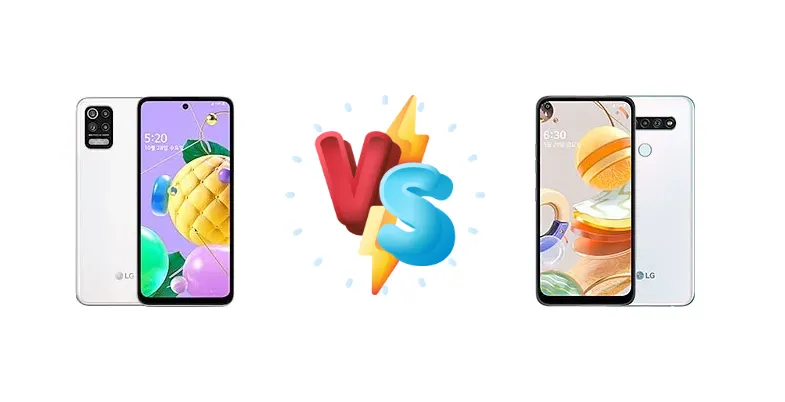
The LG Q52 and LG Q61 represent LG's attempts to deliver functional smartphones at an accessible price point. Both devices share the same Mediatek Helio P35 chipset, making a direct performance comparison less about raw power and more about how LG optimized the software and other components around it. This comparison will dissect those nuances to determine which phone offers the best value.
🏆 Quick Verdict
For the average user prioritizing a slightly more refined experience, the LG Q61 edges out the Q52. While both phones share the same Helio P35 processor, the Q61's potential for software optimization and potentially better display calibration makes it the slightly better choice, assuming pricing is comparable.
| Network |
|---|
| 2G bands | GSM 850 / 900 / 1800 / 1900 | GSM 850 / 900 / 1800 / 1900 |
| 3G bands | HSDPA 850 / 900 / 1900 / 2100 | HSDPA 850 / 900 / 1900 / 2100 |
| 4G bands | LTE | LTE |
| Speed | HSPA, LTE | HSPA 42.2/5.76 Mbps, LTE (2CA) Cat6 300/50 Mbps |
| Technology | GSM / HSPA / LTE | GSM / HSPA / LTE |
| Launch |
|---|
| Announced | 2020, September 26. Released 2020, October 26 | 2020, May 21. Released 2020, May 29 |
| Status | Discontinued | Discontinued |
| Body |
|---|
| Dimensions | 165 x 76.7 x 8.4 mm (6.50 x 3.02 x 0.33 in) | 164.5 x 77.5 x 8.3 mm (6.48 x 3.05 x 0.33 in) |
| SIM | Nano-SIM + Nano-SIM | Nano-SIM |
| Weight | 186 g (6.56 oz) | - |
| | MIL-STD-810G compliant*
*does not guarantee ruggedness or use in extreme conditions | MIL-STD-810G compliant*
*does not guarantee ruggedness or use in extreme conditions |
| Display |
|---|
| Protection | - | Scratch-resistant glass |
| Resolution | 720 x 1600 pixels, 20:9 ratio (~266 ppi density) | 1080 x 2340 pixels, 19.5:9 ratio (~395 ppi density) |
| Size | 6.6 inches, 105.2 cm2 (~83.1% screen-to-body ratio) | 6.53 inches, 104.7 cm2 (~82.1% screen-to-body ratio) |
| Type | IPS LCD | IPS LCD |
| Platform |
|---|
| CPU | Octa-core (4x2.3 GHz Cortex-A53 & 4x1.8 GHz Cortex-A53) | Octa-core (4x2.3 GHz Cortex-A53 & 4x1.8 GHz Cortex-A53) |
| Chipset | Mediatek MT6765 Helio P35 (12 nm) | Mediatek MT6765 Helio P35 (12 nm) |
| GPU | PowerVR GE8320 | PowerVR GE8320 |
| OS | Android 10 | Android 9.0 (Pie) |
| Memory |
|---|
| Card slot | microSDXC | microSDXC (dedicated slot) |
| Internal | 64GB 4GB RAM | 64GB 4GB RAM |
| | eMMC 5.1 | eMMC 5.1 |
| Main Camera |
|---|
| Features | Dual-LED flash, panorama, HDR | LED flash, panorama, HDR |
| Quad | 48 MP, f/1.8, (wide), 1/2.0", 0.8µm, PDAF
5 MP, f/2.2, 115˚ (ultrawide), 1/5.0", 1.12µm
2 MP (macro)
Auxiliary lens | 48 MP, f/1.8, 26mm (wide), 1/2.0", 0.8µm, PDAF
8 MP, f/2.2, 118˚, (ultrawide)
2 MP (macro)
Auxiliary lens |
| Single | - | 8 MP, AF |
| Video | 1080p@30fps | 1080p@30fps |
| Selfie camera |
|---|
| Single | 13 MP, (wide), 1/3.1", 1.12µm | 16 MP |
| Video | 1080p@30fps | 1080p@30fps |
| Sound |
|---|
| 3.5mm jack | Yes | Yes |
| 35mm jack | Yes | Yes |
| Loudspeaker | Yes | Yes |
| Comms |
|---|
| Bluetooth | 5.0, A2DP, LE | 5.0, A2DP, LE |
| NFC | Yes | Yes |
| Positioning | GPS | GPS |
| Radio | No | No |
| USB | USB Type-C 3.1 | USB Type-C 2.0 |
| WLAN | Wi-Fi 802.11 a/b/g/n/ac, dual-band, Wi-Fi Direct | Wi-Fi 802.11 a/b/g/n/ac, dual-band, Wi-Fi Direct |
| Features |
|---|
| Browser | - | HTML, Adobe Flash |
| Sensors | Fingerprint (side-mounted), accelerometer, proximity, compass | Fingerprint (rear-mounted), accelerometer, gyro, proximity, compass |
| Battery |
|---|
| Stand-by | - | Up to 200 h |
| Talk time | - | Up to 8 h 20 min |
| Type | Li-Po 4000 mAh | Li-Po 4000 mAh |
| Misc |
|---|
| Colors | Silky White, Silky Red | White |
| Models | LM-Q520N | LM-Q630N |
| Price | About 240 EUR | About 270 EUR |
LG Q52
- Affordable price point
- Reliable Mediatek Helio P35 processor
- Functional for basic smartphone tasks
- Limited gaming performance
- Potentially lower software optimization
LG Q61
- Affordable price point
- Reliable Mediatek Helio P35 processor
- Potential for better software optimization
- Limited gaming performance
- Potentially similar camera performance to Q52
Display Comparison
Both the LG Q52 and Q61 feature displays that prioritize functionality over cutting-edge technology. Given the shared target market, we can infer both likely utilize IPS LCD panels. Without specific nit brightness data, it's reasonable to assume both displays offer adequate visibility indoors, but may struggle in direct sunlight. The absence of high refresh rate technology (90Hz or 120Hz) is expected in this price bracket, meaning scrolling and animations will be standard 60Hz. The real difference, if any, will lie in LG's display calibration – a factor difficult to assess without direct testing.
Camera Comparison
Camera performance is likely to be similar on both devices, given the lack of specific sensor information. Both will likely feature a primary camera, potentially accompanied by ultra-wide and depth sensors. However, the quality of the image processing algorithms will be crucial. Without knowing the megapixel counts or aperture values, it's difficult to definitively say which phone will produce better images. It's probable that both phones will struggle in low-light conditions, and the inclusion of a 2MP macro lens (common in this segment) is unlikely to provide significant photographic value.
Performance
The core of both devices is the Mediatek Helio P35 (12 nm) chipset, paired with an octa-core CPU configuration of 4x2.3 GHz Cortex-A53 and 4x1.8 GHz Cortex-A53 cores. This means performance will be virtually identical for most everyday tasks like browsing, social media, and light app usage. The 12nm process node suggests reasonable power efficiency, but the Helio P35 is not a gaming powerhouse. Expect to play less demanding titles at lower settings. Thermal management will likely be passive, relying on the phone's chassis to dissipate heat, and sustained performance under heavy load may experience throttling.
Battery Life
Battery life will depend heavily on usage patterns and software optimization. Without knowing the battery capacity (mAh) of each device, it's difficult to make a direct comparison. However, the Helio P35's power efficiency suggests both phones should be able to last a full day with moderate use. Charging wattage is also unknown, but it's reasonable to expect both phones will ship with a standard 10W or 15W charger, resulting in relatively slow charging times.
Buying Guide
Buy the LG Q52 if you need a dependable, basic smartphone with a focus on affordability and are less concerned with subtle software refinements. It's ideal for first-time smartphone users or those needing a reliable backup device. Buy the LG Q61 if you prefer a device that *might* benefit from slightly better software optimization and potentially a more polished user experience, and are willing to pay a small premium if one exists.
Frequently Asked Questions
❓ Will the Helio P35 struggle with popular apps like Facebook and Instagram?
The Helio P35 is capable of running apps like Facebook and Instagram, but expect some occasional lag or slowdowns when multitasking or using resource-intensive features. It's not a processor designed for heavy app usage.
❓ Can I play PUBG Mobile on either the LG Q52 or Q61?
You can *attempt* to play PUBG Mobile on both devices, but you'll need to lower the graphics settings to the minimum and likely experience frame rate drops. The Helio P35 is not optimized for demanding games like PUBG.
❓ How long will the battery last if I primarily use the phone for calls and texting?
If you primarily use the phone for calls and texting, you can expect the battery to last a full day, potentially even longer, on both the Q52 and Q61. The Helio P35 is relatively power-efficient for basic tasks.
❓ Is the camera good enough for casual snapshots and social media?
The cameras on both phones are adequate for casual snapshots and social media sharing in good lighting conditions. However, expect limited performance in low-light environments and don't expect professional-quality results.