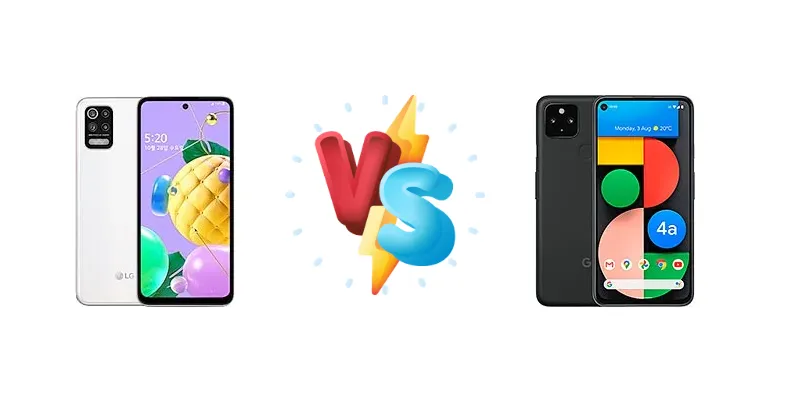
The Google Pixel 4a 5G and LG Q52 represent different approaches to the mid-range smartphone market. The Pixel 4a 5G, while initially positioned as a higher-tier device, has seen price drops making it competitive. The LG Q52 aims for affordability, but at what cost to performance and features? This comparison dissects the key differences to help you choose.
🏆 Quick Verdict
For most users, the Google Pixel 4a 5G is the superior choice. Its Snapdragon 765G chipset delivers significantly better performance, a more refined camera experience, and 5G connectivity. While the LG Q52 offers a lower price point, the performance compromises are substantial.
| Network |
|---|
| 2G bands | GSM 850 / 900 / 1800 / 1900 | GSM 850 / 900 / 1800 / 1900 |
| 3G bands | HSDPA 850 / 900 / 1900 / 2100 | HSDPA 850 / 900 / 1700(AWS) / 1900 / 2100 |
| 4G bands | LTE | 1, 2, 3, 4, 5, 7, 8, 12, 13, 14, 17, 18, 19, 20, 25, 26, 28, 29, 30, 32, 38, 39, 40, 41, 42, 46, 48, 66, 71 |
| 5G bands | - | 1, 2, 3, 5, 7, 8, 12, 28, 41, 66, 71, 77, 78 Sub6, mmWave (market dependant) |
| Speed | HSPA, LTE | HSPA, LTE, 5G |
| Technology | GSM / HSPA / LTE | GSM / HSPA / LTE / 5G |
| Launch |
|---|
| Announced | 2020, September 26. Released 2020, October 26 | 2020, September 30 |
| Status | Discontinued | Available. Released 2020, November 05 |
| Body |
|---|
| Build | - | Glass front (Gorilla Glass 3), plastic back, plastic frame |
| Dimensions | 165 x 76.7 x 8.4 mm (6.50 x 3.02 x 0.33 in) | 153.9 x 74 x 8.2 mm (Sub-6) or 8.5 mm (Sub-6 and mmWave) |
| SIM | Nano-SIM + Nano-SIM | Nano-SIM + eSIM |
| Weight | 186 g (6.56 oz) | 168 g (5G Sub-6); 171 g ( 5G Sub-6 and mmWave) (5.93 oz) |
| | MIL-STD-810G compliant*
*does not guarantee ruggedness or use in extreme conditions | - |
| Display |
|---|
| Protection | - | Corning Gorilla Glass 3 |
| Resolution | 720 x 1600 pixels, 20:9 ratio (~266 ppi density) | 1080 x 2340 pixels, 19.5:9 ratio (~413 ppi density) |
| Size | 6.6 inches, 105.2 cm2 (~83.1% screen-to-body ratio) | 6.2 inches, 95.7 cm2 (~84.1% screen-to-body ratio) |
| Type | IPS LCD | OLED, HDR |
| | - | Always-on display |
| Platform |
|---|
| CPU | Octa-core (4x2.3 GHz Cortex-A53 & 4x1.8 GHz Cortex-A53) | Octa-core (1x2.4 GHz Kryo 475 Prime & 1x2.2 GHz Kryo 475 Gold & 6x1.8 GHz Kryo 475 Silver) |
| Chipset | Mediatek MT6765 Helio P35 (12 nm) | Qualcomm SM7250 Snapdragon 765G 5G (7 nm) |
| GPU | PowerVR GE8320 | Adreno 620 |
| OS | Android 10 | Android 11, upgradable to Android 14 |
| Memory |
|---|
| Card slot | microSDXC | No |
| Internal | 64GB 4GB RAM | 128GB 6GB RAM |
| | eMMC 5.1 | UFS 2.1 |
| Main Camera |
|---|
| Dual | - | 12.2 MP, f/1.7, 27mm (wide), 1/2.55", 1.4µm, dual pixel PDAF, OIS
16 MP, f/2.2, 107˚ (ultrawide), 1.0µm |
| Features | Dual-LED flash, panorama, HDR | LED flash, Pixel Shift, Auto-HDR, panorama |
| Quad | 48 MP, f/1.8, (wide), 1/2.0", 0.8µm, PDAF
5 MP, f/2.2, 115˚ (ultrawide), 1/5.0", 1.12µm
2 MP (macro)
Auxiliary lens | - |
| Video | 1080p@30fps | 4K@30/60fps, 1080p@30/60/120/240fps; gyro-EIS |
| Selfie camera |
|---|
| Features | - | HDR |
| Single | 13 MP, (wide), 1/3.1", 1.12µm | 8 MP, f/2.0, 24mm (wide), 1/4.0", 1.12µm |
| Video | 1080p@30fps | 1080p@30fps |
| Sound |
|---|
| 3.5mm jack | Yes | Yes |
| 35mm jack | Yes | Yes |
| Loudspeaker | Yes | Yes, with stereo speakers |
| Comms |
|---|
| Bluetooth | 5.0, A2DP, LE | 5.0, A2DP, LE, aptX HD |
| NFC | Yes | Yes |
| Positioning | GPS | GPS, GLONASS, GALILEO, QZSS, BDS |
| Radio | No | No |
| USB | USB Type-C 3.1 | USB Type-C 3.1 |
| WLAN | Wi-Fi 802.11 a/b/g/n/ac, dual-band, Wi-Fi Direct | Wi-Fi 802.11 a/b/g/n/ac, dual-band, Wi-Fi Direct |
| Features |
|---|
| Sensors | Fingerprint (side-mounted), accelerometer, proximity, compass | Fingerprint (rear-mounted), accelerometer, gyro, proximity, compass, barometer |
| Battery |
|---|
| Charging | - | 18W wired, PD2.0 |
| Type | Li-Po 4000 mAh | Li-Po 3885 mAh |
| Misc |
|---|
| Colors | Silky White, Silky Red | Just Black, Clearly White |
| Models | LM-Q520N | GD1YQ, G025I, G025E, G025H, G6QU3 |
| Price | About 240 EUR | About 140 EUR |
LG Q52
- Significantly faster processor for smooth performance
- Superior camera quality with Google's computational photography
- 5G connectivity for faster data speeds
- Higher price point than the LG Q52
- May not have expandable storage (depending on variant)
Google Pixel 4a 5G
- More affordable price
- Potentially longer battery life in light usage scenarios
- May include a headphone jack (market dependent)
- Slow processor struggles with demanding tasks
- Inferior camera quality
- Lacks 5G connectivity
Display Comparison
Neither device boasts a particularly standout display. While specific panel technologies aren't provided for the LG Q52, its market positioning suggests an LCD panel. The Pixel 4a 5G also utilizes an LCD. The key difference lies in processing power impacting display responsiveness. The Snapdragon 765G's image signal processor (ISP) contributes to better image processing even on the display, while the Helio P35 will struggle with demanding graphical tasks reflected on-screen. Bezels are likely comparable given both phones target similar screen sizes, but the Pixel's smoother software animations will create a perception of a more refined visual experience.
Camera Comparison
While megapixel counts aren't specified, the Pixel 4a 5G benefits immensely from Google’s computational photography prowess, powered by the Snapdragon 765G’s ISP. The Pixel’s image processing algorithms are renowned for their dynamic range and low-light performance. The LG Q52, relying on the Helio P35’s less capable ISP, will likely produce images with less detail and dynamic range. The Pixel 4a 5G also benefits from features like Night Sight, which are unavailable on the Q52. The absence of OIS information for the Q52 suggests a reliance on software stabilization, which is less effective than hardware-based OIS found in many Pixel models.
Performance
The performance gap between these two devices is substantial. The Google Pixel 4a 5G’s Qualcomm Snapdragon 765G (7nm) is a far more advanced chipset than the LG Q52’s MediaTek Helio P35 (12nm). The 7nm process node of the Snapdragon allows for greater transistor density and improved power efficiency, translating to less heat and sustained performance. The Snapdragon 765G’s CPU configuration – a 1x2.4 GHz Kryo 475 Prime core, 1x2.2 GHz Kryo 475 Gold core, and 6x1.8 GHz Kryo 475 Silver cores – offers a more sophisticated architecture than the LG Q52’s Octa-core (4x2.3 GHz Cortex-A53 & 4x1.8 GHz Cortex-A53). The Pixel 4a 5G will handle multitasking, demanding apps, and gaming with significantly more ease. The Helio P35 in the Q52 will struggle with anything beyond basic tasks.
Battery Life
Battery capacity isn't provided for either device, but the Snapdragon 765G’s 7nm process contributes to better power efficiency. The Pixel 4a 5G also supports 18W wired charging with PD2.0, allowing for faster charging speeds. While the LG Q52’s battery life may be comparable in ideal conditions, the Snapdragon 765G will maintain performance for longer under sustained load, and the faster charging will minimize downtime. The Pixel 4a 5G’s power management is also more sophisticated, optimizing battery usage based on app behavior.
Buying Guide
Buy the LG Q52 if your primary needs are basic smartphone functionality – calls, texts, light social media – and you absolutely prioritize the lowest possible price. You're willing to accept slower app loading times and limited multitasking capabilities. Buy the Google Pixel 4a 5G if you value a smooth user experience, capable camera, 5G connectivity, and future-proofing, even if it means spending a bit more upfront.
Frequently Asked Questions
❓ Will the Helio P35 in the LG Q52 struggle with modern mobile games like PUBG or Call of Duty?
Yes, the MediaTek Helio P35 is a relatively weak chipset and will likely struggle to run demanding games like PUBG or Call of Duty at high settings. You'll likely experience significant frame rate drops and lag, even on lower graphical settings. The Pixel 4a 5G's Snapdragon 765G is far better equipped for gaming.
❓ Does the Pixel 4a 5G's 5G connectivity actually make a noticeable difference in everyday use?
The benefit of 5G depends heavily on your location and carrier coverage. If you live in an area with robust 5G infrastructure, you'll experience significantly faster download and upload speeds, especially for large files or streaming high-resolution video. However, if 5G coverage is limited, the difference may be minimal.
❓ Is the LG Q52 a good option for someone who primarily uses their phone for basic tasks like calling, texting, and browsing the web?
Yes, the LG Q52 is a suitable option for basic usage. The Helio P35 is sufficient for these tasks, and the lower price point makes it an attractive choice if performance isn't a priority. However, be prepared for slower app loading times and occasional lag when multitasking.