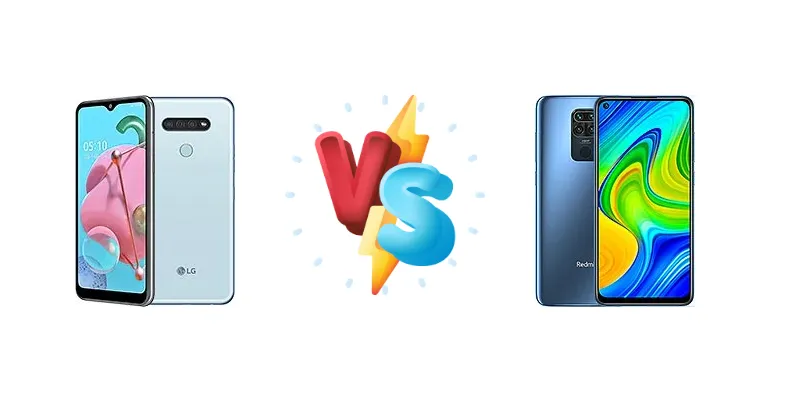
The LG Q51 and Xiaomi Redmi Note 9 represent compelling options in the sub-$200 smartphone market. While both aim to deliver essential features at an accessible price, they diverge significantly in their internal hardware, impacting performance and overall user experience. This comparison dissects these differences to determine which device offers the best value.
🏆 Quick Verdict
For most users, the Xiaomi Redmi Note 9 emerges as the superior choice. Its Helio G85 chipset, featuring more powerful Cortex-A75 cores, provides a noticeable performance boost over the LG Q51’s Helio P22. While both offer similar battery endurance, the Redmi Note 9’s 18W charging is a significant convenience advantage.
| Network |
|---|
| 2G bands | GSM 850 / 900 / 1800 / 1900 | GSM 850 / 900 / 1800 / 1900 |
| 3G bands | HSDPA 850 / 900 / 1900 / 2100 | HSDPA 850 / 900 / 1700(AWS) / 1900 / 2100 |
| 4G bands | 1, 3, 7, 8, 20 | 1, 2, 3, 4, 5, 7, 8, 20, 28, 38, 40, 41 |
| Speed | HSPA 42.2/5.76 Mbps, LTE (2CA) Cat6 300/75 Mbps | HSPA, LTE |
| Technology | GSM / HSPA / LTE | GSM / HSPA / LTE |
| Launch |
|---|
| Announced | 2020, February 25. Released 2020, February 26 | 2020, April 30 |
| Status | Discontinued | Available. Released 2020, May 12 |
| Body |
|---|
| Build | - | Glass front (Gorilla Glass 5), plastic frame, plastic back |
| Dimensions | 164.5 x 77.5 x 8.4 mm (6.48 x 3.05 x 0.33 in) | 162.3 x 77.2 x 8.9 mm (6.39 x 3.04 x 0.35 in) |
| SIM | Nano-SIM + Nano-SIM | Nano-SIM + Nano-SIM |
| Weight | - | 199 g (7.02 oz) |
| | MIL-STD-810G compliant*
*does not guarantee ruggedness or use in extreme conditions | Water-repellent coating |
| Display |
|---|
| Protection | - | Corning Gorilla Glass 5 |
| Resolution | 720 x 1520 pixels, 19:9 ratio (~259 ppi density) | 1080 x 2340 pixels, 19.5:9 ratio (~395 ppi density) |
| Size | 6.5 inches, 105.5 cm2 (~82.7% screen-to-body ratio) | 6.53 inches, 104.7 cm2 (~83.5% screen-to-body ratio) |
| Type | IPS LCD | IPS LCD, 450 nits (typ) |
| Platform |
|---|
| CPU | Octa-core 2.0 GHz Cortex-A53 | Octa-core (2x2.0 GHz Cortex-A75 & 6x1.8 GHz Cortex-A55) |
| Chipset | Mediatek MT6762 Helio P22 (12 nm) | Mediatek MT6769Z Helio G85 (12 nm) |
| GPU | PowerVR GE8320 | Mali-G52 MC2 |
| OS | Android 10 | Android 10, upgradable to Android 12, MIUI 13 |
| Memory |
|---|
| Card slot | microSDXC (dedicated slot) | microSDXC (dedicated slot) |
| Internal | 32GB 3GB RAM | 64GB 3GB RAM, 64GB 4GB RAM, 128GB 4GB RAM, 128GB 6GB RAM |
| | eMMC 5.1 | - |
| Main Camera |
|---|
| Features | LED flash, panorama, HDR | LED flash, HDR, panorama |
| Quad | - | 48 MP, f/1.8, 26mm (wide), 1/2.0", 0.8µm, PDAF
8 MP, f/2.2, 118˚ (ultrawide), 1/4.0", 1.12µm
2 MP (macro), AF
Auxiliary lens |
| Triple | 13 MP, (wide), PDAF
5 MP, 13mm (ultrawide)
Auxiliary lens | - |
| Video | 1080p@30fps | 1080p@30fps |
| Selfie camera |
|---|
| Features | - | HDR, panorama |
| Single | 13 MP, (wide), 1/3.1", 1.12µm | 13 MP, f/2.3, 29mm (standard), 1/3.1", 1.12µm |
| Video | 1080p@30fps | 1080p@30fps |
| Sound |
|---|
| 3.5mm jack | Yes | Yes |
| 35mm jack | Yes | Yes |
| Loudspeaker | Yes, with stereo speakers | Yes |
| Comms |
|---|
| Bluetooth | 5.0, A2DP, LE | 5.0, A2DP, LE |
| Infrared port | - | Yes |
| NFC | Yes | Yes (market/region dependent)M2003J15SG (Yes); M2003J15SS (No) |
| Positioning | GPS | GPS, GLONASS, GALILEO, BDS |
| Radio | No | FM radio, built-in antenna |
| USB | USB Type-C 2.0 | USB Type-C 2.0 |
| WLAN | Wi-Fi 802.11 a/b/g/n/ac, dual-band, Wi-Fi Direct, DLNA | Wi-Fi 802.11 a/b/g/n/ac, dual-band, Wi-Fi Direct |
| Features |
|---|
| Sensors | Fingerprint (rear-mounted), accelerometer, proximity, compass | Fingerprint (rear-mounted), accelerometer, gyro, proximity, compass |
| Battery |
|---|
| Charging | - | 18W wired
9W reverse wired |
| Type | Li-Po 4000 mAh | Li-Po 5020 mAh |
| Misc |
|---|
| Colors | Frozen White, Moonlight Titanium | Forest Green, Midnight Grey, Polar White |
| Models | LM-Q510N | M2003J15SC, M2003J15SG, M2003J15SS |
| Price | About 240 EUR | € 88.99 / $ 85.68 / £ 136.28 |
| SAR | - | 0.84 W/kg (head) 0.90 W/kg (body) |
| SAR EU | - | 0.80 W/kg (head) 1.14 W/kg (body) |
| Tests |
|---|
| Battery life | - | Endurance rating 125h |
| Camera | - |
Photo / Video |
| Display | - |
Contrast ratio: 1242:1 (nominal) |
| Loudspeaker | - |
-30.1 LUFS (Below average) |
| Performance | - |
AnTuTu: 200414 (v8)
GeekBench: 1292 (v5.1) |
LG Q51
- Potentially lower price point
- Simple and straightforward Android experience
- Decent battery endurance
- Significantly weaker processor
- Lacks fast charging
- Likely inferior camera performance
Xiaomi Redmi Note 9
- More powerful processor for smoother performance
- 18W fast charging for quicker top-ups
- 9W reverse wired charging
- Brighter display
- Slightly higher price
- Xiaomi’s MIUI software can be polarizing
Display Comparison
Both the LG Q51 and Redmi Note 9 feature displays with a 1242:1 contrast ratio, suggesting similar visual pop. However, the Redmi Note 9 boasts a measured peak brightness of 370 nits, which will translate to better visibility outdoors compared to the LG Q51, whose brightness is not specified. While neither display is groundbreaking, the Redmi Note 9’s higher brightness provides a tangible advantage in real-world usage.
Camera Comparison
Both devices are listed as having Photo/Video capabilities, but detailed sensor information is absent. Given the market positioning, it’s safe to assume both rely on relatively basic camera systems. Without specific megapixel counts or aperture details, it’s difficult to definitively declare a winner. However, Xiaomi generally invests more in camera software processing, potentially giving the Redmi Note 9 an edge in image quality, even with similar hardware. The presence of a 2MP macro lens on the Redmi Note 9 is unlikely to be a deciding factor for most users.
Performance
The core difference lies in the chipsets. The Redmi Note 9’s Mediatek Helio G85 utilizes a combination of 2x 2.0 GHz Cortex-A75 and 6x 1.8 GHz Cortex-A55 cores, a significant upgrade over the LG Q51’s Helio P22’s Octa-core 2.0 GHz Cortex-A53 setup. The A75 cores in the G85 are architecturally more advanced, offering substantially better single-core performance, crucial for app launch speeds and general responsiveness. This translates to a smoother experience when switching between apps and handling more demanding tasks on the Redmi Note 9. The LG Q51 will feel noticeably slower in these scenarios.
Battery Life
Both the LG Q51 and Redmi Note 9 achieve an endurance rating of 125 hours, indicating comparable battery life under similar usage conditions. However, the Redmi Note 9’s 18W wired charging capability is a major advantage. This allows for significantly faster charging times compared to the LG Q51, which lacks fast charging support. The Redmi Note 9 also offers 9W reverse wired charging, a feature absent on the LG Q51, allowing it to top up other devices, albeit slowly.
Buying Guide
Buy the LG Q51 if you prioritize a simple, no-frills Android experience and are on an extremely tight budget. It’s a functional device for basic tasks. Buy the Xiaomi Redmi Note 9 if you value smoother multitasking, occasional gaming, and faster charging. The Redmi Note 9 offers a more responsive and versatile experience for a slightly higher price.
Frequently Asked Questions
❓ Is the Helio G85 in the Redmi Note 9 powerful enough for gaming?
The Helio G85 is a capable chipset for casual gaming. While it won't handle the most demanding titles at maximum settings, it can comfortably run popular games like PUBG Mobile and Call of Duty Mobile at medium settings with playable frame rates. The LG Q51’s Helio P22 will struggle with these games.
❓ Does the Redmi Note 9 support software updates for a long period?
Xiaomi typically provides at least two major Android updates and several security patches for its Redmi Note series. However, update support can vary. It's advisable to check Xiaomi's official website for the Redmi Note 9's specific update roadmap. LG's update support for the Q51 is likely to be more limited.
❓ What type of charging port does each phone use?
Both the LG Q51 and Xiaomi Redmi Note 9 utilize a micro-USB port for charging and data transfer. This is a standard, but older, connection type. Newer phones are moving to USB-C.