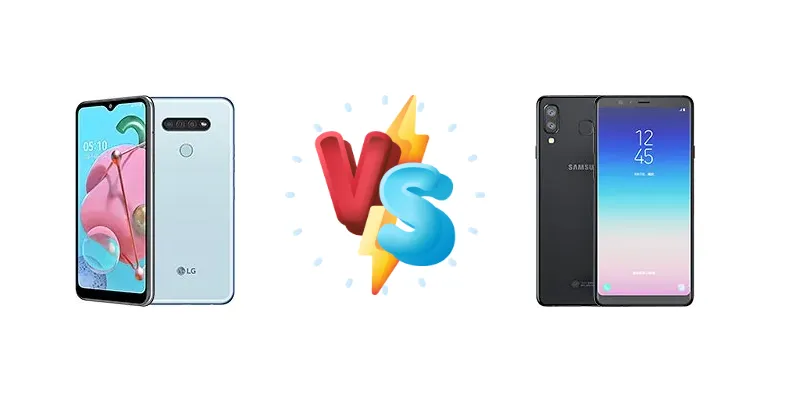
The Samsung Galaxy A8 Star (also known as A9 Star in some markets) and the LG Q51 represent different approaches to the budget smartphone segment. The A8 Star, released in 2018, aimed for a balance of features and performance with a Qualcomm Snapdragon 660, while the LG Q51, from 2019, focused on affordability with a MediaTek Helio P22. This comparison dissects their key differences to determine which offers the best value today.
🏆 Quick Verdict
For the average user, the Samsung Galaxy A8 Star (A9 Star) is the superior choice. Its Snapdragon 660 chipset provides a significantly more responsive experience for multitasking and gaming, offsetting the LG Q51’s slightly newer release date. While the Q51 is more affordable, the A8 Star’s performance advantage justifies the potential price difference.
| Network |
|---|
| 2G bands | GSM 850 / 900 / 1800 / 1900 | GSM 850 / 900 / 1800 / 1900 |
| 3G bands | HSDPA 850 / 900 / 1900 / 2100 | HSDPA 850 / 900 / 1900 / 2100 |
| 4G bands | 1, 3, 7, 8, 20 | 1, 3, 4, 5, 7, 8, 12, 17, 34, 38, 39, 40, 41 - Global |
| Speed | HSPA 42.2/5.76 Mbps, LTE (2CA) Cat6 300/75 Mbps | HSPA 42.2/5.76 Mbps, LTE (3CA) Cat9 450/50 Mbps |
| Technology | GSM / HSPA / LTE | GSM / CDMA / HSPA / LTE |
| | - | 1, 3, 8, 34, 38, 39, 40, 41 - China |
| Launch |
|---|
| Announced | 2020, February 25. Released 2020, February 26 | 2018, June. Released 2018, June |
| Status | Discontinued | Discontinued |
| Body |
|---|
| Build | - | Glass front (Gorilla Glass 5), glass back (Gorilla Glass 5), aluminum frame |
| Dimensions | 164.5 x 77.5 x 8.4 mm (6.48 x 3.05 x 0.33 in) | 162.4 x 77 x 7.6 mm (6.39 x 3.03 x 0.30 in) |
| SIM | Nano-SIM + Nano-SIM | Nano-SIM + Nano-SIM |
| Weight | - | 191 g (6.74 oz) |
| | MIL-STD-810G compliant*
*does not guarantee ruggedness or use in extreme conditions | - |
| Display |
|---|
| Protection | - | Corning Gorilla Glass 5 |
| Resolution | 720 x 1520 pixels, 19:9 ratio (~259 ppi density) | 1080 x 2220 pixels, 18.5:9 ratio (~392 ppi density) |
| Size | 6.5 inches, 105.5 cm2 (~82.7% screen-to-body ratio) | 6.3 inches, 100.7 cm2 (~80.6% screen-to-body ratio) |
| Type | IPS LCD | Super AMOLED |
| | - | Samsung Experience 9 UX |
| Platform |
|---|
| CPU | Octa-core 2.0 GHz Cortex-A53 | Octa-core (4x2.2 GHz Kryo 260 Gold & 4x1.8 GHz Kryo 260 Silver) |
| Chipset | Mediatek MT6762 Helio P22 (12 nm) | Qualcomm SDM660 Snapdragon 660 (14 nm) |
| GPU | PowerVR GE8320 | Adreno 512 |
| OS | Android 10 | Android 8.0 (Oreo), upgradable to Android 9.0 (Pie), One UI |
| Memory |
|---|
| Card slot | microSDXC (dedicated slot) | microSDXC (uses shared SIM slot) |
| Internal | 32GB 3GB RAM | 64GB 4GB RAM, 64GB 6GB RAM |
| | eMMC 5.1 | eMMC 5.1 |
| Main Camera |
|---|
| Dual | - | 24 MP, f/1.7, 27mm (wide), 1/2.8", 0.9µm, PDAF
16 MP, f/1.7, PDAF |
| Features | LED flash, panorama, HDR | LED flash, panorama, HDR |
| Triple | 13 MP, (wide), PDAF
5 MP, 13mm (ultrawide)
Auxiliary lens | - |
| Video | 1080p@30fps | 4K@30fps, 1080p@30fps |
| Selfie camera |
|---|
| Single | 13 MP, (wide), 1/3.1", 1.12µm | 24 MP, f/2.0, 26mm (wide), 1/2.8", 0.9µm |
| Video | 1080p@30fps | 1080p@30fps |
| Sound |
|---|
| 3.5mm jack | Yes | Yes |
| 35mm jack | Yes | Yes |
| Loudspeaker | Yes, with stereo speakers | Yes |
| Comms |
|---|
| Bluetooth | 5.0, A2DP, LE | 5.0, A2DP, LE |
| NFC | Yes | Yes |
| Positioning | GPS | GPS, GLONASS, BDS, GALILEO |
| Radio | No | FM radio |
| USB | USB Type-C 2.0 | USB Type-C 2.0 |
| WLAN | Wi-Fi 802.11 a/b/g/n/ac, dual-band, Wi-Fi Direct, DLNA | Wi-Fi 802.11 a/b/g/n/ac, dual-band, Wi-Fi Direct |
| Features |
|---|
| Sensors | Fingerprint (rear-mounted), accelerometer, proximity, compass | Fingerprint (rear-mounted), accelerometer, gyro, proximity, compass |
| | - | ANT+
Samsung Pay |
| Battery |
|---|
| Charging | - | 15W wired |
| Type | Li-Po 4000 mAh | Li-Ion 3700 mAh, non-removable |
| Misc |
|---|
| Colors | Frozen White, Moonlight Titanium | Black, White |
| Models | LM-Q510N | SM-G885F, SM-G8850, SM-G885Y, SM-G885S, SM-G8858 |
| Price | About 240 EUR | About 350 EUR |
| SAR EU | - | 0.43 W/kg (head) 1.79 W/kg (body) |
LG Q51
- Significantly better performance with Snapdragon 660
- Faster 15W wired charging
- Potentially superior camera image processing
- More responsive user experience
- Older device (released 2018)
- May be harder to find new
Samsung Galaxy A8 Star (A9 Star)
- More affordable price point
- Potentially longer battery life (depending on capacity)
- Newer device (released 2019)
- Easier to find new in some markets
- Substantially weaker performance with Helio P22
- Slower charging (likely)
- Less responsive user interface
- Struggles with demanding apps and games
Display Comparison
Neither device boasts a cutting-edge display. Details on panel type and resolution are missing, but both likely utilize IPS LCDs typical of their price range. The key difference lies in processing power impacting UI smoothness. The A8 Star’s more powerful chipset will contribute to a more fluid scrolling experience. While neither phone is expected to have high peak brightness, the A8 Star’s processor could potentially handle more efficient display calibration.
Camera Comparison
Without detailed camera specifications, a direct comparison is challenging. However, the A8 Star likely benefits from Qualcomm’s image signal processor (ISP) within the Snapdragon 660, offering potentially better image processing and noise reduction. The LG Q51 relies on the ISP integrated within the Helio P22, which is less sophisticated. While both phones likely feature multiple rear cameras, the A8 Star’s processing power will likely result in more detailed and vibrant photos, especially in low-light conditions. The presence of OIS on the A8 Star (a common feature in Samsung’s mid-range phones of that era) would further enhance image quality.
Performance
The Samsung Galaxy A8 Star’s Qualcomm Snapdragon 660 (14nm) is the clear winner here. Its octa-core CPU, featuring a combination of 2.2 GHz Kryo 260 Gold and 1.8 GHz Kryo 260 Silver cores, offers significantly more processing power than the LG Q51’s MediaTek Helio P22 (12nm). The Snapdragon 660’s architecture, with performance and efficiency cores, allows for better multitasking and more demanding applications. The Helio P22, comprised entirely of Cortex-A53 cores at 2.0 GHz, will struggle with heavier workloads. This translates to noticeable lag when switching between apps or playing graphically intensive games on the Q51.
Battery Life
Battery capacity details are missing for both devices. However, the Samsung Galaxy A8 Star’s 15W wired charging is a notable advantage. The LG Q51’s charging speed is unknown, but likely slower. While a larger battery capacity on the Q51 could offset the slower charging, the Snapdragon 660’s more efficient architecture in the A8 Star could result in comparable or even better real-world battery life despite a potentially smaller capacity. The 15W charging on the A8 Star allows for quicker top-ups when needed.
Buying Guide
Buy the LG Q51 if you prioritize extreme affordability and basic smartphone functionality – checking emails, light social media, and occasional calls. It’s a suitable option for first-time smartphone users or those on a very tight budget. Buy the Samsung Galaxy A8 Star (A9 Star) if you value smoother performance for everyday tasks, enjoy occasional mobile gaming, and appreciate a more refined user experience. The Snapdragon 660 offers a noticeable step up in responsiveness.
Frequently Asked Questions
❓ Will the LG Q51 struggle with popular apps like Facebook and Instagram?
While the LG Q51 can run these apps, you may experience noticeable lag when scrolling through feeds or loading images, especially with multiple apps open simultaneously. The Helio P22 chipset is not optimized for the demands of modern social media applications.
❓ Is the Snapdragon 660 in the Samsung Galaxy A8 Star (A9 Star) capable of playing modern mobile games?
The Snapdragon 660 can handle many popular mobile games at medium settings. However, demanding titles like PUBG Mobile or Call of Duty: Mobile may require lower graphics settings to maintain a smooth frame rate. It won't deliver a flagship gaming experience, but it's significantly better than the LG Q51.
❓ How does the 15W charging on the A8 Star compare to typical budget phone charging speeds?
15W charging was relatively fast for a phone in the A8 Star’s price range at the time of release. Many budget phones today offer faster charging, but 15W still provides a noticeable improvement over slower 5W or 10W charging, allowing for quicker top-ups.