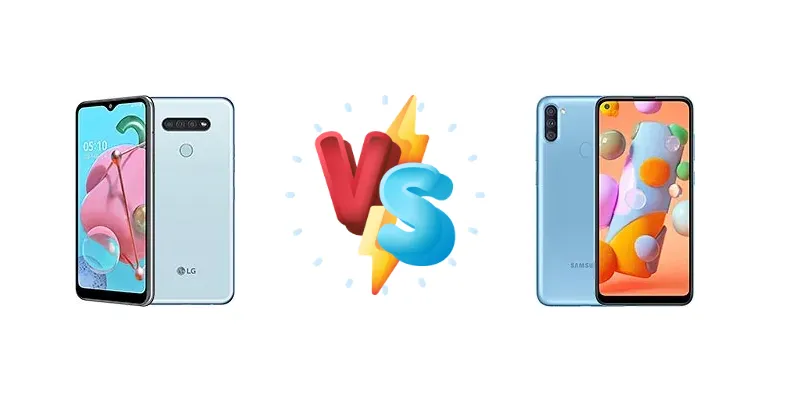
The LG Q51 and Samsung Galaxy A11 represent the lower end of the smartphone spectrum, targeting users prioritizing affordability. Both devices aim to deliver essential smartphone functionality, but differ significantly in their underlying hardware. This comparison dissects these differences, focusing on performance, battery, and overall user experience to determine which device offers the best value.
🏆 Quick Verdict
For the average user seeking a balance between performance and efficiency, the LG Q51 is the better choice. Its Mediatek Helio P22, built on a 12nm process, offers a slight edge in power efficiency over the Samsung Galaxy A11’s 14nm Snapdragon 450, translating to potentially longer battery life during sustained use.
| Network |
|---|
| 2G bands | GSM 850 / 900 / 1800 / 1900 | GSM 850 / 900 / 1800 / 1900 |
| 3G bands | HSDPA 850 / 900 / 1900 / 2100 | HSDPA 850 / 900 / 1900 / 2100 |
| 4G bands | 1, 3, 7, 8, 20 | 1, 2, 3, 5, 7, 8, 20, 28, 38, 40, 41 |
| Speed | HSPA 42.2/5.76 Mbps, LTE (2CA) Cat6 300/75 Mbps | HSPA 42.2/5.76 Mbps, LTE Cat4 150/50 Mbps |
| Technology | GSM / HSPA / LTE | GSM / HSPA / LTE |
| | - | 1, 2, 3, 4, 5, 7, 8, 12, 13, 17, 20, 25, 26, 28, 38, 39, 40, 41, 66, 71 - SM-A115U |
| Launch |
|---|
| Announced | 2020, February 25. Released 2020, February 26 | 2020, March 13. Released 2020, May 01 |
| Status | Discontinued | Discontinued |
| Body |
|---|
| Build | - | Glass front, plastic back, plastic frame |
| Dimensions | 164.5 x 77.5 x 8.4 mm (6.48 x 3.05 x 0.33 in) | 161.4 x 76.3 x 8 mm (6.35 x 3.00 x 0.31 in) |
| SIM | Nano-SIM + Nano-SIM | · Nano-SIM· Nano-SIM + Nano-SIM |
| Weight | - | 177 g (6.24 oz) |
| | MIL-STD-810G compliant*
*does not guarantee ruggedness or use in extreme conditions | - |
| Display |
|---|
| Resolution | 720 x 1520 pixels, 19:9 ratio (~259 ppi density) | 720 x 1560 pixels, 19.5:9 ratio (~268 ppi density) |
| Size | 6.5 inches, 105.5 cm2 (~82.7% screen-to-body ratio) | 6.4 inches, 100.5 cm2 (~81.6% screen-to-body ratio) |
| Type | IPS LCD | PLS LCD |
| Platform |
|---|
| CPU | Octa-core 2.0 GHz Cortex-A53 | Octa-core 1.8 GHz Cortex-A53 |
| Chipset | Mediatek MT6762 Helio P22 (12 nm) | Qualcomm SDM450 Snapdragon 450 (14 nm) |
| GPU | PowerVR GE8320 | Adreno 506 |
| OS | Android 10 | Android 10, upgradable to Android 12, One UI Core 4.1 |
| Memory |
|---|
| Card slot | microSDXC (dedicated slot) | microSDXC (dedicated slot) |
| Internal | 32GB 3GB RAM | 32GB 2GB RAM, 32GB 3GB RAM, 64GB 3GB RAM, 64GB 4GB RAM |
| | eMMC 5.1 | eMMC 5.1 |
| Main Camera |
|---|
| Features | LED flash, panorama, HDR | LED flash, panorama, HDR |
| Triple | 13 MP, (wide), PDAF
5 MP, 13mm (ultrawide)
Auxiliary lens | 13 MP, f/1.8, 27mm (wide), AF
5 MP, f/2.2, 115˚ (ultrawide)
Auxiliary lens |
| Video | 1080p@30fps | 1080p@30fps |
| Selfie camera |
|---|
| Single | 13 MP, (wide), 1/3.1", 1.12µm | 8 MP, f/2.0 |
| Video | 1080p@30fps | 1080p@30fps |
| Sound |
|---|
| 3.5mm jack | Yes | Yes |
| 35mm jack | Yes | Yes |
| Loudspeaker | Yes, with stereo speakers | Yes |
| Comms |
|---|
| Bluetooth | 5.0, A2DP, LE | 4.2, A2DP, LE |
| NFC | Yes | No |
| Positioning | GPS | GPS, GLONASS, GALILEO, BDS |
| Radio | No | FM radio |
| USB | USB Type-C 2.0 | USB Type-C 2.0 |
| WLAN | Wi-Fi 802.11 a/b/g/n/ac, dual-band, Wi-Fi Direct, DLNA | Wi-Fi 802.11 b/g/n, Wi-Fi Direct |
| Features |
|---|
| Sensors | Fingerprint (rear-mounted), accelerometer, proximity, compass | Fingerprint (rear-mounted), accelerometer, proximity |
| Battery |
|---|
| Charging | - | 15W wired |
| Type | Li-Po 4000 mAh | Li-Po 4000 mAh |
| Misc |
|---|
| Colors | Frozen White, Moonlight Titanium | Black, White, Blue, Red |
| Models | LM-Q510N | SM-A115F/DS, SM-A115F, SM-A115M, SM-A115M/DS, SM-A115U, SM-A115A, SM-A115AZ, SM-A115U1, SM-A115W, SM-A115AP, SM-S115DL |
| Price | About 240 EUR | About 160 EUR |
| SAR EU | - | 0.52 W/kg (head) 0.99 W/kg (body) |
LG Q51
- More power-efficient chipset (Helio P22 12nm)
- Potentially better sustained performance
- Likely more affordable
- Slower charging speed (likely 10W)
- Less established brand recognition
Samsung Galaxy A11
- Faster 15W wired charging
- Samsung’s established software ecosystem
- Wider availability in some markets
- Less power-efficient chipset (Snapdragon 450 14nm)
- Potentially more thermal throttling
- May be slightly more expensive
Display Comparison
Neither device boasts a standout display. Both likely feature LCD panels, typical for this price bracket. Specifics like resolution and brightness are not provided, but we can infer that they are similar, aiming for adequate visibility rather than vibrant color accuracy. The absence of high refresh rates or advanced panel technologies like LTPO is expected. Bezels are likely substantial on both, maximizing screen real estate within a budget-friendly form factor.
Camera Comparison
Without detailed sensor information, a direct camera comparison is difficult. Both devices likely feature a primary camera alongside supplementary lenses (often 2MP macro or depth sensors of limited utility). The aperture and sensor size of the main sensor are crucial, but unspecified. Image processing will also play a significant role, with Samsung typically favoring more saturated and vibrant images, while LG often aims for a more natural look. The lack of Optical Image Stabilization (OIS) on either device suggests image quality will suffer in low-light conditions.
Performance
The core difference lies in the chipsets. The LG Q51’s Mediatek Helio P22 (12nm) and the Samsung Galaxy A11’s Qualcomm Snapdragon 450 (14nm) both utilize an octa-core Cortex-A53 CPU clocked at 2.0 GHz and 1.8 GHz respectively. However, the 12nm fabrication process of the Helio P22 generally results in better power efficiency compared to the 14nm process of the Snapdragon 450. This means the Q51 may exhibit less thermal throttling under sustained load, maintaining performance for longer periods. While both are adequate for basic tasks, the Q51 has a slight advantage in sustained performance.
Battery Life
Battery capacity is not specified for either device. However, the Samsung Galaxy A11 includes 15W wired charging, a notable advantage over the LG Q51, which likely supports standard 10W charging. This means the A11 can replenish its battery significantly faster, a crucial benefit for users who frequently need to top up their charge. While the Q51’s more efficient chipset *may* result in slightly longer overall battery life, the A11’s faster charging offers a more convenient user experience.
Buying Guide
Buy the LG Q51 if you prioritize sustained performance and potentially longer battery life for everyday tasks like browsing, social media, and light multimedia consumption. Buy the Samsung Galaxy A11 if faster charging is a critical requirement, and you frequently find yourself needing to quickly top up your battery, even if it means slightly reduced overall runtime. The A11 also benefits from Samsung's established software ecosystem.
Frequently Asked Questions
❓ Will the Snapdragon 450 in the Galaxy A11 struggle with multitasking compared to the Helio P22?
While both chipsets are entry-level, the Helio P22’s slightly more efficient architecture may provide a smoother multitasking experience, especially when running multiple apps simultaneously. However, the difference will likely be noticeable only with heavier usage.
❓ Is the 15W charging on the Galaxy A11 a significant advantage in real-world use?
Yes, 15W charging is a considerable benefit. It allows you to quickly top up the battery during short breaks, reducing downtime compared to the slower charging speeds likely found on the LG Q51. This is particularly useful for users who are frequently on the go.
❓ Can either of these phones handle modern mobile games like PUBG or Call of Duty?
Both phones will struggle with demanding games like PUBG or Call of Duty at higher settings. You'll likely need to play at the lowest graphics settings and frame rates to achieve a playable experience, and even then, expect occasional stuttering and lag. They are better suited for less graphically intensive games.
❓ Which phone is likely to receive more software updates?
Samsung generally provides more consistent and longer-term software support for its devices compared to LG. While neither phone is guaranteed to receive major Android version updates, the Galaxy A11 is more likely to receive security patches and minor software improvements.