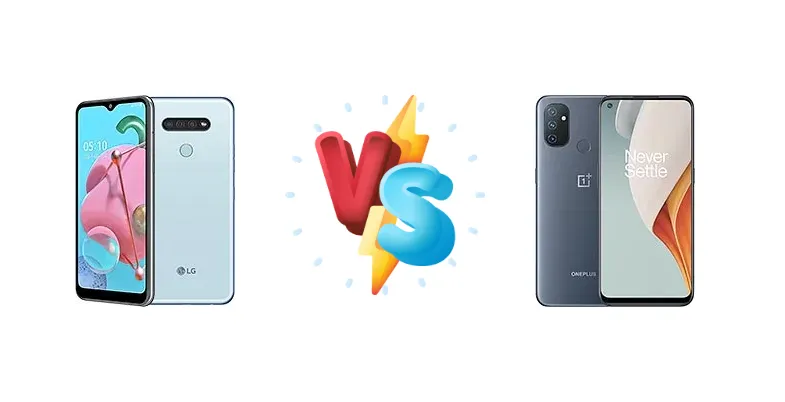
The sub-$150 smartphone market is fiercely competitive. The LG Q51, with its established brand presence, faces off against the OnePlus Nord N100, a newcomer aiming to disrupt with a more modern chipset. This comparison dives deep into the specifications and real-world implications to determine which device offers the best value for budget-conscious consumers.
🏆 Quick Verdict
For most users, the OnePlus Nord N100 is the better choice. Its Qualcomm Snapdragon 460, built on an 11nm process, delivers noticeably improved performance over the LG Q51’s older Mediatek Helio P22. While the Q51 may have a slightly longer software support history, the N100’s faster charging and more efficient processor make it the more practical option.
| Network |
|---|
| 2G bands | GSM 850 / 900 / 1800 / 1900 | GSM 850 / 900 / 1800 / 1900 |
| 3G bands | HSDPA 850 / 900 / 1900 / 2100 | HSDPA 850 / 900 / 1700(AWS) / 1900 / 2100 |
| 4G bands | 1, 3, 7, 8, 20 | 1, 2, 3, 4, 5, 7, 8, 12, 17, 20, 28, 38, 40, 41 - International |
| Speed | HSPA 42.2/5.76 Mbps, LTE (2CA) Cat6 300/75 Mbps | HSPA 42.2/5.76 Mbps, LTE Cat13 400/50 Mbps |
| Technology | GSM / HSPA / LTE | GSM / CDMA / HSPA / LTE |
| | - | 1, 2, 3, 4, 5, 7, 8, 12, 13, 17, 20, 25, 26, 28, 38, 41, 66, 71 - USA |
| Launch |
|---|
| Announced | 2020, February 25. Released 2020, February 26 | 2020, October 26 |
| Status | Discontinued | Available. Released 2020, November 11 |
| Body |
|---|
| Build | - | Glass front (Gorilla Glass 3), plastic frame |
| Dimensions | 164.5 x 77.5 x 8.4 mm (6.48 x 3.05 x 0.33 in) | 164.9 x 75.1 x 8.5 mm (6.49 x 2.96 x 0.33 in) |
| SIM | Nano-SIM + Nano-SIM | Nano-SIM + Nano-SIM |
| Weight | - | 188 g (6.63 oz) |
| | MIL-STD-810G compliant*
*does not guarantee ruggedness or use in extreme conditions | - |
| Display |
|---|
| Protection | - | Corning Gorilla Glass 3 |
| Resolution | 720 x 1520 pixels, 19:9 ratio (~259 ppi density) | 720 x 1600 pixels, 20:9 ratio (~269 ppi density) |
| Size | 6.5 inches, 105.5 cm2 (~82.7% screen-to-body ratio) | 6.52 inches, 102.6 cm2 (~82.9% screen-to-body ratio) |
| Type | IPS LCD | IPS LCD, 90Hz |
| Platform |
|---|
| CPU | Octa-core 2.0 GHz Cortex-A53 | Octa-core (4x1.8 GHz Kryo 240 & 4x1.6 GHz Kryo 240) |
| Chipset | Mediatek MT6762 Helio P22 (12 nm) | Qualcomm SM4250 Snapdragon 460 (11 nm) |
| GPU | PowerVR GE8320 | Adreno 610 |
| OS | Android 10 | Android 10, OxygenOS 10.5.9 |
| Memory |
|---|
| Card slot | microSDXC (dedicated slot) | microSDXC |
| Internal | 32GB 3GB RAM | 64GB 4GB RAM |
| | eMMC 5.1 | UFS 2.1 |
| Main Camera |
|---|
| Features | LED flash, panorama, HDR | LED flash, HDR, panorama |
| Triple | 13 MP, (wide), PDAF
5 MP, 13mm (ultrawide)
Auxiliary lens | 13 MP, f/2.2, (wide), PDAF
2 MP (macro)
Auxiliary lens |
| Video | 1080p@30fps | 1080p@30fps, gyro-EIS |
| Selfie camera |
|---|
| Features | - | HDR |
| Single | 13 MP, (wide), 1/3.1", 1.12µm | 8 MP, f/2.0 |
| Video | 1080p@30fps | 1080p@30fps |
| Sound |
|---|
| 3.5mm jack | Yes | Yes |
| 35mm jack | Yes | Yes |
| Loudspeaker | Yes, with stereo speakers | Yes, with stereo speakers |
| Comms |
|---|
| Bluetooth | 5.0, A2DP, LE | 5.0, A2DP, LE |
| NFC | Yes | - |
| Positioning | GPS | GPS, GLONASS, GALILEO, BDS |
| Radio | No | FM radio |
| USB | USB Type-C 2.0 | USB Type-C 2.0, OTG |
| WLAN | Wi-Fi 802.11 a/b/g/n/ac, dual-band, Wi-Fi Direct, DLNA | Wi-Fi 802.11 a/b/g/n/ac, dual-band, Wi-Fi Direct |
| Features |
|---|
| Sensors | Fingerprint (rear-mounted), accelerometer, proximity, compass | Fingerprint (rear-mounted), accelerometer, gyro, proximity, compass |
| Battery |
|---|
| Charging | - | 18W wired |
| Type | Li-Po 4000 mAh | Li-Po 5000 mAh |
| Misc |
|---|
| Colors | Frozen White, Moonlight Titanium | Midnight Frost |
| Models | LM-Q510N | BE2013, BE2015, BE2011, BE2012 |
| Price | About 240 EUR | About 80 EUR |
| Pricing |
|---|
| 64GB 4GB RAM | - | $ 125.00 |
| RENEWED | - | $ 129.00 |
LG Q51
- Established brand reputation
- Potentially longer software support (LG historically provides updates)
- May be available at a slightly lower price point
- Older, less efficient Mediatek Helio P22 chipset
- Likely slower performance in demanding tasks
- Slower charging speeds (estimated)
OnePlus Nord N100
- More powerful and efficient Qualcomm Snapdragon 460 chipset
- Faster 18W wired charging
- Better multitasking and app loading speeds
- OnePlus’s software update commitment for this model is less certain
- May be slightly more expensive than the LG Q51
- Build quality may feel less premium
Display Comparison
Neither device boasts a standout display. Both likely utilize LCD panels, common in this price bracket. The lack of specified display specs for the Q51 makes a direct comparison difficult, but the N100’s focus on affordability suggests similar quality. Expect 720p+ resolution on both, adequate for the screen sizes, but lacking the sharpness of higher-resolution displays. Color accuracy and brightness will likely be average, suitable for indoor use but potentially washed out in direct sunlight.
Camera Comparison
Camera performance is likely to be similar, leaning towards basic functionality on both devices. Without detailed sensor information, it’s difficult to make definitive claims. However, the focus should be on the main sensor; any 2MP macro or depth sensors included are unlikely to deliver significant image quality improvements. The Snapdragon 460’s image signal processor (ISP) likely offers slightly better image processing capabilities than the Helio P22’s, potentially resulting in more detailed and vibrant photos in good lighting conditions. Low-light performance will likely be a weakness on both.
Performance
The core difference lies in the chipsets. The OnePlus Nord N100’s Qualcomm Snapdragon 460 (11nm) is a significant upgrade over the LG Q51’s Mediatek Helio P22 (12nm). The 11nm process node allows for greater transistor density and improved power efficiency, translating to better sustained performance and less heat generation. While both are octa-core CPUs, the Snapdragon 460’s Kryo 240 cores, with their split clock speeds (1.8GHz & 1.6GHz), offer a more refined architecture than the Q51’s Cortex-A53 cores running at a uniform 2.0GHz. This means the N100 will handle multitasking and app loading more smoothly. The N100’s 4GB of RAM, paired with the Snapdragon 460, provides a more responsive user experience.
Battery Life
The OnePlus Nord N100’s 18W wired charging is a key advantage. While battery capacity isn’t specified for the Q51, the N100’s 5000mAh battery, combined with the more efficient Snapdragon 460, should provide all-day battery life for moderate users. The 18W charging will significantly reduce charging times compared to a standard 10W or 15W charger likely included with the Q51. This faster charging is a practical benefit for users who need to quickly top up their phone throughout the day.
Buying Guide
Buy the LG Q51 if you prioritize brand familiarity and potentially longer software update support, and your usage is limited to very basic tasks like calls, texts, and light social media. Buy the OnePlus Nord N100 if you want a phone that feels more responsive for everyday tasks, offers faster charging, and provides a better experience for casual gaming and multimedia consumption. The N100 is the clear choice for users who want a bit more future-proofing.
Frequently Asked Questions
❓ Will the Snapdragon 460 in the OnePlus Nord N100 handle popular games like PUBG Mobile?
While the Snapdragon 460 isn’t a gaming powerhouse, it can run PUBG Mobile at lower settings (balanced graphics, medium frame rate). Expect playable performance, but don’t anticipate a smooth experience at maximum settings. The Helio P22 in the LG Q51 will struggle significantly with PUBG Mobile, even on the lowest settings.
❓ How long will software updates be supported on the OnePlus Nord N100?
OnePlus’s software support for the Nord N100 is less defined than for their flagship devices. While it launched with Android 10, it has received updates to Android 12. Expect at least one more major Android update, but long-term support beyond that is uncertain. LG historically provided longer software support, but their mobile division has been discontinued, making future updates for the Q51 increasingly unlikely.
❓ Is the 64GB of storage on the OnePlus Nord N100 enough, and can it be expanded?
64GB is a minimum acceptable amount of storage in 2024, but it fills up quickly with apps, photos, and videos. Fortunately, the OnePlus Nord N100 supports microSD card expansion, allowing you to add up to 512GB of additional storage. The LG Q51 also likely supports microSD expansion, but the slower processor may impact app loading times from the card.