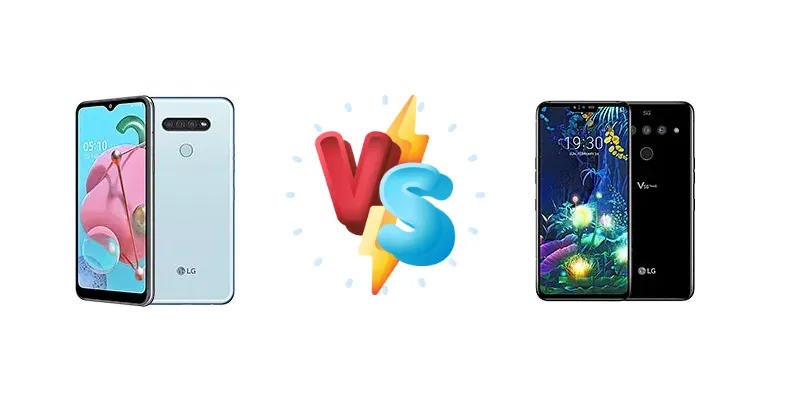
The LG V50 ThinQ 5G represented LG’s foray into 5G connectivity with a flagship feature set, while the Q51 aimed for the budget-conscious consumer. This comparison dissects the core differences between these two LG devices, focusing on how their contrasting hardware impacts real-world performance and user experience. We'll examine whether the V50's premium components justify its higher price point, or if the Q51 provides sufficient functionality for everyday tasks.
🏆 Quick Verdict
For most users, the LG V50 ThinQ 5G is the superior choice. Its Snapdragon 855 chipset provides significantly faster performance, crucial for demanding apps and future-proofing. While the Q51 offers affordability, its Helio P22 struggles with intensive tasks, making the V50 a worthwhile investment for power users.
| Network |
|---|
| 2G bands | GSM 850 / 900 / 1800 / 1900 | GSM 850 / 900 / 1800 / 1900 |
| 3G bands | HSDPA 850 / 900 / 1900 / 2100 | HSDPA 850 / 900 / 1700(AWS) / 1900 / 2100 - USA |
| 4G bands | 1, 3, 7, 8, 20 | 1, 2, 3, 4, 5, 7, 8, 12, 13, 17, 20, 25, 26, 28, 40, 41, 46, 66, 71 - USA |
| 5G bands | - | 41, 260, 261 NSA |
| Speed | HSPA 42.2/5.76 Mbps, LTE (2CA) Cat6 300/75 Mbps | HSPA 42.2/5.76 Mbps, LTE (6CA) Cat18 1200/75 Mbps, 5G (2+ Gbps DL) |
| Technology | GSM / HSPA / LTE | GSM / CDMA / HSPA / EVDO / LTE / 5G |
| | - | CDMA2000 1xEV-DO |
| Launch |
|---|
| Announced | 2020, February 25. Released 2020, February 26 | 2019, February 24. Released 2019, April 19 |
| Status | Discontinued | Discontinued |
| Body |
|---|
| Build | - | Glass front (Gorilla Glass 5), glass back (Gorilla Glass 6), aluminum frame |
| Dimensions | 164.5 x 77.5 x 8.4 mm (6.48 x 3.05 x 0.33 in) | 159.2 x 76.1 x 8.3 mm (6.27 x 3.00 x 0.33 in) |
| SIM | Nano-SIM + Nano-SIM | · Nano-SIM· Nano-SIM + Nano-SIM |
| Weight | - | 183 g (6.46 oz) |
| | MIL-STD-810G compliant*
*does not guarantee ruggedness or use in extreme conditions | IP68 dust/water resistant (up to 1.5m for 30 min)
MIL-STD-810G compliant*
*does not guarantee ruggedness or use in extreme conditions |
| Display |
|---|
| Protection | - | Corning Gorilla Glass 5 |
| Resolution | 720 x 1520 pixels, 19:9 ratio (~259 ppi density) | 1440 x 3120 pixels, 19.5:9 ratio (~538 ppi density) |
| Size | 6.5 inches, 105.5 cm2 (~82.7% screen-to-body ratio) | 6.4 inches, 100.2 cm2 (~82.7% screen-to-body ratio) |
| Type | IPS LCD | P-OLED, HDR10 |
| | - | Always-on display |
| Platform |
|---|
| CPU | Octa-core 2.0 GHz Cortex-A53 | Octa-core (1x2.84 GHz Kryo 485 & 3x2.42 GHz Kryo 485 & 4x1.78 GHz Kryo 485) |
| Chipset | Mediatek MT6762 Helio P22 (12 nm) | Qualcomm SM8150 Snapdragon 855 (7 nm) |
| GPU | PowerVR GE8320 | Adreno 640 |
| OS | Android 10 | Android 9.0 (Pie), upgradable to Android 11 |
| Memory |
|---|
| Card slot | microSDXC (dedicated slot) | microSDXC (dedicated slot) |
| Internal | 32GB 3GB RAM | 128GB 6GB RAM |
| | eMMC 5.1 | UFS 2.1 |
| Main Camera |
|---|
| Features | LED flash, panorama, HDR | LED flash, HDR, panorama |
| Triple | 13 MP, (wide), PDAF
5 MP, 13mm (ultrawide)
Auxiliary lens | 12 MP, 27mm (wide), f/1.5, 1/2.55", 1.4µm, dual pixel PDAF, 3-axis OIS
12 MP, 52mm (telephoto), f/2.4, 1/3.4", 1.0µm, 2x optical zoom, PDAF, OIS
16 MP, 16mm (ultrawide), f/1.9, 1/3.1", 1.0µm, no AF |
| Video | 1080p@30fps | 4K@30/60fps, 1080p@30/60/240fps, 24-bit/192kHz stereo sound rec., HDR10 video, gyro-EIS |
| Selfie camera |
|---|
| Dual | - | 8 MP, f/1.9, 26mm (wide), 1/4.0", 1.12µm
5 MP, 21mm (wide), f/2.2, 1/5.0", 1.12µm |
| Features | - | HDR |
| Single | 13 MP, (wide), 1/3.1", 1.12µm | - |
| Video | 1080p@30fps | 1080p@60fps |
| Sound |
|---|
| 3.5mm jack | Yes | Yes |
| 35mm jack | Yes | Yes |
| Loudspeaker | Yes, with stereo speakers | Yes, with stereo speakers |
| | - | 32-bit/192kHz audio
24-bit/192kHz audio recording
Tuned with Meridian Audio |
| Comms |
|---|
| Bluetooth | 5.0, A2DP, LE | 5.0, A2DP, LE, aptX HD |
| NFC | Yes | Yes |
| Positioning | GPS | GPS, GLONASS, GALILEO |
| Radio | No | FM radio |
| USB | USB Type-C 2.0 | USB Type-C 3.1 |
| WLAN | Wi-Fi 802.11 a/b/g/n/ac, dual-band, Wi-Fi Direct, DLNA | Wi-Fi 802.11 a/b/g/n/ac, dual-band, Wi-Fi Direct, DLNA |
| Features |
|---|
| Sensors | Fingerprint (rear-mounted), accelerometer, proximity, compass | Fingerprint (rear-mounted), accelerometer, gyro, proximity, compass, barometer |
| Battery |
|---|
| Charging | - | 18W wired, PD2.0, QC3, 50% in 36 min
10W wireless (Qi) |
| Type | Li-Po 4000 mAh | Li-Po 4000 mAh, non-removable |
| Misc |
|---|
| Colors | Frozen White, Moonlight Titanium | New Aurora Black |
| Models | LM-Q510N | LM-V500, LM-V500N, LM-V500EM, LM-V500XM, LM-V450PM, LM-V450 |
| Price | About 240 EUR | About 550 EUR |
| Tests |
|---|
| Audio quality | - |
Noise -92.5dB / Crosstalk -92.6dB |
| Battery life | - |
Endurance rating 96h
|
| Camera | - |
Photo / Video |
| Display | - |
Contrast ratio: 194000:1 (nominal) |
| Loudspeaker | - |
-25.2 LUFS (Very good)
|
| Performance | - |
AnTuTu: 343758 (v7), 421934 (v8)
GeekBench: 10928 (v4.4), 2672 (v5.1)
GFXBench: 22fps (ES 3.1 onscreen) |
LG Q51
- Extremely affordable price point.
- Decent battery life (96h endurance).
- Functional for basic smartphone tasks.
- Weak performance with the Helio P22 chipset.
- Limited camera capabilities.
- Likely lower display quality.
LG V50 ThinQ 5G
- Flagship-level performance with Snapdragon 855.
- Fast charging (18W wired, 10W wireless).
- Superior display quality (brightness, contrast).
- Higher price compared to the Q51.
- May be difficult to find new.
- Larger size and weight.
Display Comparison
The LG V50 ThinQ 5G boasts a brighter display, measured at 533 nits, offering better visibility in direct sunlight compared to the Q51 (brightness not specified, assumed lower). While both devices feature displays for photo and video consumption, the V50’s contrast ratio of 194000:1 suggests richer blacks and more vibrant colors. The Q51’s display specifications are limited, suggesting a more basic panel likely lacking the color accuracy and viewing angles of the V50’s flagship-grade screen.
Camera Comparison
Both phones feature photo and video capabilities, but details are sparse. The V50, being a flagship, likely incorporates more advanced image processing algorithms and potentially larger sensor sizes (not specified) for improved low-light performance. The Q51’s camera system is expected to be more basic, prioritizing affordability over image quality. Without specific sensor details, it’s difficult to make a precise comparison, but the V50’s higher-end chipset allows for more sophisticated computational photography.
Performance
The performance gap between these devices is substantial. The LG V50 ThinQ 5G’s Qualcomm Snapdragon 855 (7nm) is a flagship-tier chipset with an octa-core CPU configuration (1x2.84 GHz Kryo 485, 3x2.42 GHz Kryo 485, 4x1.78 GHz Kryo 485) designed for demanding workloads. In contrast, the LG Q51 utilizes the Mediatek MT6762 Helio P22 (12nm) with an octa-core 2.0 GHz Cortex-A53 CPU. The 7nm fabrication process of the Snapdragon 855 provides superior power efficiency and thermal management, resulting in sustained performance during prolonged use. The Q51’s Helio P22 will likely exhibit throttling under heavy load, impacting gaming and multitasking.
Battery Life
Both the LG V50 ThinQ 5G and the LG Q51 share an endurance rating of 96 hours, suggesting comparable battery life under similar usage conditions. However, the V50 offers significantly faster charging with 18W wired charging (PD2.0, QC3) reaching 50% in 36 minutes, and 10W wireless charging (Qi). The Q51’s charging specifications are not provided, implying a slower charging rate. The V50’s faster charging capabilities provide greater convenience, especially for users who frequently need to top up their battery.
Buying Guide
Buy the LG Q51 if you prioritize extreme affordability and only need a smartphone for basic communication, light social media, and occasional web browsing. Its Mediatek Helio P22 chipset is sufficient for these tasks. Buy the LG V50 ThinQ 5G if you demand smooth multitasking, enjoy mobile gaming, or want a phone capable of handling demanding applications and 5G connectivity. The Snapdragon 855 delivers a vastly superior experience.
Frequently Asked Questions
❓ Is the LG Q51 suitable for playing demanding mobile games like PUBG or Call of Duty?
The LG Q51’s Mediatek Helio P22 chipset is not well-suited for demanding games. While you might be able to run them at low settings, expect significant frame rate drops and potential overheating. The Q51 lacks the processing power and thermal management to provide a smooth gaming experience.
❓ Does the LG V50 ThinQ 5G still receive software updates?
Software update support for the LG V50 ThinQ 5G is limited, as LG has exited the smartphone market. While it may have received updates to Android 11 or 12, further major Android version updates are unlikely. Security patches may also be infrequent.
❓ What type of SIM cards does the LG V50 ThinQ 5G support?
The LG V50 ThinQ 5G supports a Nano-SIM card and also includes a microSDXC card slot for expandable storage, allowing users to increase the phone's internal capacity.
❓ How does the 5G connectivity on the V50 impact real-world battery life?
Utilizing 5G connectivity on the V50 ThinQ 5G will generally consume more battery power than using 4G LTE. However, the 96h endurance rating suggests the battery is sufficiently large to handle moderate 5G usage. Battery drain will be more noticeable during intensive 5G activities like streaming or downloading large files.