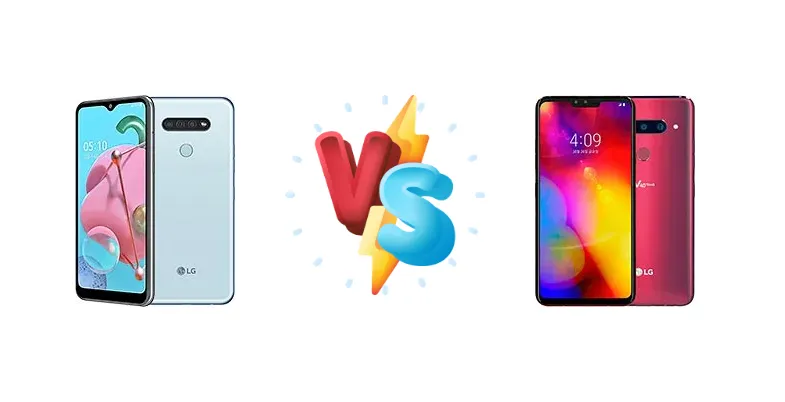
LG has a history of producing solid smartphones, but the Q51 and V40 ThinQ represent different eras and target audiences. The Q51 aimed for affordability, while the V40 ThinQ was a flagship powerhouse. Let's dive into a head-to-head comparison to see which phone holds up best today.
🏆 Quick Verdict
The LG V40 ThinQ is the clear winner. Despite its age, the Snapdragon 845 chipset, superior camera system, and faster charging significantly outperform the Q51. While the Q51 offers a more modern design and potentially better software support, the V40's overall performance and features justify its consideration.
| Network |
|---|
| 2G bands | GSM 850 / 900 / 1800 / 1900 | GSM 850 / 900 / 1800 / 1900 |
| 3G bands | HSDPA 850 / 900 / 1900 / 2100 | HSDPA 850 / 900 / 1700(AWS) / 1900 / 2100 - V405QA7 |
| 4G bands | 1, 3, 7, 8, 20 | 1, 2, 3, 4, 5, 7, 8, 12, 13, 14, 17, 20, 25, 26, 28, 29, 30, 38, 39, 40, 41, 46, 66, 71 - V405QA7 |
| Speed | HSPA 42.2/5.76 Mbps, LTE (2CA) Cat6 300/75 Mbps | HSPA 42.2/5.76 Mbps, LTE (4CA) Cat16 1024/150 Mbps |
| Technology | GSM / HSPA / LTE | GSM / CDMA / HSPA / EVDO / LTE |
| | - | CDMA2000 1xEV-DO - V405QA7 |
| Launch |
|---|
| Announced | 2020, February 25. Released 2020, February 26 | 2018, October 03. Released 2018, October 16 |
| Status | Discontinued | Discontinued |
| Body |
|---|
| Build | - | Glass front (Gorilla Glass 5), glass back (Gorilla Glass 5), aluminum frame |
| Dimensions | 164.5 x 77.5 x 8.4 mm (6.48 x 3.05 x 0.33 in) | 158.8 x 75.7 x 7.6 mm (6.25 x 2.98 x 0.30 in) |
| SIM | Nano-SIM + Nano-SIM | · Nano-SIM· Nano-SIM + Nano-SIM |
| Weight | - | 169 g (5.96 oz) |
| | MIL-STD-810G compliant*
*does not guarantee ruggedness or use in extreme conditions | IP68 dust/water resistant (up to 1.5m for 30 min)
MIL-STD-810G compliant*
*does not guarantee ruggedness or use in extreme conditions |
| Display |
|---|
| Protection | - | Corning Gorilla Glass 5 |
| Resolution | 720 x 1520 pixels, 19:9 ratio (~259 ppi density) | 1440 x 3120 pixels, 19.5:9 ratio (~537 ppi density) |
| Size | 6.5 inches, 105.5 cm2 (~82.7% screen-to-body ratio) | 6.4 inches, 100.5 cm2 (~83.6% screen-to-body ratio) |
| Type | IPS LCD | P-OLED, HDR10 |
| | - | Always-on display |
| Platform |
|---|
| CPU | Octa-core 2.0 GHz Cortex-A53 | Octa-core (4x2.8 GHz Kryo 385 Gold & 4x1.7 GHz Kryo 385 Silver) |
| Chipset | Mediatek MT6762 Helio P22 (12 nm) | Qualcomm SDM845 Snapdragon 845 (10 nm) |
| GPU | PowerVR GE8320 | Adreno 630 |
| OS | Android 10 | Android 8.1 (Oreo), upgradable to Android 10 |
| Memory |
|---|
| Card slot | microSDXC (dedicated slot) | microSDXC (uses shared SIM slot) |
| Internal | 32GB 3GB RAM | 64GB 6GB RAM, 128GB 6GB RAM |
| | eMMC 5.1 | UFS 2.1 |
| Main Camera |
|---|
| Features | LED flash, panorama, HDR | LED flash, HDR, panorama |
| Triple | 13 MP, (wide), PDAF
5 MP, 13mm (ultrawide)
Auxiliary lens | 12 MP, 27mm (standard), f/1.5, 1/2.55", 1.4µm, dual pixel PDAF, 3-axis OIS
12 MP, 52mm (telephoto), f/2.4, 1.0µm, 2x optical zoom, PDAF, OIS
16 MP, 16mm (ultrawide), f/1.9, 1/3.1", 1.0µm, no AF |
| Video | 1080p@30fps | 4K@30/60fps, 1080p@30/60/240fps, 24-bit/192kHz stereo sound rec., HDR video, gyro-EIS |
| Selfie camera |
|---|
| Dual | - | 8 MP, f/1.9, 26mm (standard), 1/3.2", 1.4µm
5 MP, 21mm (wide), f/2.2, 1.4µm |
| Features | - | HDR |
| Single | 13 MP, (wide), 1/3.1", 1.12µm | - |
| Video | 1080p@30fps | 1080p@30fps |
| Sound |
|---|
| 3.5mm jack | Yes | Yes |
| 35mm jack | Yes | Yes |
| Loudspeaker | Yes, with stereo speakers | Yes |
| | - | 32-bit/192kHz audio
24-bit/48kHz audio recording
Tuned with Meridian Audio |
| Comms |
|---|
| Bluetooth | 5.0, A2DP, LE | 5.0, A2DP, LE, aptX HD |
| NFC | Yes | Yes |
| Positioning | GPS | GPS, GLONASS, GALILEO |
| Radio | No | FM radio (market/region dependent) |
| USB | USB Type-C 2.0 | USB Type-C 2.0 |
| WLAN | Wi-Fi 802.11 a/b/g/n/ac, dual-band, Wi-Fi Direct, DLNA | Wi-Fi 802.11 a/b/g/n/ac, dual-band, Wi-Fi Direct, DLNA |
| Features |
|---|
| Sensors | Fingerprint (rear-mounted), accelerometer, proximity, compass | Fingerprint (rear-mounted), accelerometer, gyro, proximity, compass, barometer |
| Battery |
|---|
| Charging | - | 18W wired, PD2.0, QC3, 50% in 36 min
10W wireless (Qi) |
| Type | Li-Po 4000 mAh | Li-Po 3300 mAh, non-removable |
| Misc |
|---|
| Colors | Frozen White, Moonlight Titanium | New Platinum Gray, Carmine Red, New Aurora Black, New Moroccan Blue |
| Models | LM-Q510N | V405, LM-V405, LM-V409N |
| Price | About 240 EUR | About 330 EUR |
| Tests |
|---|
| Audio quality | - |
Noise -93.3dB / Crosstalk -94.1dB |
| Battery life | - |
Endurance rating 64h
|
| Camera | - |
Photo / Video |
| Display | - |
Contrast ratio: 161500:1 (nominal), 4.256 (sunlight) |
| Loudspeaker | - |
Voice 68dB / Noise 74dB / Ring 77dB
|
| Performance | - |
AnTuTu: 254304 (v7)
GeekBench: 8568 (v4.4)
GFXBench: 16fps (ES 3.1 onscreen) |
LG Q51
- Modern Design
- Potentially Longer Software Support
- Affordable Price (when new)
- Underpowered Chipset
- Mediocre Camera
- IPS LCD Display
- Slower Charging
LG V40 ThinQ
- Powerful Snapdragon 845 Chipset
- Excellent Triple-Lens Camera
- Vibrant OLED Display
- Fast Charging (Wired & Wireless)
- Older Design
- Potentially Limited Software Updates
- Battery Age (may degrade)
Display Comparison
The LG V40 ThinQ boasts a significantly better display. While both offer impressive contrast ratios (161500:1), the V40's OLED panel delivers richer colors, deeper blacks, and better viewing angles compared to the Q51's IPS LCD. The V40 also generally has a higher resolution, resulting in sharper visuals.
Camera Comparison
The V40 ThinQ's camera system is a major advantage. It features a triple-lens setup (wide, ultrawide, and telephoto) offering greater versatility and image quality. The Q51's single-lens camera is decent for casual snapshots, but lacks the V40's dynamic range, detail, and low-light performance.
Performance
The V40 ThinQ's Snapdragon 845 is a substantial upgrade over the Q51's Helio P22. The Snapdragon 845 offers significantly faster processing speeds and smoother multitasking, making the V40 feel much more responsive. The Q51's performance is adequate for basic tasks, but struggles with demanding apps and games.
Battery Life
Both phones are reported to have excellent endurance ratings (64h). However, the V40 ThinQ's faster charging capabilities (18W wired, wireless) provide a noticeable advantage when topping up the battery.
Buying Guide
The LG Q51 is a good option for budget-conscious users who prioritize a modern design and extended software support (if available). The LG V40 ThinQ is ideal for users who want a flagship-level camera, powerful performance, and fast charging, even if it means dealing with an older device.
Frequently Asked Questions
❓ Is the LG V40 ThinQ still worth buying in [current year]?
Yes, if you prioritize performance and camera quality over the latest features. It's a powerful and capable phone, especially considering its price on the used market.
❓ Will the LG Q51 receive software updates?
LG's software support has been limited. Check LG's website for the latest update information, but don't expect major Android version upgrades.