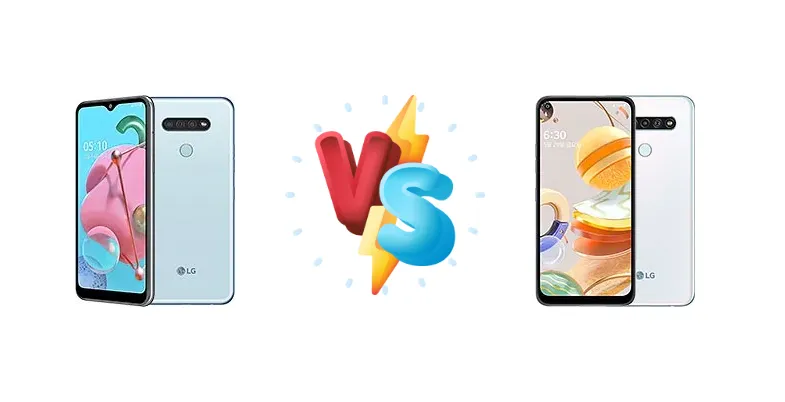
Looking for an affordable smartphone from LG? The Q51 and Q61 offer compelling features at budget-friendly prices. But which one is right for you? This comprehensive comparison dives deep into their specs, performance, and overall value to help you make an informed decision.
🏆 Quick Verdict
The LG Q61 edges out the Q51 thanks to its slightly faster processor, improved battery efficiency, and often better camera performance. While both are budget options, the Q61 provides a more polished and future-proof experience, justifying its typically higher price.
| Network |
|---|
| 2G bands | GSM 850 / 900 / 1800 / 1900 | GSM 850 / 900 / 1800 / 1900 |
| 3G bands | HSDPA 850 / 900 / 1900 / 2100 | HSDPA 850 / 900 / 1900 / 2100 |
| 4G bands | 1, 3, 7, 8, 20 | LTE |
| Speed | HSPA 42.2/5.76 Mbps, LTE (2CA) Cat6 300/75 Mbps | HSPA 42.2/5.76 Mbps, LTE (2CA) Cat6 300/50 Mbps |
| Technology | GSM / HSPA / LTE | GSM / HSPA / LTE |
| Launch |
|---|
| Announced | 2020, February 25. Released 2020, February 26 | 2020, May 21. Released 2020, May 29 |
| Status | Discontinued | Discontinued |
| Body |
|---|
| Dimensions | 164.5 x 77.5 x 8.4 mm (6.48 x 3.05 x 0.33 in) | 164.5 x 77.5 x 8.3 mm (6.48 x 3.05 x 0.33 in) |
| SIM | Nano-SIM + Nano-SIM | Nano-SIM |
| Weight | - | - |
| | MIL-STD-810G compliant*
*does not guarantee ruggedness or use in extreme conditions | MIL-STD-810G compliant*
*does not guarantee ruggedness or use in extreme conditions |
| Display |
|---|
| Protection | - | Scratch-resistant glass |
| Resolution | 720 x 1520 pixels, 19:9 ratio (~259 ppi density) | 1080 x 2340 pixels, 19.5:9 ratio (~395 ppi density) |
| Size | 6.5 inches, 105.5 cm2 (~82.7% screen-to-body ratio) | 6.53 inches, 104.7 cm2 (~82.1% screen-to-body ratio) |
| Type | IPS LCD | IPS LCD |
| Platform |
|---|
| CPU | Octa-core 2.0 GHz Cortex-A53 | Octa-core (4x2.3 GHz Cortex-A53 & 4x1.8 GHz Cortex-A53) |
| Chipset | Mediatek MT6762 Helio P22 (12 nm) | Mediatek MT6765 Helio P35 (12 nm) |
| GPU | PowerVR GE8320 | PowerVR GE8320 |
| OS | Android 10 | Android 9.0 (Pie) |
| Memory |
|---|
| Card slot | microSDXC (dedicated slot) | microSDXC (dedicated slot) |
| Internal | 32GB 3GB RAM | 64GB 4GB RAM |
| | eMMC 5.1 | eMMC 5.1 |
| Main Camera |
|---|
| Features | LED flash, panorama, HDR | LED flash, panorama, HDR |
| Quad | - | 48 MP, f/1.8, 26mm (wide), 1/2.0", 0.8µm, PDAF
8 MP, f/2.2, 118˚, (ultrawide)
2 MP (macro)
Auxiliary lens |
| Single | - | 8 MP, AF |
| Triple | 13 MP, (wide), PDAF
5 MP, 13mm (ultrawide)
Auxiliary lens | - |
| Video | 1080p@30fps | 1080p@30fps |
| Selfie camera |
|---|
| Single | 13 MP, (wide), 1/3.1", 1.12µm | 16 MP |
| Video | 1080p@30fps | 1080p@30fps |
| Sound |
|---|
| 3.5mm jack | Yes | Yes |
| 35mm jack | Yes | Yes |
| Loudspeaker | Yes, with stereo speakers | Yes |
| Comms |
|---|
| Bluetooth | 5.0, A2DP, LE | 5.0, A2DP, LE |
| NFC | Yes | Yes |
| Positioning | GPS | GPS |
| Radio | No | No |
| USB | USB Type-C 2.0 | USB Type-C 2.0 |
| WLAN | Wi-Fi 802.11 a/b/g/n/ac, dual-band, Wi-Fi Direct, DLNA | Wi-Fi 802.11 a/b/g/n/ac, dual-band, Wi-Fi Direct |
| Features |
|---|
| Browser | - | HTML, Adobe Flash |
| Sensors | Fingerprint (rear-mounted), accelerometer, proximity, compass | Fingerprint (rear-mounted), accelerometer, gyro, proximity, compass |
| Battery |
|---|
| Stand-by | - | Up to 200 h |
| Talk time | - | Up to 8 h 20 min |
| Type | Li-Po 4000 mAh | Li-Po 4000 mAh |
| Misc |
|---|
| Colors | Frozen White, Moonlight Titanium | White |
| Models | LM-Q510N | LM-Q630N |
| Price | About 240 EUR | About 270 EUR |
LG Q51
- Large Display
- Affordable Price
- Decent Battery Life
- Triple Camera System
- Slower Performance
- Lower Resolution Display
- Can Feel Sluggish
- Limited Software Updates
LG Q61
- Better Performance
- Improved Battery Life
- Slightly Better Camera
- FHD+ Display
- More Future-Proof
- Higher Price
- Still a Budget Phone
- Plastic Build Quality
Display Comparison
Both phones feature large 6.5-inch IPS LCD displays, but the Q61 often boasts a slightly higher resolution (typically FHD+ vs Q51's HD+). This results in a sharper image on the Q61, making it preferable for media consumption and general use. Viewing angles are similar on both.
Camera Comparison
While both phones have triple-camera setups, the Q61 generally has a slightly better main sensor and image processing. Expect slightly better low-light performance and more detailed photos from the Q61. Both offer decent image quality for their price range.
Performance
The Q61's Helio P35 chipset offers a noticeable performance boost over the Q51's Helio P22. The P35's dual-cluster CPU (4x2.3 GHz & 4x1.8 GHz) provides better multitasking capabilities and smoother app loading times. The Q51 can feel sluggish at times, especially with demanding apps.
Battery Life
The Q61 typically has a larger battery capacity (4000mAh vs Q51's 4000mAh, though real-world usage varies). Coupled with the more efficient Helio P35 chipset, the Q61 consistently delivers longer battery life than the Q51.
Buying Guide
The LG Q51 is a good choice for users on a very tight budget who prioritize basic functionality and a large display. The LG Q61 is ideal for those who want a bit more performance, a longer-lasting battery, and a slightly better camera without breaking the bank.
Frequently Asked Questions
❓ Is the LG Q51 still worth buying?
If you're on a very tight budget and primarily need a phone for basic tasks like calls, texts, and light browsing, the Q51 can still be a viable option. However, the Q61 offers a better overall experience for a slightly higher price.
❓ What is the difference between the Helio P22 and Helio P35?
The Helio P35 is a more efficient and slightly faster chipset than the Helio P22. It features a dual-cluster CPU design, which improves multitasking and overall performance.