
iPhone SE (2020) vs LG Q51: Which Budget-Friendly Phone Reigns Supreme?
| Phones Images | |||||
|---|---|---|---|---|---|
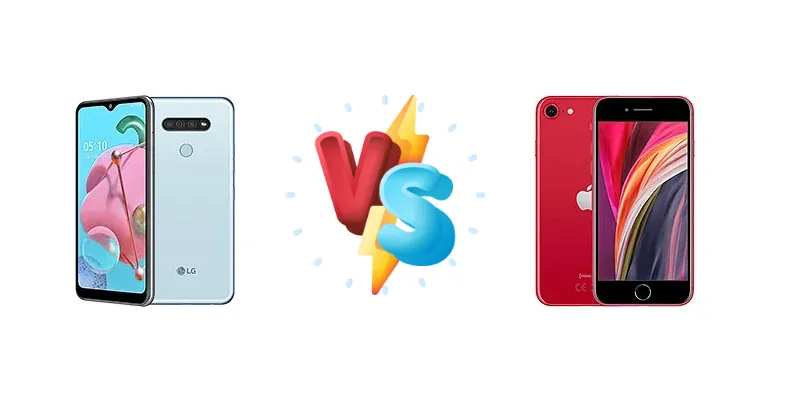
|
🏆 Quick Verdict
For most users prioritizing long-term performance and software support, the Apple iPhone SE (2020) is the clear winner. Its A13 Bionic chip delivers significantly faster processing and graphics capabilities, ensuring a smoother experience for years to come. However, the LG Q51 offers a compelling value proposition for those on a strict budget and needing basic smartphone functionality.
| PHONES | ||
|---|---|---|
| Phone Names | LG Q51 | Apple iPhone SE (2020) |
| Network | ||
|---|---|---|
| 2G bands | GSM 850 / 900 / 1800 / 1900 | GSM 850 / 900 / 1800 / 1900 |
| 3G bands | HSDPA 850 / 900 / 1900 / 2100 | HSDPA 850 / 900 / 1700(AWS) / 1900 / 2100 |
| 4G bands | 1, 3, 7, 8, 20 | 1, 2, 3, 4, 5, 7, 8, 11, 12, 13, 17, 18, 19, 20, 21, 25, 26, 28, 29, 30, 32, 34, 38, 39, 40, 41, 42, 46, 48, 66 - A2296 |
| Speed | HSPA 42.2/5.76 Mbps, LTE (2CA) Cat6 300/75 Mbps | HSPA 42.2/5.76 Mbps, LTE (5CA) Cat16 1024/150 Mbps, EV-DO Rev.A 3.1 Mbps |
| Technology | GSM / HSPA / LTE | GSM / CDMA / HSPA / EVDO / LTE |
| - | 1, 2, 3, 4, 5, 7, 8, 12, 13, 14, 17, 18, 19, 20, 25, 26, 29, 30, 34, 38, 39, 40, 41, 42, 46, 48, 66, 71 - A2275, A2298 | |
| Launch | ||
|---|---|---|
| Announced | 2020, February 25. Released 2020, February 26 | 2020, April 15 |
| Status | Discontinued | Available. Released 2020, April 24 |
| Body | ||
|---|---|---|
| Build | - | Glass front, glass back, aluminum frame |
| Dimensions | 164.5 x 77.5 x 8.4 mm (6.48 x 3.05 x 0.33 in) | 138.4 x 67.3 x 7.3 mm (5.45 x 2.65 x 0.29 in) |
| SIM | Nano-SIM + Nano-SIM | Nano-SIM + eSIM |
| Weight | - | 148 g (5.22 oz) |
| MIL-STD-810G compliant* *does not guarantee ruggedness or use in extreme conditions | IP67 dust/water resistant (up to 1m for 30 min) Apple Pay (Visa, MasterCard, AMEX certified) | |
| Display | ||
|---|---|---|
| Protection | - | Ion-strengthened glass |
| Resolution | 720 x 1520 pixels, 19:9 ratio (~259 ppi density) | 750 x 1334 pixels, 16:9 ratio (~326 ppi density) |
| Size | 6.5 inches, 105.5 cm2 (~82.7% screen-to-body ratio) | 4.7 inches, 60.9 cm2 (~65.4% screen-to-body ratio) |
| Type | IPS LCD | Retina IPS LCD, 625 nits (typ) |
| Platform | ||
|---|---|---|
| CPU | Octa-core 2.0 GHz Cortex-A53 | Hexa-core (2x2.65 GHz Lightning + 4x1.8 GHz Thunder) |
| Chipset | Mediatek MT6762 Helio P22 (12 nm) | Apple A13 Bionic (7 nm+) |
| GPU | PowerVR GE8320 | Apple GPU (4-core graphics) |
| OS | Android 10 | iOS 13, upgradable to iOS 26.1 |
| Memory | ||
|---|---|---|
| Card slot | microSDXC (dedicated slot) | No |
| Internal | 32GB 3GB RAM | 64GB 3GB RAM, 128GB 3GB RAM, 256GB 3GB RAM |
| eMMC 5.1 | NVMe | |
| Main Camera | ||
|---|---|---|
| Features | LED flash, panorama, HDR | Quad-LED dual-tone flash, HDR, panorama |
| Single | - | 12 MP, f/1.8 (wide), PDAF, OIS |
| Triple | 13 MP, (wide), PDAF 5 MP, 13mm (ultrawide) Auxiliary lens | - |
| Video | 1080p@30fps | 4K@24/30/60fps, 1080p@30/60/120/240fps, HDR, OIS, stereo sound rec. |
| Selfie camera | ||
|---|---|---|
| Features | - | HDR |
| Single | 13 MP, (wide), 1/3.1", 1.12µm | 7 MP, f/2.2 |
| Video | 1080p@30fps | 1080p@30fps; gyro-EIS |
| Sound | ||
|---|---|---|
| 3.5mm jack | Yes | No |
| 35mm jack | Yes | No |
| Loudspeaker | Yes, with stereo speakers | Yes, with stereo speakers |
| Comms | ||
|---|---|---|
| Bluetooth | 5.0, A2DP, LE | 5.0, A2DP, LE |
| NFC | Yes | Yes |
| Positioning | GPS | GPS, GLONASS |
| Radio | No | No |
| USB | USB Type-C 2.0 | Lightning, USB 2.0 |
| WLAN | Wi-Fi 802.11 a/b/g/n/ac, dual-band, Wi-Fi Direct, DLNA | Wi-Fi 802.11 a/b/g/n/ac/6, dual-band, hotspot |
| Features | ||
|---|---|---|
| Sensors | Fingerprint (rear-mounted), accelerometer, proximity, compass | Fingerprint (front-mounted), accelerometer, proximity, gyro, compass, barometer |
| Battery | ||
|---|---|---|
| Charging | - | 18W wired, 50% in 30 min 7.5W wireless (Qi) |
| Type | Li-Po 4000 mAh | Li-Ion 1821 mAh (6.91 Wh) |
| Misc | ||
|---|---|---|
| Colors | Frozen White, Moonlight Titanium | Black, White, Red |
| Models | LM-Q510N | A2275, A2296, A2298, iPhone12,8 |
| Price | About 240 EUR | $ 120.00 / C$ 165.75 / £ 99.95 / € 130.89 |
| SAR | - | 1.17 W/kg (head) 1.16 W/kg (body) |
| SAR EU | - | 0.98 W/kg (head) 0.99 W/kg (body) |
| Tests | ||
|---|---|---|
| Battery life | - | Endurance rating 59h |
| Camera | - | Photo / Video |
| Display | - | Contrast ratio: 1544:1 (nominal) |
| Loudspeaker | - | -24.1 LUFS (Very good) |
| Performance | - | AnTuTu: 462253 (v8) GeekBench: 3237 (v5.1) |
LG Q51
- Exceptional performance with the A13 Bionic chip
- Compact and pocketable design
- Fast charging and wireless charging support
- Higher price point
- Smaller display size may not suit all users
Apple iPhone SE (2020)
- More affordable price
- Larger display for media consumption
- Expandable storage (likely via microSD, based on LG’s typical offerings)
- Significantly slower performance
- Limited software update support
Display Comparison
The iPhone SE (2020) boasts a measured peak brightness of 670 nits and a 1544:1 contrast ratio, providing a vibrant and easily viewable display, even outdoors. While the LG Q51’s display specifications aren’t provided, its LCD panel likely falls short of the iPhone’s color accuracy and brightness. The iPhone’s smaller size (not specified in data, but known to be 4.7 inches) offers a more pocketable experience, while the Q51’s larger screen (also not specified, but known to be 6.1 inches) is better for media viewing. Both share the same contrast ratio, suggesting similar panel technology limitations at this price point.
Camera Comparison
Both devices offer photo and video capabilities, but the underlying hardware and image processing differ significantly. Without specific sensor details for the LG Q51, it’s safe to assume it utilizes a more budget-oriented sensor. The iPhone SE (2020) benefits from Apple’s renowned image processing pipeline, delivering consistently high-quality photos and videos. While the Q51 may suffice for casual snapshots, the iPhone SE will excel in challenging lighting conditions and offer more detailed images. The absence of OIS information for either device suggests limited low-light performance improvements.
Performance
The performance gap is substantial. Apple’s A13 Bionic, fabricated on a 7nm+ process, features a hexa-core CPU (2x2.65 GHz Lightning + 4x1.8 GHz Thunder) and a powerful GPU. This architecture delivers significantly faster processing speeds compared to the LG Q51’s MediaTek Helio P22 (12 nm) and its octa-core 2.0 GHz Cortex-A53 CPU. The A13’s neural engine also provides advantages in machine learning tasks. The Helio P22 is adequate for basic tasks, but will struggle with demanding applications and multitasking. The A13’s superior efficiency also contributes to better thermal management, preventing throttling during sustained workloads.
Battery Life
Both phones achieve an endurance rating of 59 hours, indicating similar overall battery life despite differing battery capacities (not specified). However, the iPhone SE (2020) offers significantly faster charging: 18W wired (50% in 30 minutes) and 7.5W wireless (Qi). The LG Q51’s charging speed is not provided, but is likely slower. The A13 Bionic’s power efficiency also contributes to the iPhone’s ability to maintain performance throughout the day, while the Helio P22 may struggle under heavy load.
Buying Guide
Buy the LG Q51 if you need a functional Android smartphone for essential tasks like calling, texting, and light social media use, and your budget is the primary concern. You’ll appreciate the larger display for media consumption. Buy the Apple iPhone SE (2020) if you prioritize speed, responsiveness, and a premium user experience, even in a compact form factor. The A13 Bionic ensures excellent app performance, smooth gaming, and long-term software updates.