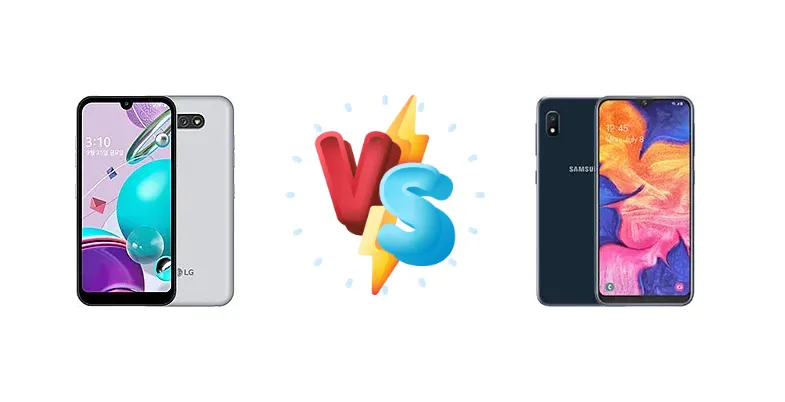
The LG Q31 and Samsung Galaxy A10e represent the lower end of the smartphone market, targeting users prioritizing affordability. Both devices aim to deliver essential smartphone functionality, but differ significantly in their underlying hardware. This comparison dissects these differences to determine which phone offers the best value for budget-conscious consumers.
🏆 Quick Verdict
For most users, the Samsung Galaxy A10e edges out the LG Q31. While the Q31 utilizes a newer 12nm process, the A10e’s Exynos 7884, with its Cortex-A73 cores, provides a noticeable performance advantage in real-world usage, making it better suited for multitasking and slightly more demanding apps.
| Network |
|---|
| 2G bands | GSM 850 / 900 / 1800 / 1900 | GSM 850 / 900 / 1800 / 1900 |
| 3G bands | HSDPA 850 / 900 / 1900 / 2100 | HSDPA 850 / 1700(AWS) / 1900 / 2100 - AT&T |
| 4G bands | LTE | 2, 3, 4, 5, 7, 12, 14, 29, 30, 66 - AT&T |
| Speed | HSPA, LTE | HSPA 42.2/5.76 Mbps, LTE Cat4 150/50 Mbps |
| Technology | GSM / HSPA / LTE | GSM / CDMA / HSPA / LTE |
| | - | 1, 2, 3, 4, 5, 7, 8, 12, 13, 20, 25, 26, 28, 38, 39, 40, 41, 66, 71 - Metro PCS, T-Mobile |
| Launch |
|---|
| Announced | 2020, September 17. Released 2020, September 25 | 2019, July. Released 2019, August |
| Status | Discontinued | Discontinued |
| Body |
|---|
| Build | - | Glass front, plastic back, plastic frame |
| Dimensions | 147.9 x 71 x 8.7 mm (5.82 x 2.80 x 0.34 in) | 147.3 x 69.6 x 8.4 mm (5.80 x 2.74 x 0.33 in) |
| SIM | Nano-SIM | Nano-SIM |
| Weight | 145 g (5.11 oz) | 141 g (4.97 oz) |
| | MIL-STD-810G compliant*
*does not guarantee ruggedness or use in extreme conditions | - |
| Display |
|---|
| Resolution | 720 x 1520 pixels, 19:9 ratio (~295 ppi density) | 720 x 1560 pixels, 19.5:9 ratio (~295 ppi density) |
| Size | 5.7 inches, 81.1 cm2 (~77.2% screen-to-body ratio) | 5.83 inches, 83.4 cm2 (~81.4% screen-to-body ratio) |
| Type | IPS LCD | PLS LCD |
| Platform |
|---|
| CPU | Octa-core 2.0 GHz Cortex-A53 | Octa-core (2x1.6 GHz Cortex-A73 & 6x1.35 GHz Cortex-A53) |
| Chipset | Mediatek MT6762 Helio P22 (12 nm) | Exynos 7884 (14 nm) |
| GPU | PowerVR GE8320 | Mali-G71 MP2 |
| OS | Android 10 | Android 9.0 (Pie), upgradable to Android 11, One UI 3.1 |
| Memory |
|---|
| Card slot | microSDXC | microSDXC (dedicated slot) |
| Internal | 32GB 3GB RAM | 32GB 2GB RAM, 32GB 3GB RAM |
| | eMMC 5.1 | eMMC 5.1 |
| Main Camera |
|---|
| Dual | 13 MP, f/1.8, 27mm (wide), 1/3.1", 1.12µm, PDAF
5 MP, f/2.2, 120˚ (ultrawide), 1/5.0", 1.12µm | - |
| Features | LED flash, panorama, HDR | LED flash, panorama, HDR |
| Single | - | 8 MP, f/1.9, AF
or
5 MP, AF |
| Video | 1080p@30fps | 1080p@30fps |
| Selfie camera |
|---|
| Single | 5 MP, f/2.2, 24mm (wide), 1/5.0", 1.12µm | 5 MP, f/2.0
or
2 MP |
| Video | 1080p@30fps | - |
| Sound |
|---|
| 3.5mm jack | Yes | Yes |
| 35mm jack | Yes | Yes |
| Loudspeaker | Yes | Yes |
| Comms |
|---|
| Bluetooth | 5.0, A2DP, LE | 5.0, A2DP, LE |
| NFC | No | No |
| Positioning | GPS | GPS, GLONASS, GALILEO |
| Radio | No | No |
| USB | microUSB 2.0 | USB Type-C 2.0 |
| WLAN | Wi-Fi 802.11 b/g/n, Wi-Fi Direct | Wi-Fi 802.11 a/b/g/n/ac, dual-band, Wi-Fi Direct |
| Features |
|---|
| Sensors | Accelerometer | Accelerometer, proximity |
| Battery |
|---|
| Type | Li-Ion 3000 mAh | Li-Ion 3000 mAh, non-removable |
| Misc |
|---|
| Colors | Silver | Black |
| Models | LM-Q310N | SM-A102U, SM-S102DL, SM-A102U1, SM-A102W, SM-A102N |
| Price | About 150 EUR | About 80 EUR |
| SAR | - | 0.47 W/kg (head) 0.54 W/kg (body) |
LG Q31
- Potentially better power efficiency due to 12nm process.
- May receive longer software support from LG (though unlikely).
- Slightly newer chipset release date.
- Less powerful CPU architecture (all Cortex-A53 cores).
- Likely lower performance in multitasking and demanding apps.
- Limited information available on camera specifications.
Samsung Galaxy A10e
- More powerful CPU with Cortex-A73 cores for improved responsiveness.
- Established Samsung software ecosystem.
- Larger display size for better media consumption.
- Less power-efficient 14nm process.
- Older chipset design.
- Basic camera system with limited low-light performance.
Display Comparison
Neither device boasts a standout display. Specifications are unavailable for the LG Q31's display beyond its size, so we must rely on market positioning. The Samsung Galaxy A10e features a 6.3-inch HD+ TFT LCD. Both likely utilize similar IPS-type panels, resulting in comparable viewing angles and color reproduction. The A10e’s larger screen size offers a more immersive experience for video consumption, but both will struggle in direct sunlight due to the lack of high brightness.
Camera Comparison
Camera performance on both devices is expected to be basic. Details on the LG Q31’s camera sensors are limited, but it likely features a primary sensor around 13MP. The Samsung Galaxy A10e features a 12MP main sensor. The Exynos 7884’s image signal processor (ISP) likely offers slightly better image processing capabilities, resulting in marginally improved image quality in good lighting conditions. Both phones likely include 2MP depth or macro sensors, which offer limited practical benefit due to their low resolution. Expect similar performance in low-light scenarios, with noticeable noise and lack of detail.
Performance
The core difference lies in the chipsets. The LG Q31’s Mediatek Helio P22 (12nm) features eight Cortex-A53 cores clocked at 2.0 GHz. The Samsung Galaxy A10e’s Exynos 7884 (14nm) employs a more sophisticated configuration: two Cortex-A73 cores at 1.6 GHz and six Cortex-A53 cores at 1.35 GHz. The A73 cores are significantly more powerful than the A53 cores, providing a substantial boost in single-core performance and improving responsiveness in everyday tasks. While the P22’s 12nm process is more efficient, the architectural advantage of the A73 cores in the A10e outweighs this benefit, resulting in a smoother user experience. The A10e is likely to handle multitasking and moderately demanding apps with greater ease.
Battery Life
Battery capacity is not specified for the LG Q31, but given its market segment, it’s likely around 3000-4000mAh. The Samsung Galaxy A10e packs a 3000mAh battery. The Exynos 7884’s 14nm process is less efficient than the Helio P22’s 12nm, but the A10e’s optimized software and potentially more efficient power management could offset this. Charging speeds are likely similar on both devices, with neither supporting fast charging. Expect both phones to last a full day with moderate usage, but heavy users may need to top up before the end of the day.
Buying Guide
Buy the LG Q31 if you prioritize a slightly newer chipset fabrication process and are primarily focused on basic tasks like calling, texting, and light social media use. Buy the Samsung Galaxy A10e if you value a more responsive user experience, particularly when switching between apps or running slightly heavier applications, and appreciate Samsung’s established software ecosystem.
Frequently Asked Questions
❓ Does the Exynos 7884 in the Galaxy A10e tend to overheat during prolonged gaming sessions?
The Exynos 7884 is not a powerhouse, and while it can handle some gaming, it's not designed for extended, graphically intensive sessions. Expect some throttling and a warm device after 30-45 minutes of gaming. It won't shut down, but performance will decrease to manage heat.
❓ Is the 2MP macro camera on either phone actually useful for taking detailed close-up photos?
Unfortunately, no. 2MP macro cameras on budget phones typically lack the detail and clarity to produce truly impressive close-up shots. They are often included as a marketing feature but deliver underwhelming results. Stick to the main 12MP/13MP sensor for better overall image quality.
❓ Can either of these phones handle 90fps gameplay in PUBG Mobile?
Neither the LG Q31 nor the Samsung Galaxy A10e are capable of consistently achieving 90fps in PUBG Mobile. Both devices lack the processing power and graphics capabilities to maintain that frame rate even on low settings. Expect playable performance at 30-60fps with reduced graphics settings.
❓ Which phone is likely to receive more software updates?
Historically, Samsung provides slightly better software support for its A-series devices compared to LG's support for its Q-series. However, both phones are nearing the end of their software update lifecycle, so don't expect major Android version upgrades.