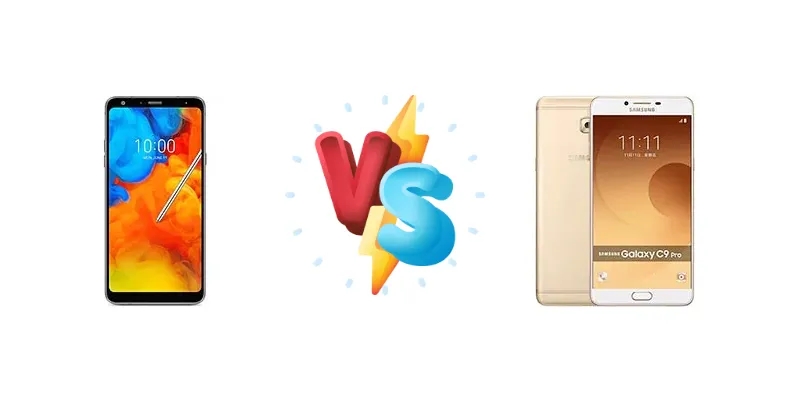
Released in different eras, the Samsung Galaxy C9 Pro and LG Q Stylus represent distinct approaches to the mid-range smartphone market. The C9 Pro, with its Snapdragon 653, aimed for solid performance and fast charging, while the Q Stylus focused on productivity and creativity with its integrated stylus. This comparison dissects their key differences to help you determine which device best suits your needs.
🏆 Quick Verdict
For users prioritizing performance and faster charging, the Samsung Galaxy C9 Pro is the clear winner. Its Snapdragon 653 chipset offers a noticeable advantage in processing power. However, the LG Q Stylus remains a compelling option for those who heavily utilize a stylus for note-taking, drawing, or precise navigation.
| Network |
|---|
| 2G bands | GSM 850 / 900 / 1800 / 1900 | GSM 850 / 900 / 1800 / 1900 - SIM 1 & SIM 2 |
| 3G bands | HSDPA 850 / 900 / 1900 / 2100 | HSDPA 850 / 900 / 1900 / 2100 |
| 4G bands | 1, 3, 5, 7, 8, 28, 38, 39, 40, 41 | 1, 3, 5, 40, 41 - India |
| Speed | HSPA, LTE | HSPA 42.2/5.76 Mbps, LTE (2CA) Cat6 300/50 Mbps |
| Technology | GSM / HSPA / LTE | GSM / HSPA / LTE |
| Launch |
|---|
| Announced | 2018, June. Released 2018, August | 2016, October. Released 2016, November |
| Status | Discontinued | Discontinued |
| Body |
|---|
| Build | Glass front, plastic back, aluminum frame | Glass front (Gorilla Glass 4), aluminum back, aluminum frame |
| Dimensions | 160.1 x 77.7 x 8.1 mm (6.30 x 3.06 x 0.32 in) | 162.9 x 80.7 x 6.9 mm (6.41 x 3.18 x 0.27 in) |
| SIM | · Nano-SIM· Nano-SIM + Nano-SIM | Nano-SIM + Nano-SIM |
| Weight | 171 g (6.03 oz) | 189 g (6.67 oz) |
| | Stylus
IP68 dust/water resistant (up to 1.5m for 30 mins)
MIL-STD-810G compliant*
*does not guarantee ruggedness or use in extreme conditions | - |
| Display |
|---|
| Protection | - | Corning Gorilla Glass 4 |
| Resolution | 1080 x 2160 pixels, 18:9 ratio (~389 ppi density) | 1080 x 1920 pixels, 16:9 ratio (~367 ppi density) |
| Size | 6.2 inches, 99.7 cm2 (~80.2% screen-to-body ratio) | 6.0 inches, 99.2 cm2 (~75.5% screen-to-body ratio) |
| Type | IPS LCD | Super AMOLED |
| Platform |
|---|
| CPU | Octa-core (4x1.5 GHz Cortex-A53 & 4x1.0 GHz Cortex-A53) - Q Stylus/Q Stylus αOcta-core 1.8 GHz | Octa-core (4x1.95 GHz Cortex-A72 & 4x1.4 GHz Cortex-A53) |
| Chipset | Mediatek MT6750 - Q Stylus/Q Stylus α | Qualcomm MSM8976 Pro Snapdragon 653 (28 nm) |
| GPU | Mali-T860MP2 - Q Stylus/Q Stylus α | Adreno 510 |
| OS | Android 8.1 (Oreo) | Android 6.0.1 (Marshmallow), upgradable to Android 8.0 (Oreo) |
| Memory |
|---|
| Card slot | microSDXC (dedicated slot) | microSDXC (dedicated slot) |
| Internal | 32GB 3GB RAM, 64GB 4GB RAM | 64GB 6GB RAM |
| | eMMC 5.1 | eMMC 5.1 |
| Main Camera |
|---|
| Features | LED flash, panorama, HDR | Dual-LED dual-tone flash, panorama, HDR |
| Single | 13 MP, PDAF (Q Stylus α)
16 MP, PDAF (Q Stylus/ Q Stylus+) | 16 MP, f/1.9, PDAF |
| Video | 1080p@30fps | 1080p@30fps |
| Selfie camera |
|---|
| Single | 8 MP or 5 MP - Q Stylus/Q Stylus+
5 MP - Q Stylus α | 16 MP, f/1.9, 27mm (wide), 1/3.06", 1.0µm |
| Video | - | 1080p@30fps |
| Sound |
|---|
| 3.5mm jack | Yes | Yes |
| 35mm jack | Yes | Yes |
| Loudspeaker | Yes | Yes, with stereo speakers |
| Comms |
|---|
| Bluetooth | 4.2, A2DP, LE | 4.2, A2DP, LE |
| NFC | Yes | Yes |
| Positioning | GPS, GLONASS, BDS, GALILEO | GPS, GLONASS/ BDS (region dependent) |
| Radio | FM radio | Stereo FM radio with RDS |
| USB | USB Type-C 2.0 | USB Type-C |
| WLAN | Wi-Fi 802.11 b/g/n, Wi-Fi Direct, DLNA | Wi-Fi 802.11 a/b/g/n/ac, dual-band, Wi-Fi Direct |
| Features |
|---|
| Sensors | Fingerprint (rear-mounted), accelerometer, gyro, proximity, compass | Fingerprint (front-mounted), accelerometer, proximity, compass |
| | - | ANT+ |
| Battery |
|---|
| Charging | 10W wired | 18W wired |
| Type | Li-Ion 3300 mAh, non-removable | Li-Ion 4000 mAh, non-removable |
| Misc |
|---|
| Colors | Aurora Black, Moroccan Blue, Lavender Violet | Gold, Pink Gold, Black |
| Models | Q710, LM-Q710.FG | SM-C9000, SM-C900F, SM-C9008, SM-C900Y |
| Price | About 300 EUR | About 380 EUR |
| SAR EU | - | 0.79 W/kg (head) 1.62 W/kg (body) |
| Tests |
|---|
| Performance | - |
GFXBench: 5.8fps (ES 3.1 onscreen) |
LG Q Stylus
- Integrated Stylus for productivity and creativity
- More compact size for easier one-handed use
- Potentially lower price point (depending on market)
- Less powerful processor compared to the C9 Pro
- Slower charging speed (10W)
- Likely less refined camera performance
Samsung Galaxy C9 Pro
- Faster Snapdragon 653 processor for smoother performance
- 18W fast charging for quicker top-ups
- Potentially better camera image quality
- Larger size may be less comfortable for some users
- Lacks stylus functionality
- May be harder to find new
Display Comparison
Neither device boasts a cutting-edge display by today's standards, but differences exist. While specific panel technologies aren't detailed, the C9 Pro's larger size (6.0 inches vs. 5.7 inches on the Q Stylus) offers a more immersive viewing experience. Both likely utilize IPS LCD panels, common for the price point. The lack of information on resolution or brightness makes a direct comparison difficult, but the C9 Pro's positioning suggests a slightly higher quality panel.
Camera Comparison
Detailed camera specifications are absent, making a precise comparison challenging. However, given Samsung’s history, the C9 Pro likely features a more refined image processing pipeline and potentially a larger sensor. The focus should be on real-world image quality, but the C9 Pro’s chipset likely provides more processing power for post-capture editing and noise reduction. The LG Q Stylus may offer unique stylus-integrated camera features, but the C9 Pro likely delivers superior overall image quality.
Performance
The core difference lies in the chipsets. The Samsung Galaxy C9 Pro’s Qualcomm MSM8976 Pro Snapdragon 653, built on a 28nm process, features a more powerful CPU configuration: 4x1.95 GHz Cortex-A72 cores paired with 4x1.4 GHz Cortex-A53 cores. This contrasts with the LG Q Stylus’s Mediatek MT6750, which uses 4x1.5 GHz Cortex-A53 and 4x1.0 GHz Cortex-A53 cores. The Cortex-A72 cores in the C9 Pro provide a significant architectural advantage, resulting in faster application loading and smoother multitasking. The Snapdragon 653 also benefits from a more mature GPU, offering better graphics performance for gaming. The Q Stylus's CPU, while octa-core, relies on less efficient Cortex-A53 cores across the board.
Battery Life
The Samsung Galaxy C9 Pro’s 18W wired charging is a significant advantage over the LG Q Stylus’s 10W charging. This translates to considerably faster charging times, reducing downtime. While battery capacity isn't specified, the faster charging speed of the C9 Pro mitigates any potential disadvantage from a slightly smaller battery. Users who frequently find themselves needing to top up their phone will greatly benefit from the C9 Pro’s faster charging capabilities.
Buying Guide
Buy the LG Q Stylus if you need a dedicated stylus for productivity and creative tasks, and aren't overly concerned with demanding gaming or intensive multitasking. Buy the Samsung Galaxy C9 Pro if you prioritize smoother performance for apps, faster charging speeds, and a more responsive user experience, even if it means sacrificing stylus functionality.
Frequently Asked Questions
❓ Is the Mediatek MT6750 in the LG Q Stylus capable of handling modern mobile games?
The Mediatek MT6750 can run many mobile games, but it will likely struggle with graphically demanding titles at higher settings. Expect lower frame rates and potential lag compared to the Snapdragon 653 in the C9 Pro, especially in games like PUBG or Genshin Impact.
❓ Does the Samsung Galaxy C9 Pro support USB-C or Micro-USB?
The Samsung Galaxy C9 Pro utilizes Micro-USB, which is slower and less convenient than the USB-C standard found on more modern devices. This means slower data transfer speeds and the need for a different cable than many current chargers.
❓ How does the stylus functionality on the LG Q Stylus compare to the Samsung Galaxy Note series?
The Q Stylus's stylus experience is significantly less advanced than the Samsung Galaxy Note series. It lacks features like air commands or pressure sensitivity found on the S Pen. It's primarily designed for basic note-taking and navigation, rather than detailed drawing or artistic creation.
❓ Is the Snapdragon 653 in the C9 Pro still a viable chipset in 2024?
While not a flagship-level chipset, the Snapdragon 653 remains capable of handling everyday tasks and many popular apps. However, it will show its age when running demanding applications or multitasking heavily. It's sufficient for basic use but won't provide a cutting-edge experience.