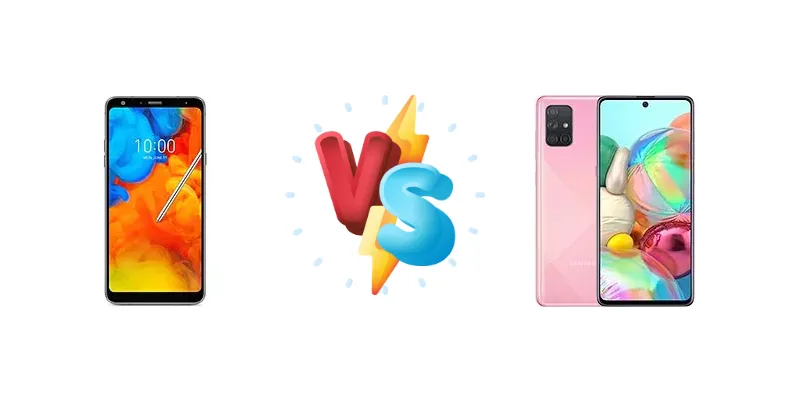
The LG Q Stylus and Samsung Galaxy A71 represent different approaches to the mid-range smartphone market. The Q Stylus prioritizes integrated stylus functionality and a more budget-conscious price point, while the A71 focuses on delivering a more powerful processor and a brighter display. This comparison dissects their key differences to determine which device best suits your needs.
🏆 Quick Verdict
For the average user, the Samsung Galaxy A71 is the superior choice. Its Qualcomm Snapdragon 730 chipset provides a significantly faster and more responsive experience than the LG Q Stylus’s Mediatek MT6750. While the Q Stylus offers a stylus, the A71’s overall performance and brighter display justify the price difference.
| Network |
|---|
| 2G bands | GSM 850 / 900 / 1800 / 1900 | GSM 850 / 900 / 1800 / 1900 |
| 3G bands | HSDPA 850 / 900 / 1900 / 2100 | HSDPA 850 / 900 / 1900 / 2100 |
| 4G bands | 1, 3, 5, 7, 8, 28, 38, 39, 40, 41 | 1, 2, 3, 4, 5, 7, 8, 12, 13, 17, 20, 28, 38, 40, 41, 66 |
| Speed | HSPA, LTE | HSPA, LTE |
| Technology | GSM / HSPA / LTE | GSM / HSPA / LTE |
| | - | HSDPA 850 / 900 / 1700(AWS) / 1900 / 2100 |
| Launch |
|---|
| Announced | 2018, June. Released 2018, August | 2019, December 12. Released 2020, January 17 |
| Status | Discontinued | Discontinued |
| Body |
|---|
| Build | Glass front, plastic back, aluminum frame | Glass front (Gorilla Glass 3), plastic back, plastic frame |
| Dimensions | 160.1 x 77.7 x 8.1 mm (6.30 x 3.06 x 0.32 in) | 163.6 x 76 x 7.7 mm (6.44 x 2.99 x 0.30 in) |
| SIM | · Nano-SIM· Nano-SIM + Nano-SIM | · Nano-SIM· Nano-SIM + Nano-SIM |
| Weight | 171 g (6.03 oz) | 179 g (6.31 oz) |
| | Stylus
IP68 dust/water resistant (up to 1.5m for 30 mins)
MIL-STD-810G compliant*
*does not guarantee ruggedness or use in extreme conditions | - |
| Display |
|---|
| Protection | - | Corning Gorilla Glass 3 |
| Resolution | 1080 x 2160 pixels, 18:9 ratio (~389 ppi density) | 1080 x 2400 pixels, 20:9 ratio (~393 ppi density) |
| Size | 6.2 inches, 99.7 cm2 (~80.2% screen-to-body ratio) | 6.7 inches, 108.4 cm2 (~87.2% screen-to-body ratio) |
| Type | IPS LCD | Super AMOLED Plus |
| Platform |
|---|
| CPU | Octa-core (4x1.5 GHz Cortex-A53 & 4x1.0 GHz Cortex-A53) - Q Stylus/Q Stylus αOcta-core 1.8 GHz | Octa-core (2x2.2 GHz Kryo 470 Gold & 6x1.8 GHz Kryo 470 Silver) |
| Chipset | Mediatek MT6750 - Q Stylus/Q Stylus α | Qualcomm SDM730 Snapdragon 730 (8 nm) - GlobalQualcomm SDM730 Snapdragon 730G (8 nm) - Philippines |
| GPU | Mali-T860MP2 - Q Stylus/Q Stylus α | Adreno 618 |
| OS | Android 8.1 (Oreo) | Android 10, upgradable to Android 13, One UI 5 |
| Memory |
|---|
| Card slot | microSDXC (dedicated slot) | microSDXC (dedicated slot) |
| Internal | 32GB 3GB RAM, 64GB 4GB RAM | 128GB 6GB RAM, 128GB 8GB RAM |
| | eMMC 5.1 | UFS 2.1 |
| Main Camera |
|---|
| Features | LED flash, panorama, HDR | LED flash, panorama, HDR |
| Quad | - | 64 MP, f/1.8, 26mm (wide), 1/1.72", 0.8µm, PDAF
12 MP, f/2.2, 123˚ (ultrawide)
5 MP (macro)
Auxiliary lens |
| Single | 13 MP, PDAF (Q Stylus α)
16 MP, PDAF (Q Stylus/ Q Stylus+) | - |
| Video | 1080p@30fps | 4K@30fps, 1080p@30/240fps, 1080p@960fps; gyro-EIS |
| Selfie camera |
|---|
| Features | - | HDR |
| Single | 8 MP or 5 MP - Q Stylus/Q Stylus+
5 MP - Q Stylus α | 32 MP, f/2.2, 26mm (wide), 1/2.8", 0.8µm |
| Video | - | 4K@30fps, 1080p@30fps |
| Sound |
|---|
| 3.5mm jack | Yes | Yes |
| 35mm jack | Yes | Yes |
| Loudspeaker | Yes | Yes |
| Comms |
|---|
| Bluetooth | 4.2, A2DP, LE | 5.0, A2DP, LE |
| NFC | Yes | Yes (market dependent) |
| Positioning | GPS, GLONASS, BDS, GALILEO | GPS, GLONASS, GALILEO, BDS |
| Radio | FM radio | FM radio |
| USB | USB Type-C 2.0 | USB Type-C 2.0, OTG |
| WLAN | Wi-Fi 802.11 b/g/n, Wi-Fi Direct, DLNA | Wi-Fi 802.11 a/b/g/n/ac, dual-band, Wi-Fi Direct |
| Features |
|---|
| Sensors | Fingerprint (rear-mounted), accelerometer, gyro, proximity, compass | Fingerprint (under display, optical), accelerometer, gyro, proximity, compass |
| | - | ANT+ |
| Battery |
|---|
| Charging | 10W wired | 25W wired |
| Type | Li-Ion 3300 mAh, non-removable | Li-Ion 4500 mAh, non-removable |
| Misc |
|---|
| Colors | Aurora Black, Moroccan Blue, Lavender Violet | Prism Crush Black, Prism Crush Silver, Prism Crush Blue, Prism Crush Pink |
| Models | Q710, LM-Q710.FG | SM-A715F, SM-A715F/DS, SM-A715F/DSN, SM-A715F/DSM, SM-A715W, SM-A715X |
| Price | About 300 EUR | About 120 EUR |
| SAR | - | 0.98 W/kg (head) 0.90 W/kg (body) |
| SAR EU | - | 0.51 W/kg (head) 1.56 W/kg (body) |
| Tests |
|---|
| Audio quality | - |
Noise -93.5dB / Crosstalk -92.6dB |
| Battery life | - | Endurance rating 102h |
| Camera | - |
Photo / Video |
| Display | - |
Contrast ratio: Infinite (nominal) |
| Loudspeaker | - |
-29.0 LUFS (Average) |
| Performance | - |
AnTuTu: 192 458(v7), 263396 (v8)
GeekBench: 7039 (v4.4), 1733 (v5.1)
GFXBench: 15fps (ES 3.1 onscreen) |
LG Q Stylus
- Integrated Stylus for note-taking and drawing
- More affordable price point
- Decent battery endurance
- Significantly weaker processor
- Slower charging speed (10W)
- Likely lower display brightness
Samsung Galaxy A71
- Faster and more efficient Snapdragon 730 processor
- Brighter and more vibrant display (515 nits)
- Faster 25W wired charging
- No integrated stylus
- Higher price compared to the Q Stylus
- May be larger and less comfortable to hold for some users
Display Comparison
The Samsung Galaxy A71 boasts a notably brighter display, reaching a measured 515 nits, compared to the LG Q Stylus (brightness data unavailable, but expected to be lower given the chipset and price point). This difference translates to better visibility outdoors. While both likely utilize IPS LCD panels, the A71’s higher brightness and 'Infinite' contrast ratio (nominal) suggest superior image quality. The Q Stylus’s primary display advantage is its stylus compatibility, a feature absent on the A71.
Camera Comparison
Both devices offer photo and video capabilities, but details are limited. The A71 likely benefits from Samsung’s more advanced image processing algorithms. Without specific sensor size or aperture information for the Q Stylus, it’s difficult to make a direct comparison. However, given the A71’s positioning, it likely features a more sophisticated camera system overall. The Q Stylus’s camera is likely adequate for casual snapshots, but the A71 will deliver superior image quality in most scenarios.
Performance
The performance gap between these two devices is substantial. The Samsung Galaxy A71’s Qualcomm Snapdragon 730 (8nm) is a far more capable chipset than the LG Q Stylus’s Mediatek MT6750. The Snapdragon 730 features a more modern CPU architecture – octa-core (2x2.2 GHz Kryo 470 Gold & 6x1.8 GHz Kryo 470 Silver) versus the Q Stylus’s octa-core (4x1.5 GHz Cortex-A53 & 4x1.0 GHz Cortex-A53). This translates to faster app loading times, smoother multitasking, and a better gaming experience on the A71. The 8nm process node of the Snapdragon 730 also contributes to improved thermal efficiency.
Battery Life
Both the LG Q Stylus and Samsung Galaxy A71 achieve an endurance rating of 102 hours, suggesting comparable battery life under similar usage conditions. However, the A71’s 25W wired charging is a significant advantage over the Q Stylus’s slower 10W charging. This means the A71 can be topped up much faster, minimizing downtime. While both have similar endurance, the A71’s charging speed provides a more convenient user experience.
Buying Guide
Buy the LG Q Stylus if you absolutely require a built-in stylus for note-taking, sketching, or precise input and are operating on a very tight budget. Buy the Samsung Galaxy A71 if you prioritize smooth performance for gaming and multitasking, a brighter and more vibrant display for media consumption, and faster charging capabilities. The A71 is the better all-rounder for most users.
Frequently Asked Questions
❓ Is the stylus on the LG Q Stylus truly useful for productivity, or is it a gimmick?
The stylus is genuinely useful for users who frequently take handwritten notes, sketch, or require precise input. It offers a more natural writing experience than using a finger on glass, and can be particularly beneficial for tasks like signing documents or annotating screenshots. However, if you rarely use a stylus, the A71’s superior performance will be more valuable.
❓ Will the Mediatek MT6750 in the LG Q Stylus struggle with demanding apps or games?
Yes, the Mediatek MT6750 is a relatively older and less powerful chipset. It will likely struggle with graphically intensive games and may exhibit lag when running multiple apps simultaneously. The Samsung Galaxy A71’s Snapdragon 730 offers a much smoother and more responsive experience for these tasks.
❓ How much faster is the charging on the Samsung Galaxy A71 compared to the LG Q Stylus?
The A71’s 25W charging is significantly faster than the Q Stylus’s 10W charging. While exact 0-100% times are unavailable, the A71 will likely charge in around 90-120 minutes, while the Q Stylus could take over 3 hours. This difference is substantial for users who need to quickly top up their battery.