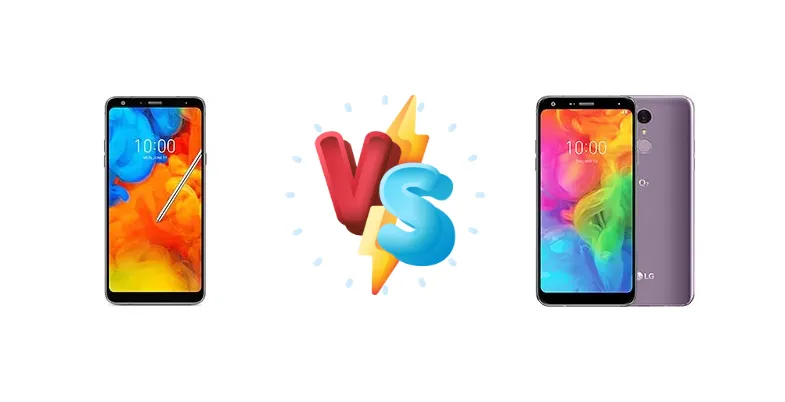
The LG Q Stylus and LG Q7 represent LG’s foray into the affordable smartphone market. While both devices share a similar aesthetic and target budget-conscious consumers, they diverge in key areas – most notably the inclusion of a stylus on the Q Stylus and chipset variations across models. This comparison dissects these differences to determine which phone delivers the best value.
🏆 Quick Verdict
For the average user prioritizing a smooth experience and faster charging, the LG Q7 (specifically the Q7+ with the Snapdragon 450) is the better choice. Its more efficient chipset and 15W charging offer a noticeable advantage over the Q Stylus’s Mediatek MT6750. However, the Q Stylus remains compelling for those who actively utilize a stylus for note-taking or creative tasks.
| Network |
|---|
| 2G bands | GSM 850 / 900 / 1800 / 1900 | GSM 850 / 900 / 1800 / 1900 |
| 3G bands | HSDPA 850 / 900 / 1900 / 2100 | HSDPA 850 / 900 / 1900 / 2100 |
| 4G bands | 1, 3, 5, 7, 8, 28, 38, 39, 40, 41 | 1, 3, 5, 7, 8, 28, 38, 40, 41 |
| Speed | HSPA, LTE | HSPA 42.2/5.76 Mbps, LTE (2CA) Cat6 300/50 Mbps |
| Technology | GSM / HSPA / LTE | GSM / HSPA / LTE |
| Launch |
|---|
| Announced | 2018, June. Released 2018, August | 2018, May. Released 2018, June |
| Status | Discontinued | Discontinued |
| Body |
|---|
| Build | Glass front, plastic back, aluminum frame | - |
| Dimensions | 160.1 x 77.7 x 8.1 mm (6.30 x 3.06 x 0.32 in) | 143.8 x 69.3 x 8.4 mm (5.66 x 2.73 x 0.33 in) |
| SIM | · Nano-SIM· Nano-SIM + Nano-SIM | · Nano-SIM· Nano-SIM + Nano-SIM |
| Weight | 171 g (6.03 oz) | 145 g (5.11 oz) |
| | Stylus
IP68 dust/water resistant (up to 1.5m for 30 mins)
MIL-STD-810G compliant*
*does not guarantee ruggedness or use in extreme conditions | IP68 dust/water resistant (up to 1.5m for 30 mins)
MIL-STD-810G compliant*
*does not guarantee ruggedness or use in extreme conditions |
| Display |
|---|
| Resolution | 1080 x 2160 pixels, 18:9 ratio (~389 ppi density) | 1080 x 2160 pixels, 18:9 ratio (~442 ppi density) |
| Size | 6.2 inches, 99.7 cm2 (~80.2% screen-to-body ratio) | 5.5 inches, 77.0 cm2 (~77.3% screen-to-body ratio) |
| Type | IPS LCD | IPS LCD |
| Platform |
|---|
| CPU | Octa-core (4x1.5 GHz Cortex-A53 & 4x1.0 GHz Cortex-A53) - Q Stylus/Q Stylus αOcta-core 1.8 GHz | Octa-core (4x1.5 GHz Cortex-A53 & 4x1.0 GHz Cortex-A53) - Q7, Q7αOcta-core 1.8 GHz Cortex-A53 - Q7+ |
| Chipset | Mediatek MT6750 - Q Stylus/Q Stylus α | Mediatek MT6750S (28 nm) - Q7, Q7αQualcomm SDM450 Snapdragon 450 (14 nm) - Q7+ |
| GPU | Mali-T860MP2 - Q Stylus/Q Stylus α | Mali-T860MP2 - Q7, Q7αAdreno 506 - Q7+ |
| OS | Android 8.1 (Oreo) | Android 8.1 (Oreo), upgradable to Android 9.0 (Pie) |
| Memory |
|---|
| Card slot | microSDXC (dedicated slot) | microSDXC (dedicated slot) |
| Internal | 32GB 3GB RAM, 64GB 4GB RAM | 32GB 3GB RAM, 64GB 4GB RAM |
| | eMMC 5.1 | eMMC 5.1 |
| Main Camera |
|---|
| Features | LED flash, panorama, HDR | LED flash, panorama, HDR |
| Single | 13 MP, PDAF (Q Stylus α)
16 MP, PDAF (Q Stylus/ Q Stylus+) | 13 MP, f/2.2, 1/3.1", 1.12µm, PDAF (Q7, Q7α)
16 MP, PDAF (Q7+) |
| Video | 1080p@30fps | 1080p@30fps (gyro-EIS) |
| Selfie camera |
|---|
| Single | 8 MP or 5 MP - Q Stylus/Q Stylus+
5 MP - Q Stylus α | 5 MP (Q7α)
8 MP, f/1.9, 1/4.0", 1.12µm (Q7, Q7+) |
| Video | - | 1080p@30fps |
| Sound |
|---|
| 3.5mm jack | Yes | Yes |
| 35mm jack | Yes | Yes |
| Loudspeaker | Yes | Yes |
| Comms |
|---|
| Bluetooth | 4.2, A2DP, LE | 4.2, A2DP, LE |
| NFC | Yes | Yes |
| Positioning | GPS, GLONASS, BDS, GALILEO | GPS, GLONASS |
| Radio | FM radio | Stereo FM radio with RDS |
| USB | USB Type-C 2.0 | USB Type-C 2.0, OTG |
| WLAN | Wi-Fi 802.11 b/g/n, Wi-Fi Direct, DLNA | Wi-Fi 802.11 b/g/n, Wi-Fi Direct, DLNA |
| Features |
|---|
| Sensors | Fingerprint (rear-mounted), accelerometer, gyro, proximity, compass | Fingerprint (rear-mounted), accelerometer, gyro, proximity, compass |
| Battery |
|---|
| Charging | 10W wired | 15W wired |
| Type | Li-Ion 3300 mAh, non-removable | Li-Po 3000 mAh, non-removable |
| Misc |
|---|
| Colors | Aurora Black, Moroccan Blue, Lavender Violet | Aurora Black, Moroccan Blue, Lavender Violet |
| Models | Q710, LM-Q710.FG | LM-Q610, LM-Q610.FG, LM-Q610.FGN, LM-Q610(FGN), LM-Q610.YN, LM-Q725L, LM-Q725K, LM-Q725S |
| Price | About 300 EUR | About 150 EUR |
LG Q Stylus
- Integrated Stylus for note-taking and creative tasks
- Familiar LG User Interface
- Affordable price point
- Less efficient Mediatek MT6750 chipset
- Slower 10W charging
- Potentially more thermal throttling
LG Q7
- More efficient Snapdragon 450 (Q7+) chipset
- Faster 15W charging
- Improved thermal management
- Lacks stylus functionality
- Similar camera performance to Q Stylus
- Base model (Q7) uses MT6750S, offering less improvement
Display Comparison
Both the LG Q Stylus and Q7 feature displays that are adequate for their price point, but detailed specifications are lacking. Given the market segment, we can assume both utilize IPS LCD panels. The key difference isn't display quality, but rather the utility offered by the Q Stylus’s compatibility with its included stylus. While neither phone is likely to boast high peak brightness or wide color gamuts, the stylus functionality is a unique advantage for specific users.
Camera Comparison
Camera details are sparse, but both phones likely feature similar primary camera setups geared towards casual photography. The focus should be on image processing rather than raw sensor capabilities. The absence of detailed sensor information suggests neither phone excels in low-light performance. Any differences in image quality will likely stem from LG’s software algorithms. The inclusion of a 2MP macro camera on both devices is largely a marketing tactic, offering limited practical benefit due to the small sensor size and fixed focus.
Performance
The performance landscape is where the most significant differences emerge. The LG Q Stylus utilizes the Mediatek MT6750, an octa-core processor with a split core configuration (4x1.5 GHz Cortex-A53 & 4x1.0 GHz Cortex-A53). The LG Q7, however, offers two chipset options: the MT6750S (a slightly binned version of the MT6750) and the Qualcomm Snapdragon 450 (Q7+). The Snapdragon 450, built on a 14nm process versus the MT6750/S’s 28nm, offers superior power efficiency. This translates to better thermal management and potentially less throttling during sustained workloads. While both chipsets feature the same core count and similar clock speeds, the architectural improvements in the Snapdragon 450 provide a tangible performance edge, particularly in graphics-intensive tasks.
Battery Life
Both devices likely feature similar battery capacities, typical for the budget segment. However, the LG Q7 boasts 15W wired charging, a significant improvement over the Q Stylus’s 10W charging. This faster charging speed translates to a quicker turnaround time from 0-100%, a crucial advantage for users who rely heavily on their smartphones throughout the day. While a larger battery capacity is always preferable, the Q7’s faster charging mitigates the impact of a potentially smaller battery.
Buying Guide
Buy the LG Q Stylus if you frequently take handwritten notes, sketch, or require precise input on your smartphone. The integrated stylus adds a layer of functionality absent in the Q7. Buy the LG Q7 if you prioritize a more responsive user experience, faster charging, and slightly better overall performance for everyday tasks and light gaming. The Q7+ variant with the Snapdragon 450 is particularly recommended.
Frequently Asked Questions
❓ Does the Mediatek MT6750 in the Q Stylus struggle with multitasking or demanding apps?
The Mediatek MT6750 is a capable processor for basic tasks, but it can exhibit slowdowns when handling multiple apps simultaneously or running graphically intensive games. The split core architecture, while efficient, isn't as optimized for sustained performance as the Snapdragon 450 found in the Q7+.
❓ Is the stylus on the LG Q Stylus compatible with all apps, or are there limitations?
The stylus is compatible with most LG apps designed for stylus input, such as the memo app and certain creative tools. However, compatibility with third-party apps varies. Some apps may not recognize the stylus at all, while others may offer limited functionality.
❓ Which version of the LG Q7 should I buy – the standard Q7, Q7α, or Q7+?
The LG Q7+ is the most desirable version due to its inclusion of the Qualcomm Snapdragon 450 chipset. This provides a significant performance and efficiency advantage over the standard Q7 and Q7α, which utilize the Mediatek MT6750S. If the price difference is minimal, the Q7+ is worth the investment.
❓ How long does it realistically take to fully charge the LG Q Stylus and LG Q7?
With its 10W charging, the LG Q Stylus will likely take around 2.5 to 3 hours to fully charge from 0%. The LG Q7, with its 15W charging, should complete a full charge in approximately 1.8 to 2.2 hours. These are estimates, and actual charging times may vary depending on usage.