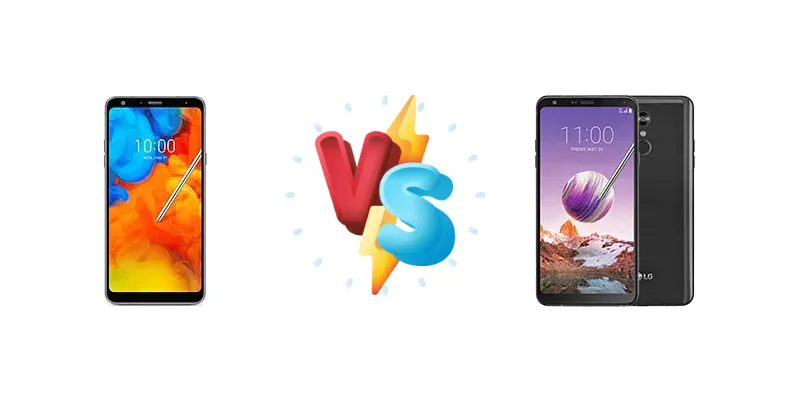
The LG Q Stylus and Q Stylo 4 represent LG’s attempt to deliver affordable smartphones with a focus on usability. While both target the budget-conscious consumer, they diverge in key areas – the Q Stylus prioritizing integrated stylus functionality powered by the Mediatek MT6750, and the Q Stylo 4 opting for Qualcomm’s Snapdragon 450. This comparison dissects these differences to determine which device offers the best value.
🏆 Quick Verdict
For the average user prioritizing smooth, consistent performance and efficient power usage, the LG Q Stylo 4 emerges as the better choice. The Snapdragon 450’s 14nm process provides a noticeable advantage in thermal management and sustained performance over the Mediatek MT6750, despite similar CPU clock speeds.
| Network |
|---|
| 2G bands | GSM 850 / 900 / 1800 / 1900 | GSM 850 / 900 / 1800 / 1900 |
| 3G bands | HSDPA 850 / 900 / 1900 / 2100 | HSDPA 850 / 900 / 1900 / 2100 |
| 4G bands | 1, 3, 5, 7, 8, 28, 38, 39, 40, 41 | 1, 2, 3, 4, 5, 7, 12, 13, 20, 38, 41, 66, 71 |
| Speed | HSPA, LTE | HSPA 42.2/5.76 Mbps, LTE (2CA) Cat6 300/50 Mbps |
| Technology | GSM / HSPA / LTE | GSM / HSPA / LTE |
| Launch |
|---|
| Announced | 2018, June. Released 2018, August | 2018, June. Released 2018, June |
| Status | Discontinued | Discontinued |
| Body |
|---|
| Build | Glass front, plastic back, aluminum frame | - |
| Dimensions | 160.1 x 77.7 x 8.1 mm (6.30 x 3.06 x 0.32 in) | 160 x 77.7 x 8.1 mm (6.30 x 3.06 x 0.32 in) |
| SIM | · Nano-SIM· Nano-SIM + Nano-SIM | Nano-SIM |
| Weight | 171 g (6.03 oz) | 172 g (6.07 oz) |
| | Stylus
IP68 dust/water resistant (up to 1.5m for 30 mins)
MIL-STD-810G compliant*
*does not guarantee ruggedness or use in extreme conditions | Stylus |
| Display |
|---|
| Resolution | 1080 x 2160 pixels, 18:9 ratio (~389 ppi density) | 1080 x 2160 pixels, 18:9 ratio (~390 ppi density) |
| Size | 6.2 inches, 99.7 cm2 (~80.2% screen-to-body ratio) | 6.2 inches, 99.2 cm2 (~79.8% screen-to-body ratio) |
| Type | IPS LCD | IPS LCD |
| Platform |
|---|
| CPU | Octa-core (4x1.5 GHz Cortex-A53 & 4x1.0 GHz Cortex-A53) - Q Stylus/Q Stylus αOcta-core 1.8 GHz | Octa-core 1.8 GHz Cortex-A53 |
| Chipset | Mediatek MT6750 - Q Stylus/Q Stylus α | Qualcomm SDM450 Snapdragon 450 (14 nm) |
| GPU | Mali-T860MP2 - Q Stylus/Q Stylus α | Adreno 506 |
| OS | Android 8.1 (Oreo) | Android 8.1 (Oreo), LG UX 7 |
| Memory |
|---|
| Card slot | microSDXC (dedicated slot) | microSDXC (dedicated slot) |
| Internal | 32GB 3GB RAM, 64GB 4GB RAM | 32GB 2GB RAM |
| | eMMC 5.1 | eMMC 5.1 |
| Main Camera |
|---|
| Features | LED flash, panorama, HDR | LED flash, panorama, HDR |
| Single | 13 MP, PDAF (Q Stylus α)
16 MP, PDAF (Q Stylus/ Q Stylus+) | 13 MP, f/2.4, PDAF |
| Video | 1080p@30fps | 1080p@30fps |
| Selfie camera |
|---|
| Single | 8 MP or 5 MP - Q Stylus/Q Stylus+
5 MP - Q Stylus α | 5 MP |
| Video | - | 720p |
| Sound |
|---|
| 3.5mm jack | Yes | Yes |
| 35mm jack | Yes | Yes |
| Loudspeaker | Yes | Yes |
| Comms |
|---|
| Bluetooth | 4.2, A2DP, LE | 4.2, A2DP, LE |
| NFC | Yes | Yes |
| Positioning | GPS, GLONASS, BDS, GALILEO | GPS, GLONASS |
| Radio | FM radio | No |
| USB | USB Type-C 2.0 | USB Type-C 2.0 |
| WLAN | Wi-Fi 802.11 b/g/n, Wi-Fi Direct, DLNA | Wi-Fi 802.11 a/b/g/n/ac, dual-band, Wi-Fi Direct, DLNA |
| Features |
|---|
| Sensors | Fingerprint (rear-mounted), accelerometer, gyro, proximity, compass | Fingerprint (rear-mounted), accelerometer, gyro, proximity, compass |
| Battery |
|---|
| Charging | 10W wired | 10W wired |
| Type | Li-Ion 3300 mAh, non-removable | Li-Ion 3300 mAh, non-removable |
| Misc |
|---|
| Colors | Aurora Black, Moroccan Blue, Lavender Violet | Aurora Black |
| Models | Q710, LM-Q710.FG | LM-Q710(FGN), LM-Q710.FGN, Q710AL, LML713DL, Q710PL |
| Price | About 300 EUR | About 250 EUR |
| SAR | - | 1.12 W/kg (head) 1.22 W/kg (body) |
LG Q Stylus
- Integrated Stylus for note-taking and drawing
- Potentially lower initial cost (depending on retailer)
- Slightly higher CPU clock speed in the Q Stylus α variant
- Less efficient Mediatek MT6750 chipset
- Potential for thermal throttling under load
- Likely shorter battery life compared to the Q Stylo 4
LG Q Stylo 4
- More efficient Qualcomm Snapdragon 450 chipset
- Better thermal management and sustained performance
- Potentially longer battery life
- Modern 14nm manufacturing process
- Lacks integrated stylus functionality
- Potentially slightly higher initial cost
Display Comparison
Both the LG Q Stylus and Q Stylo 4 share a listed price point of $240, suggesting similar display quality. However, detailed display specifications like resolution, panel type (IPS vs. VA), and color gamut coverage are absent. Without this data, a direct comparison is difficult. We can infer that both likely utilize IPS LCD panels common in this price bracket, but the Q Stylo 4’s more efficient chipset *could* translate to slightly better battery life during display-intensive tasks.
Camera Comparison
Detailed camera specifications are unavailable. Given the target market, both phones likely feature modest camera setups. Without sensor size, aperture information, or image processing details, a meaningful comparison is impossible. It’s reasonable to assume both phones include a primary camera and potentially a secondary depth sensor, but image quality will likely be heavily reliant on software optimization rather than superior hardware.
Performance
The core difference lies in the chipsets. The LG Q Stylus utilizes the Mediatek MT6750, featuring an octa-core CPU split into two clusters: four Cortex-A53 cores clocked at 1.5 GHz and four at 1.0 GHz. The Q Stylo 4, conversely, employs the Qualcomm Snapdragon 450, an octa-core Cortex-A53 processor clocked uniformly at 1.8 GHz. While clock speed is similar, the Snapdragon 450’s 14nm manufacturing process is significantly more efficient than the MT6750’s (likely 28nm). This translates to lower heat generation and reduced throttling under sustained load, benefiting users who frequently multitask or play mobile games. The Q Stylus α variant boasts a slightly higher CPU clock speed of 1.8 GHz, but the architectural disadvantage remains.
Battery Life
Both devices offer 10W wired charging, indicating similar charging speeds. Battery capacity is not specified, but the Snapdragon 450’s superior power efficiency in the Q Stylo 4 suggests it will deliver longer battery life on a single charge, even if the Q Stylus has a slightly larger battery. The reduced heat output of the Snapdragon 450 also contributes to better long-term battery health.
Buying Guide
Buy the LG Q Stylus if you absolutely require a built-in stylus for note-taking, sketching, or precise navigation, and are willing to accept potentially lower sustained performance. Buy the LG Q Stylo 4 if you prioritize a more responsive user experience, better thermal efficiency for longer app usage, and a generally more modern chipset architecture, even without the stylus feature.
Frequently Asked Questions
❓ Will the Mediatek MT6750 in the Q Stylus struggle with demanding apps like social media or video editing?
The Mediatek MT6750 is a capable processor for basic tasks, but it may exhibit slowdowns or stuttering when running resource-intensive applications for extended periods. The Snapdragon 450 in the Q Stylo 4 is better equipped to handle these workloads due to its more efficient architecture and thermal management.
❓ Is the stylus on the LG Q Stylus compatible with all apps, or are there limitations?
The LG Q Stylus’s stylus functionality is generally compatible with most note-taking and drawing applications. However, compatibility may vary depending on the specific app and its stylus support. Some apps may require specific stylus settings or configurations to function optimally.
❓ Does the Snapdragon 450 in the Q Stylo 4 support any form of fast charging, even though both phones have 10W charging?
While both phones are listed with 10W charging, the Snapdragon 450 supports Qualcomm’s Quick Charge technology, even at lower wattages. This *could* result in slightly faster charging times and more efficient power delivery compared to the Q Stylus, though the difference will likely be minimal with a 10W charger.