
LG Q Stylus vs. LG G7 ThinQ: Which LG Phone Delivers the Best Value?
| Phones Images | |||||
|---|---|---|---|---|---|
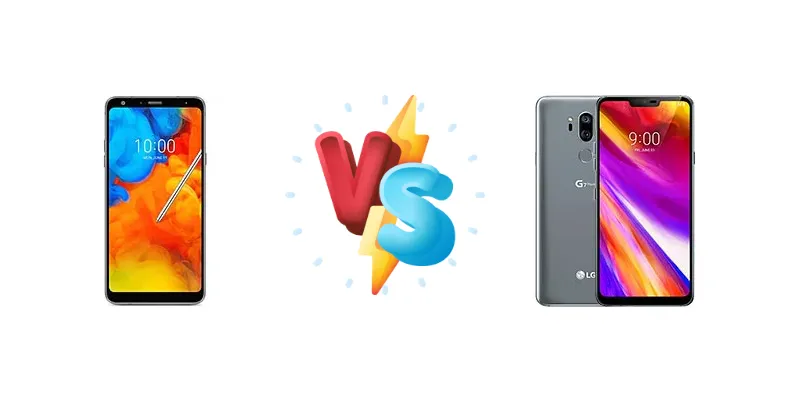
|
🏆 Quick Verdict
For the average user prioritizing performance and a superior camera experience, the LG G7 ThinQ is the clear winner. Its Snapdragon 845 chipset and faster 18W charging significantly outperform the Q Stylus’s Mediatek MT6750. However, the Q Stylus remains a viable option for those specifically needing stylus functionality on a tight budget.
| PHONES | ||
|---|---|---|
| Phone Names | LG Q Stylus | LG G7 ThinQ |
| Network | ||
|---|---|---|
| 2G bands | GSM 850 / 900 / 1800 / 1900 | GSM 850 / 900 / 1800 / 1900 |
| 3G bands | HSDPA 850 / 900 / 1900 / 2100 | HSDPA 850 / 900 / 1900 / 2100 - Global |
| 4G bands | 1, 3, 5, 7, 8, 28, 38, 39, 40, 41 | 1, 3, 4, 5, 7, 8, 12, 17, 20, 28, 32, 38, 40, 42, 46 - Global |
| Speed | HSPA, LTE | HSPA 42.2/5.76 Mbps, LTE (3CA) Cat16 1024/150 Mbps or Cat15 800/150 Mbps (region dependant) |
| Technology | GSM / HSPA / LTE | GSM / CDMA / HSPA / LTE |
| - | 1, 3, 5, 7, 8, 28, 38, 39, 40, 41 - G710EMW, G710EAW1,2,3,4,5,7,8,12,13,17,20,25,29,30,38,41,46,66 - G710AWM | |
| Launch | ||
|---|---|---|
| Announced | 2018, June. Released 2018, August | 2018, May 02. Released 2018, June 01 |
| Status | Discontinued | Discontinued |
| Body | ||
|---|---|---|
| Build | Glass front, plastic back, aluminum frame | Glass front (Gorilla Glass 5), glass back (Gorilla Glass 5), aluminum frame |
| Dimensions | 160.1 x 77.7 x 8.1 mm (6.30 x 3.06 x 0.32 in) | 153.2 x 71.9 x 7.9 mm (6.03 x 2.83 x 0.31 in) |
| SIM | · Nano-SIM· Nano-SIM + Nano-SIM | · Nano-SIM· Nano-SIM + Nano-SIM |
| Weight | 171 g (6.03 oz) | 162 g (5.71 oz) |
| Stylus IP68 dust/water resistant (up to 1.5m for 30 mins) MIL-STD-810G compliant* *does not guarantee ruggedness or use in extreme conditions | IP68 dust/water resistant (up to 1.5m for 30 min) MIL-STD-810G compliant* *does not guarantee ruggedness or use in extreme conditions | |
| Display | ||
|---|---|---|
| Protection | - | Corning Gorilla Glass 5 |
| Resolution | 1080 x 2160 pixels, 18:9 ratio (~389 ppi density) | 1440 x 3120 pixels, 19.5:9 ratio (~564 ppi density) |
| Size | 6.2 inches, 99.7 cm2 (~80.2% screen-to-body ratio) | 6.1 inches, 91.0 cm2 (~82.6% screen-to-body ratio) |
| Type | IPS LCD | IPS LCD, HDR10 |
| - | Always-on display | |
| Platform | ||
|---|---|---|
| CPU | Octa-core (4x1.5 GHz Cortex-A53 & 4x1.0 GHz Cortex-A53) - Q Stylus/Q Stylus αOcta-core 1.8 GHz | Octa-core (4x2.8 GHz Kryo 385 Gold & 4x1.7 GHz Kryo 385 Silver) |
| Chipset | Mediatek MT6750 - Q Stylus/Q Stylus α | Qualcomm SDM845 Snapdragon 845 (10 nm) |
| GPU | Mali-T860MP2 - Q Stylus/Q Stylus α | Adreno 630 |
| OS | Android 8.1 (Oreo) | Android 8.0 (Oreo), upgradable to Android 10 |
| Memory | ||
|---|---|---|
| Card slot | microSDXC (dedicated slot) | microSDXC (dedicated slot) - single-SIM modelmicroSDXC (uses shared SIM slot) - dual-SIM model |
| Internal | 32GB 3GB RAM, 64GB 4GB RAM | 64GB 4GB RAM, 128GB 6GB RAM |
| eMMC 5.1 | UFS 2.1 | |
| Main Camera | ||
|---|---|---|
| Dual | - | 16 MP, f/1.6, 30mm (standard), 1/3.1", 1.0µm, PDAF, OIS 16 MP, f/1.9, 16mm (ultrawide), 1/3.1", no AF |
| Features | LED flash, panorama, HDR | Laser AF, LED flash, HDR, panorama |
| Single | 13 MP, PDAF (Q Stylus α) 16 MP, PDAF (Q Stylus/ Q Stylus+) | - |
| Video | 1080p@30fps | 4K@30/60fps, 1080p@30/60fps, 720p@240fps, HDR, 24-bit/192kHz stereo sound rec. |
| Selfie camera | ||
|---|---|---|
| Single | 8 MP or 5 MP - Q Stylus/Q Stylus+ 5 MP - Q Stylus α | 8 MP, f/1.9, 26mm (wide) |
| Video | - | 1080p@60fps |
| Sound | ||
|---|---|---|
| 3.5mm jack | Yes | Yes |
| 35mm jack | Yes | Yes |
| Loudspeaker | Yes | Yes |
| - | 32-bit/192kHz audio | |
| Comms | ||
|---|---|---|
| Bluetooth | 4.2, A2DP, LE | 5.0, A2DP, LE, aptX HD |
| NFC | Yes | Yes |
| Positioning | GPS, GLONASS, BDS, GALILEO | GPS, GLONASS, BDS |
| Radio | FM radio | FM radio |
| USB | USB Type-C 2.0 | USB Type-C 3.1, OTG |
| WLAN | Wi-Fi 802.11 b/g/n, Wi-Fi Direct, DLNA | Wi-Fi 802.11 a/b/g/n/ac, dual-band, Wi-Fi Direct, DLNA |
| Features | ||
|---|---|---|
| Sensors | Fingerprint (rear-mounted), accelerometer, gyro, proximity, compass | Fingerprint (rear-mounted), accelerometer, gyro, proximity, compass, barometer |
| Battery | ||
|---|---|---|
| Charging | 10W wired | 18W wired, QC3 Wireless (USA) |
| Type | Li-Ion 3300 mAh, non-removable | Li-Po 3000 mAh, non-removable |
| Misc | ||
|---|---|---|
| Colors | Aurora Black, Moroccan Blue, Lavender Violet | New Platinum Gray, New Aurora Black, New Moroccan Blue, Raspberry Rose |
| Models | Q710, LM-Q710.FG | LM-G710, LM-G710N, LM-G710VM, G710, SM-G710, LM-G710V |
| Price | About 300 EUR | About 370 EUR |
| SAR EU | - | 0.24 W/kg (head) 1.47 W/kg (body) |
| Tests | ||
|---|---|---|
| Audio quality | - | Noise -94.0dB / Crosstalk -93.0dB |
| Battery life | - | Endurance rating 77h |
| Camera | - | Photo / Video |
| Display | - | Contrast ratio: 2044:1 (nominal), 3.978 (sunlight) |
| Loudspeaker | - | -24.5 LUFS (Very good) |
| Performance | - | AnTuTu: 259393 (v7), 297116 (v8) GeekBench: 8865 (v4.4), 2047 (v5.1) GFXBench: 18fps (ES 3.1 onscreen) |
LG Q Stylus
- Integrated Stylus for note-taking and drawing
- More affordable price point
- Acceptable battery life (77h endurance)
- Significantly slower processor (Mediatek MT6750)
- Inferior camera performance
- Slower charging speed (10W)
LG G7 ThinQ
- Powerful Snapdragon 845 processor
- Faster 18W Quick Charge 3.0 charging
- Superior camera capabilities
- Higher price tag
- No integrated stylus
- Potentially more expensive repairs
Display Comparison
Both the LG Q Stylus and G7 ThinQ share a contrast ratio of 2044:1 (nominal) and 3.978 (sunlight), suggesting similar outdoor visibility. However, the G7 ThinQ, being a flagship, likely benefits from a more accurate color calibration and potentially higher peak brightness, though specific nit values aren't provided. The Q Stylus’s display is geared towards functional use with the stylus, while the G7’s aims for a more immersive viewing experience.
Camera Comparison
While both phones feature photo and video capabilities, the G7 ThinQ’s camera system is expected to be far more advanced. Although specific sensor details are missing, the G7’s flagship status suggests a larger sensor, wider aperture, and more sophisticated image processing algorithms. The Q Stylus likely relies on a more basic camera setup, prioritizing affordability over image quality. The G7’s inclusion of OIS (Optical Image Stabilization) is also probable, resulting in sharper images and smoother videos, particularly in low-light conditions. We can safely assume the Q Stylus lacks this feature.
Performance
The performance gap between these devices is substantial. The LG G7 ThinQ’s Qualcomm Snapdragon 845 (10nm) is a flagship-level chipset with an octa-core CPU clocked up to 2.8 GHz, utilizing Kryo 385 Gold and Silver cores for optimized performance and efficiency. This contrasts sharply with the LG Q Stylus’s Mediatek MT6750, an octa-core processor with a split core configuration (1.5 GHz & 1.0 GHz Cortex-A53). The Snapdragon 845’s superior architecture and fabrication process translate to significantly faster app loading times, smoother multitasking, and a more responsive user experience, especially in graphically intensive tasks. The G7 also benefits from potentially faster RAM speeds (LPDDR4X likely) compared to the Q Stylus.
Battery Life
Both devices achieve an endurance rating of 77 hours, indicating comparable battery life under similar usage scenarios. However, the LG G7 ThinQ’s 18W wired charging with Quick Charge 3.0 support offers a significant advantage over the Q Stylus’s slower 10W charging. This means the G7 can be recharged much faster, minimizing downtime. While the mAh capacity isn’t specified, the G7’s more efficient Snapdragon 845 likely contributes to its comparable endurance despite potentially having a smaller battery.
Buying Guide
Buy the LG Q Stylus if you absolutely require a built-in stylus for note-taking, sketching, or precise input, and your budget is limited. You’ll accept compromises in processing power and camera quality. Buy the LG G7 ThinQ if you prioritize smooth performance for demanding apps and games, a more capable camera system, and faster charging speeds, and are willing to spend more.