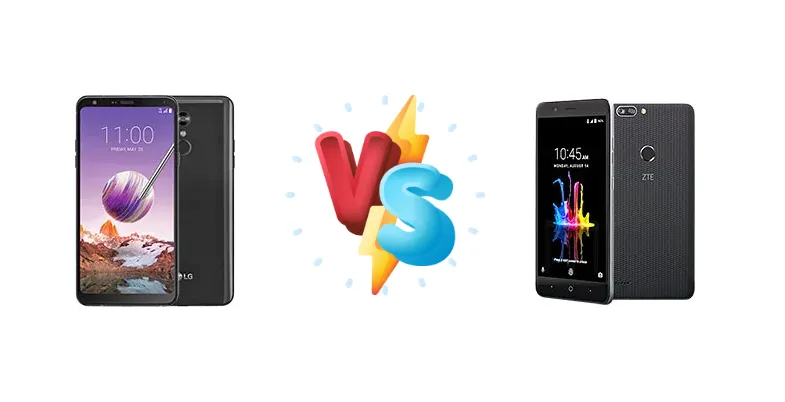
The LG Q Stylo 4 and ZTE Blade Z Max represent a segment of the smartphone market increasingly focused on delivering functionality at an accessible price point. Both devices target users prioritizing essential features over flagship specifications, but they take different approaches to achieving this. This comparison dissects their core components to determine which offers the better overall experience.
🏆 Quick Verdict
For the average user, the LG Q Stylo 4 emerges as the slightly better choice. While the ZTE Blade Z Max boasts faster 18W charging, the LG Q Stylo 4’s newer Snapdragon 450 chipset, built on a smaller 14nm process, provides a more efficient and potentially smoother user experience, justifying the trade-off.
| Network |
|---|
| 2G bands | GSM 850 / 900 / 1800 / 1900 | GSM 850 / 900 / 1800 / 1900 - SIM 1 & SIM 2 |
| 3G bands | HSDPA 850 / 900 / 1900 / 2100 | HSDPA 850 / 1700(AWS) / 1900 |
| 4G bands | 1, 2, 3, 4, 5, 7, 12, 13, 20, 38, 41, 66, 71 | 2, 4, 5, 12, 66 |
| Speed | HSPA 42.2/5.76 Mbps, LTE (2CA) Cat6 300/50 Mbps | HSPA 42.2/5.76 Mbps, LTE (2CA) Cat6 300/50 Mbps |
| Technology | GSM / HSPA / LTE | GSM / HSPA / LTE |
| Launch |
|---|
| Announced | 2018, June. Released 2018, June | 2017, August. Released 2017, August |
| Status | Discontinued | Discontinued |
| Body |
|---|
| Dimensions | 160 x 77.7 x 8.1 mm (6.30 x 3.06 x 0.32 in) | 166.1 x 84.6 x 8.4 mm (6.54 x 3.33 x 0.33 in) |
| SIM | Nano-SIM | Nano-SIM |
| Weight | 172 g (6.07 oz) | 175 g (6.17 oz) |
| | Stylus | - |
| Display |
|---|
| Protection | - | Asahi Dragontrail Glass |
| Resolution | 1080 x 2160 pixels, 18:9 ratio (~390 ppi density) | 1080 x 1920 pixels, 16:9 ratio (~367 ppi density) |
| Size | 6.2 inches, 99.2 cm2 (~79.8% screen-to-body ratio) | 6.0 inches, 99.2 cm2 (~70.6% screen-to-body ratio) |
| Type | IPS LCD | IPS LCD |
| Platform |
|---|
| CPU | Octa-core 1.8 GHz Cortex-A53 | Octa-core 1.4 GHz Cortex-A53 |
| Chipset | Qualcomm SDM450 Snapdragon 450 (14 nm) | Qualcomm MSM8940 Snapdragon 435 (28 nm) |
| GPU | Adreno 506 | Adreno 505 |
| OS | Android 8.1 (Oreo), LG UX 7 | Android 7.1.1 (Nougat) |
| Memory |
|---|
| Card slot | microSDXC (dedicated slot) | microSDXC (dedicated slot) |
| Internal | 32GB 2GB RAM | 32GB 2GB RAM |
| | eMMC 5.1 | eMMC 5.1 |
| Main Camera |
|---|
| Dual | - | 16 MP, PDAF
Auxiliary lens |
| Features | LED flash, panorama, HDR | LED flash, HDR, panorama |
| Single | 13 MP, f/2.4, PDAF | - |
| Video | 1080p@30fps | 1080p@30fps |
| Selfie camera |
|---|
| Single | 5 MP | 8 MP |
| Video | 720p | 1080p@30fps |
| Sound |
|---|
| 3.5mm jack | Yes | Yes |
| 35mm jack | Yes | Yes |
| Loudspeaker | Yes | Yes |
| Comms |
|---|
| Bluetooth | 4.2, A2DP, LE | 4.2, A2DP, LE |
| NFC | Yes | No |
| Positioning | GPS, GLONASS | GPS |
| Radio | No | FM radio |
| USB | USB Type-C 2.0 | USB Type-C |
| WLAN | Wi-Fi 802.11 a/b/g/n/ac, dual-band, Wi-Fi Direct, DLNA | Wi-Fi 802.11 b/g/n, Wi-Fi Direct |
| Features |
|---|
| Sensors | Fingerprint (rear-mounted), accelerometer, gyro, proximity, compass | Fingerprint (rear-mounted), accelerometer, gyro, proximity, compass |
| Battery |
|---|
| Charging | 10W wired | 18W wired, QC2 |
| Stand-by | - | Up to 528 h (3G) |
| Talk time | - | Up to 31 h (3G) |
| Type | Li-Ion 3300 mAh, non-removable | Li-Ion 4080 mAh, non-removable |
| Misc |
|---|
| Colors | Aurora Black | Black |
| Models | LM-Q710(FGN), LM-Q710.FGN, Q710AL, LML713DL, Q710PL | Z982 |
| Price | About 250 EUR | About 110 EUR |
| SAR | 1.12 W/kg (head) 1.22 W/kg (body) | - |
LG Q Stylo 4
- More efficient Snapdragon 450 chipset
- Modern 14nm fabrication process
- Potentially smoother multitasking
- Slower 10W charging
- Display specifications are unknown
ZTE Blade Z Max
- Faster 18W charging with Quick Charge 2.0
- Quick battery top-ups
- Potentially longer battery life with efficient usage
- Older Snapdragon 435 chipset
- Less efficient 28nm fabrication process
- Potentially more thermal throttling
Display Comparison
Both devices share a similar display price point of $240, suggesting comparable panel quality. However, detailed display specifications like resolution, brightness, and color accuracy are missing. Given the price bracket, both likely utilize IPS LCD panels. The lack of information prevents a definitive assessment, but the focus is clearly not on display excellence in either case.
Camera Comparison
Without detailed camera specifications, a direct comparison is difficult. Both phones likely feature basic camera setups geared towards casual photography. The absence of information regarding sensor size, aperture, or image stabilization suggests neither device will excel in low-light conditions or offer advanced photographic features. It's reasonable to assume both rely heavily on software processing to enhance image quality.
Performance
The core difference lies in the chipsets. The LG Q Stylo 4 utilizes the Qualcomm Snapdragon 450, fabricated on a 14nm process, while the ZTE Blade Z Max features the older Snapdragon 435, built on a larger 28nm node. This process difference is significant; the 14nm process generally translates to better power efficiency and potentially lower thermal throttling under sustained load. While both CPUs are octa-core Cortex-A53 designs, the Snapdragon 450’s 1.8 GHz clock speed versus the 435’s 1.4 GHz indicates a performance advantage, albeit a modest one. This means the LG Q Stylo 4 should handle multitasking and app launches slightly faster.
Battery Life
Battery capacity is not specified for either device. However, the ZTE Blade Z Max’s 18W wired charging with Quick Charge 2.0 support is a clear advantage over the LG Q Stylo 4’s slower 10W charging. This means the ZTE Blade Z Max can replenish its battery significantly faster, a crucial benefit for users who frequently use their phones throughout the day. While a larger battery capacity on the LG Q Stylo 4 could offset this, the more efficient Snapdragon 450 might provide comparable real-world battery life despite the slower charging speed.
Buying Guide
Buy the LG Q Stylo 4 if you prioritize a more modern chipset architecture for improved efficiency and responsiveness in everyday tasks. This phone is ideal for users who frequently use social media, browse the web, and need a reliable device for basic communication. Buy the ZTE Blade Z Max if fast charging is a critical requirement and you frequently find yourself needing to quickly top up your battery, even if it means sacrificing some processing efficiency.
Frequently Asked Questions
❓ Will the Snapdragon 450 in the LG Q Stylo 4 handle basic gaming like Candy Crush or Subway Surfers without significant lag?
Yes, the Snapdragon 450 is more than capable of handling casual games like Candy Crush and Subway Surfers. While it won't deliver a high-end gaming experience, the 1.8 GHz clock speed and octa-core architecture provide sufficient processing power for these types of games without noticeable lag.
❓ How much faster is the 18W charging on the ZTE Blade Z Max compared to the 10W charging on the LG Q Stylo 4 in a real-world scenario?
The 18W charging on the ZTE Blade Z Max will significantly reduce charging times. While exact figures depend on battery capacity (which is unknown for both devices), you can expect a 0-100% charge to be approximately 30-60 minutes faster on the ZTE Blade Z Max compared to the LG Q Stylo 4.
❓ Is the difference in chipset fabrication process (14nm vs 28nm) noticeable in everyday use?
The difference in fabrication process is primarily noticeable in power efficiency and thermal management. The LG Q Stylo 4’s 14nm Snapdragon 450 will generally consume less power for the same tasks, resulting in slightly longer battery life. It also generates less heat, potentially reducing performance throttling during prolonged use.