
Moto G Play (2023) vs LG Q Stylo 4: A Deep Dive into Budget Smartphone Performance
| Phones Images | |||||
|---|---|---|---|---|---|
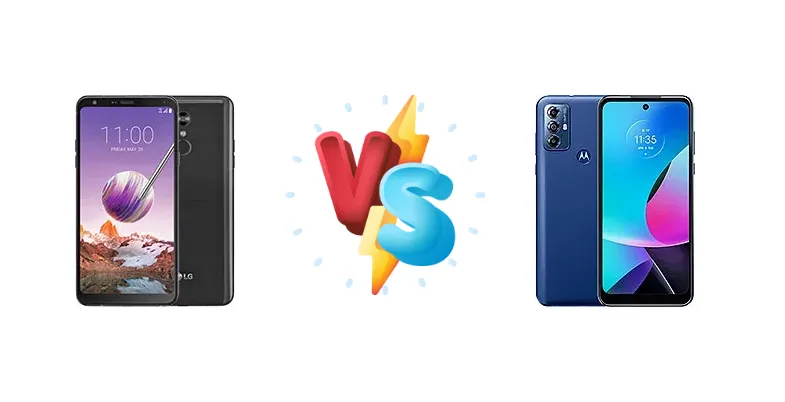
|
🏆 Quick Verdict
For most users, the Motorola Moto G Play (2023) is the superior choice. Its Mediatek Helio G37 chipset, built on a more efficient 12nm process, provides a noticeable performance uplift over the LG Q Stylo 4’s Snapdragon 450, making it better suited for everyday tasks and light gaming.
| PHONES | ||
|---|---|---|
| Phone Names | LG Q Stylo 4 | Motorola Moto G Play (2023) |
| Network | ||
|---|---|---|
| 2G bands | GSM 850 / 900 / 1800 / 1900 | GSM 850 / 900 / 1800 / 1900 |
| 3G bands | HSDPA 850 / 900 / 1900 / 2100 | HSDPA 850 / 900 / 1700(AWS) / 1900 / 2100 |
| 4G bands | 1, 2, 3, 4, 5, 7, 12, 13, 20, 38, 41, 66, 71 | 1, 2, 3, 4, 5, 7, 8, 12, 13, 14, 17, 18, 19, 20, 25, 26, 29, 30, 38, 39, 40, 41, 66, 71 |
| Speed | HSPA 42.2/5.76 Mbps, LTE (2CA) Cat6 300/50 Mbps | HSPA, LTE |
| Technology | GSM / HSPA / LTE | GSM / CDMA / HSPA / LTE |
| - | CDMA 800 / 1900 | |
| Launch | ||
|---|---|---|
| Announced | 2018, June. Released 2018, June | 2022, December 08 |
| Status | Discontinued | Available. Released 2022, December 12 |
| Body | ||
|---|---|---|
| Build | - | Plastic frame, plastic back |
| Dimensions | 160 x 77.7 x 8.1 mm (6.30 x 3.06 x 0.32 in) | 167.2 x 76.5 x 9.4 mm (6.58 x 3.01 x 0.37 in) |
| SIM | Nano-SIM | Nano-SIM |
| Weight | 172 g (6.07 oz) | 203 g (7.20 oz) |
| Stylus | Water-repellent coating | |
| Display | ||
|---|---|---|
| Resolution | 1080 x 2160 pixels, 18:9 ratio (~390 ppi density) | 720 x 1600 pixels, 20:9 ratio (~270 ppi density) |
| Size | 6.2 inches, 99.2 cm2 (~79.8% screen-to-body ratio) | 6.5 inches, 102.0 cm2 (~79.7% screen-to-body ratio) |
| Type | IPS LCD | IPS LCD, 90Hz |
| Platform | ||
|---|---|---|
| CPU | Octa-core 1.8 GHz Cortex-A53 | Octa-core (4x2.3 GHz Cortex-A53 & 4x1.8 GHz Cortex-A53) |
| Chipset | Qualcomm SDM450 Snapdragon 450 (14 nm) | Mediatek MT6765 Helio G37 (12 nm) |
| GPU | Adreno 506 | PowerVR GE8320 |
| OS | Android 8.1 (Oreo), LG UX 7 | Android 12 |
| Memory | ||
|---|---|---|
| Card slot | microSDXC (dedicated slot) | microSDXC (dedicated slot) |
| Internal | 32GB 2GB RAM | 32GB 3GB RAM |
| eMMC 5.1 | eMMC 5.1 | |
| Main Camera | ||
|---|---|---|
| Features | LED flash, panorama, HDR | LED flash, HDR, panorama |
| Single | 13 MP, f/2.4, PDAF | - |
| Triple | - | 16 MP, f/2.2, (wide), 1.12µm, PDAF 2 MP (macro) Auxiliary lens |
| Video | 1080p@30fps | 1080p@30/60fps |
| Selfie camera | ||
|---|---|---|
| Features | - | HDR |
| Single | 5 MP | 5 MP, f/2.4, (wide), 1.12µm |
| Video | 720p | 1080p@30fps |
| Sound | ||
|---|---|---|
| 3.5mm jack | Yes | Yes |
| 35mm jack | Yes | Yes |
| Loudspeaker | Yes | Yes |
| Comms | ||
|---|---|---|
| Bluetooth | 4.2, A2DP, LE | 5.0, A2DP, LE |
| NFC | Yes | No |
| Positioning | GPS, GLONASS | GPS, GLONASS |
| Radio | No | No |
| USB | USB Type-C 2.0 | USB Type-C 2.0 |
| WLAN | Wi-Fi 802.11 a/b/g/n/ac, dual-band, Wi-Fi Direct, DLNA | Wi-Fi 802.11 a/b/g/n/ac, dual-band |
| Features | ||
|---|---|---|
| Sensors | Fingerprint (rear-mounted), accelerometer, gyro, proximity, compass | Fingerprint (rear-mounted), accelerometer, proximity, barometer |
| Battery | ||
|---|---|---|
| Charging | 10W wired | 10W wired |
| Type | Li-Ion 3300 mAh, non-removable | Li-Po 5000 mAh |
| Misc | ||
|---|---|---|
| Colors | Aurora Black | Deep Indigo |
| Models | LM-Q710(FGN), LM-Q710.FGN, Q710AL, LML713DL, Q710PL | XT2271-1, XT2271-3, XT2271-5, XT2271-4 |
| Price | About 250 EUR | $ 54.00 / C$ 129.00 |
| SAR | 1.12 W/kg (head) 1.22 W/kg (body) | - |
| Tests | ||
|---|---|---|
| Display | 240 USD | - |
LG Q Stylo 4
- Potentially lower initial cost
- Familiar LG user interface (for existing LG users)
- May be readily available in specific regions
- Older chipset (Snapdragon 450)
- Less efficient 14nm process
- Likely limited software support
Motorola Moto G Play (2023)
- More powerful and efficient Helio G37 chipset
- 12nm process for better thermal management
- Likely longer software support lifecycle
- May be slightly more expensive upfront
- Motorola's software can be perceived as 'bloated' by some users
- Build quality may be primarily plastic
Display Comparison
Both devices share a similar display price point of $240, but detailed display specs are unavailable. Given the Q Stylo 4's age, it likely utilizes an older IPS LCD panel. The Moto G Play (2023) likely benefits from more recent display technology, potentially offering improved color accuracy and viewing angles. Without specific nit brightness or resolution data, it's difficult to definitively declare a winner, but the newer device likely has a slight edge.
Camera Comparison
Detailed camera specifications are lacking for both devices. However, given the market positioning, it's safe to assume both feature basic camera setups. Without sensor size or aperture information, a direct comparison is impossible. The LG Q Stylo 4's age suggests its camera technology is likely less advanced than the Moto G Play (2023).
Performance
The Motorola Moto G Play (2023) boasts a significant advantage in processing power. Its Mediatek Helio G37, fabricated on a 12nm process, features an octa-core CPU with a faster clock speed configuration (4x2.3 GHz Cortex-A53 & 4x1.8 GHz Cortex-A53) compared to the LG Q Stylo 4’s Snapdragon 450 (octa-core 1.8 GHz Cortex-A53). The 12nm process node is more efficient than the Snapdragon 450’s 14nm node, translating to better thermal management and potentially longer sustained performance. This means the Moto G Play (2023) will handle multitasking and app loading more smoothly.
Battery Life
Both phones offer 10W wired charging. While battery capacity isn't specified, the Moto G Play (2023)'s more efficient chipset (Helio G37 on 12nm) will likely result in better battery life despite potentially having a similar capacity to the LG Q Stylo 4. The improved efficiency means less power is consumed during typical usage, extending the time between charges.
Buying Guide
Buy the LG Q Stylo 4 if you prioritize a potentially lower upfront cost and are primarily using the phone for very basic tasks like calls and texts, and aren't concerned with future software updates. Buy the Motorola Moto G Play (2023) if you want a more responsive experience, better performance for apps and multitasking, and a device that will likely receive more consistent software support.