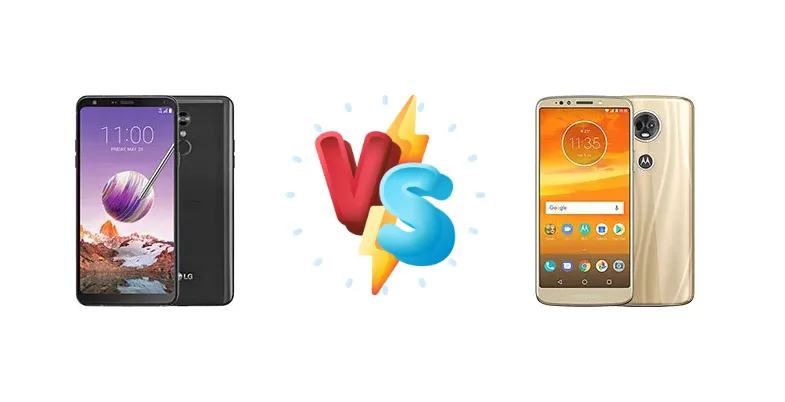
The LG Q Stylo 4 and Motorola Moto E5 Plus represent a segment of the market where value is paramount. Both phones aim to deliver a functional Android experience at an accessible price point, but they achieve this with significantly different hardware choices. This comparison dissects those choices, focusing on the core performance and efficiency trade-offs between Qualcomm’s Snapdragon 450 and Snapdragon 425.
🏆 Quick Verdict
For the average user prioritizing responsiveness and occasional multitasking, the LG Q Stylo 4 is the better choice. Its Snapdragon 450, built on a 14nm process, offers a noticeable performance advantage over the Moto E5 Plus’s Snapdragon 425, despite the latter’s potential for slightly faster charging speeds in some markets.
| Network |
|---|
| 2G bands | GSM 850 / 900 / 1800 / 1900 | GSM 850 / 900 / 1800 / 1900 |
| 3G bands | HSDPA 850 / 900 / 1900 / 2100 | HSDPA 850 / 900 / 1900 / 2100 - Europe |
| 4G bands | 1, 2, 3, 4, 5, 7, 12, 13, 20, 38, 41, 66, 71 | 1, 3, 5, 7, 8, 20, 38, 40 - Europe |
| Speed | HSPA 42.2/5.76 Mbps, LTE (2CA) Cat6 300/50 Mbps | HSPA 42.2/5.76 Mbps, LTE Cat4 150/50 Mbps or LTE (2CA) Cat6 300/50 Mbps - USA only |
| Technology | GSM / HSPA / LTE | GSM / CDMA / HSPA / EVDO / LTE |
| | - | 1, 2, 3, 4, 5, 7, 8, 12, 13, 14, 17, 25, 26, 29, 30, 38, 41, 66, 71 - USA |
| Launch |
|---|
| Announced | 2018, June. Released 2018, June | 2018, April. Released 2018, May |
| Status | Discontinued | Discontinued |
| Body |
|---|
| Build | - | Glass front (Gorilla Glass), plastic back, plastic frame |
| Dimensions | 160 x 77.7 x 8.1 mm (6.30 x 3.06 x 0.32 in) | 160.9 x 75.3 x 9.4 mm (6.33 x 2.96 x 0.37 in) |
| SIM | Nano-SIM | · Nano-SIM· Nano-SIM + Nano-SIM |
| Weight | 172 g (6.07 oz) | 196.6 g (6.95 oz) |
| | Stylus | - |
| Display |
|---|
| Protection | - | Corning Gorilla Glass (unspecified version) |
| Resolution | 1080 x 2160 pixels, 18:9 ratio (~390 ppi density) | 720 x 1440 pixels, 18:9 ratio (~268 ppi density) |
| Size | 6.2 inches, 99.2 cm2 (~79.8% screen-to-body ratio) | 6.0 inches, 92.9 cm2 (~76.7% screen-to-body ratio) |
| Type | IPS LCD | IPS LCD |
| Platform |
|---|
| CPU | Octa-core 1.8 GHz Cortex-A53 | Quad-core 1.4 GHz Cortex-A53 |
| Chipset | Qualcomm SDM450 Snapdragon 450 (14 nm) | Qualcomm MSM8917 Snapdragon 425 (28 nm) |
| GPU | Adreno 506 | Adreno 308 |
| OS | Android 8.1 (Oreo), LG UX 7 | Android 8.0 (Oreo) |
| Memory |
|---|
| Card slot | microSDXC (dedicated slot) | microSDXC (dedicated slot) |
| Internal | 32GB 2GB RAM | 16GB 2GB RAM, 32GB 3GB RAM |
| | eMMC 5.1 | eMMC 5.1 |
| Main Camera |
|---|
| Features | LED flash, panorama, HDR | Laser AF, LED flash, HDR, panorama |
| Single | 13 MP, f/2.4, PDAF | 12 MP, f/2.0, 1/2.8", 1.25µm, PDAF |
| Video | 1080p@30fps | 1080p@30fps |
| Selfie camera |
|---|
| Features | - | LED flash |
| Single | 5 MP | 5 MP, f/2.0 |
| Video | 720p | - |
| Sound |
|---|
| 3.5mm jack | Yes | Yes |
| 35mm jack | Yes | Yes |
| Loudspeaker | Yes | Yes |
| Comms |
|---|
| Bluetooth | 4.2, A2DP, LE | 4.2, A2DP, LE |
| NFC | Yes | No |
| Positioning | GPS, GLONASS | GPS, GLONASS, BDS |
| Radio | No | FM radio |
| USB | USB Type-C 2.0 | microUSB 2.0 |
| WLAN | Wi-Fi 802.11 a/b/g/n/ac, dual-band, Wi-Fi Direct, DLNA | Wi-Fi 802.11 b/g/n, Wi-Fi DirectWi-Fi 802.11 a/b/g/n, dual-band, Wi-Fi Direct - USA |
| Features |
|---|
| Sensors | Fingerprint (rear-mounted), accelerometer, gyro, proximity, compass | Fingerprint (rear-mounted), accelerometer, proximity |
| Battery |
|---|
| Charging | 10W wired | 10W / 15W wired (market dependent) |
| Type | Li-Ion 3300 mAh, non-removable | Li-Ion 5000 mAh, non-removable |
| Misc |
|---|
| Colors | Aurora Black | Black, Flash gray, Mineral blue, Fine Gold |
| Models | LM-Q710(FGN), LM-Q710.FGN, Q710AL, LML713DL, Q710PL | - |
| Price | About 250 EUR | About 170 EUR |
| SAR | 1.12 W/kg (head) 1.22 W/kg (body) | 0.99 W/kg (head) 1.13 W/kg (body) |
| SAR EU | - | 0.90 W/kg (head) 1.47 W/kg (body) |
LG Q Stylo 4
- Faster processor for smoother multitasking
- More efficient 14nm Snapdragon 450 chipset
- Better sustained performance due to improved thermal management
- Limited to 10W charging
- Display specs are unknown
Motorola Moto E5 Plus
- Potentially faster charging (15W in some markets)
- Likely longer battery life for basic usage
- Simple and straightforward Android experience
- Significantly slower processor
- Less efficient 28nm Snapdragon 425 chipset
- Prone to performance throttling under load
Display Comparison
Both devices share a similar display price point of $240, suggesting comparable panel quality. However, detailed display specs like resolution, brightness, and color accuracy are missing. Given the market segment, we can assume both utilize IPS LCD panels. The lack of information prevents a detailed comparison, but the focus here is on internal performance, not display fidelity.
Camera Comparison
Without detailed camera specifications, a direct comparison is difficult. Both phones likely feature basic camera setups geared towards casual photography. The absence of information regarding sensor size, aperture, or image stabilization suggests neither phone will excel in low-light conditions. Any differences in image quality will likely stem from software processing rather than hardware capabilities.
Performance
The core difference lies in the chipsets. The LG Q Stylo 4’s Snapdragon 450, an octa-core processor clocked at 1.8 GHz, significantly outperforms the Motorola Moto E5 Plus’s quad-core Snapdragon 425 running at 1.4 GHz. Crucially, the Snapdragon 450 is fabricated on a 14nm process, offering superior power efficiency and thermal characteristics compared to the Moto E5 Plus’s 28nm Snapdragon 425. This means the Q Stylo 4 is less likely to throttle under sustained load, maintaining performance for longer periods. While both CPUs utilize Cortex-A53 cores, the increased core count and process node advantage give the Q Stylo 4 a clear edge in multi-threaded tasks and overall responsiveness.
Battery Life
The Moto E5 Plus supports 10W or 15W charging (market dependent), while the Q Stylo 4 is limited to 10W. This *could* translate to slightly faster charging times for the E5 Plus in certain regions. However, the Snapdragon 450’s superior efficiency in the Q Stylo 4 may offset this advantage, resulting in comparable real-world battery life despite potentially smaller battery capacity (spec not provided). The 28nm process of the Snapdragon 425 is inherently less efficient, meaning the E5 Plus will likely consume more power for the same tasks.
Buying Guide
Buy the LG Q Stylo 4 if you need a phone capable of handling more demanding apps and multitasking without significant slowdowns. It’s ideal for users who occasionally play mobile games or frequently switch between applications. Buy the Motorola Moto E5 Plus if battery life is your absolute top priority and your usage is limited to basic tasks like calls, texts, and light social media browsing. The E5 Plus is a solid option for those who need a phone that can reliably last a full day on a single charge.
Frequently Asked Questions
❓ Will the Snapdragon 425 in the Moto E5 Plus struggle with modern Android apps?
Yes, the Snapdragon 425 is a relatively low-end processor. While it can handle basic tasks like calls, texts, and light browsing, it will likely exhibit noticeable slowdowns and lag when running more demanding apps or multitasking. The quad-core architecture and lower clock speed are significant limitations.
❓ Is the 14nm process of the Snapdragon 450 in the LG Q Stylo 4 a significant advantage?
Absolutely. The 14nm process node is far more efficient than the 28nm process used in the Snapdragon 425. This translates to lower power consumption, less heat generation, and sustained performance. The Q Stylo 4 is less likely to throttle under load, maintaining responsiveness for longer periods.
❓ Does the Moto E5 Plus's potential 15W charging make a big difference in real-world use?
The difference is likely marginal. While 15W charging is faster than 10W, the Snapdragon 450's efficiency in the Q Stylo 4 may mean it reaches similar charge levels in a comparable timeframe, even with the slower charging speed. Battery capacity (which is unknown for both devices) also plays a crucial role.