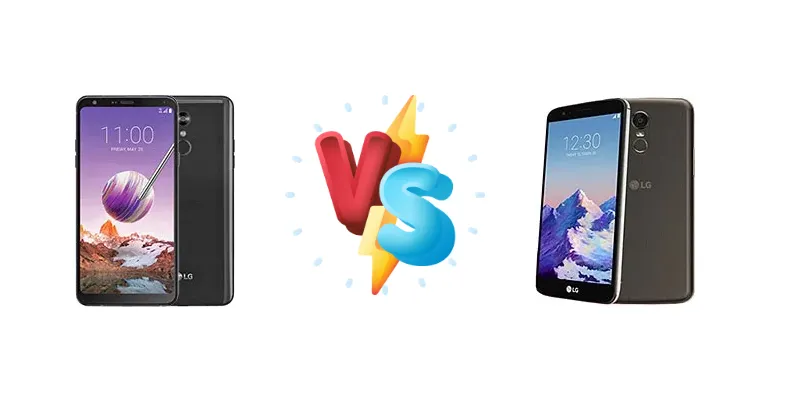
The LG Q Stylo 4 and LG Stylus 3 represent LG’s attempts to deliver affordable smartphones with the added functionality of a stylus. While both cater to a similar user base, significant differences in their core hardware, particularly the chipset, dictate their performance and overall user experience. This comparison dives deep into these differences to determine which device offers the best value for budget-conscious consumers.
🏆 Quick Verdict
For the average user, the LG Q Stylo 4 emerges as the better choice. Its Qualcomm Snapdragon 450 chipset, built on a more efficient 14nm process, provides a noticeable performance advantage over the LG Stylus 3’s Mediatek MT6750 or Snapdragon 435, translating to smoother multitasking and app loading times.
| Network |
|---|
| 2G bands | GSM 850 / 900 / 1800 / 1900 | GSM 850 / 900 / 1800 / 1900 - SIM 1 & SIM 2 (dual-SIM model only) |
| 3G bands | HSDPA 850 / 900 / 1900 / 2100 | HSDPA 850 / 900 / 1900 / 2100 |
| 4G bands | 1, 2, 3, 4, 5, 7, 12, 13, 20, 38, 41, 66, 71 | 2, 4, 5, 12, 25, 26, 41 - LS777 |
| Speed | HSPA 42.2/5.76 Mbps, LTE (2CA) Cat6 300/50 Mbps | HSPA 42.2/5.76 Mbps, LTE (2CA) Cat6 300/50 Mbps |
| Technology | GSM / HSPA / LTE | GSM / CDMA / HSPA / LTE |
| | - | 3, 5, 40 - M400DK |
| Launch |
|---|
| Announced | 2018, June. Released 2018, June | 2016, December. Released 2017, March |
| Status | Discontinued | Discontinued |
| Body |
|---|
| Build | - | Glass front, plastic back, plastic frame |
| Dimensions | 160 x 77.7 x 8.1 mm (6.30 x 3.06 x 0.32 in) | 155.6 x 79.8 x 7.4 mm (6.13 x 3.14 x 0.29 in) |
| SIM | Nano-SIM | · Nano-SIM· Nano-SIM + Nano-SIM |
| Weight | 172 g (6.07 oz) | 149 g (5.26 oz) |
| | Stylus | Stylus |
| Display |
|---|
| Resolution | 1080 x 2160 pixels, 18:9 ratio (~390 ppi density) | 720 x 1280 pixels, 16:9 ratio (~258 ppi density) |
| Size | 6.2 inches, 99.2 cm2 (~79.8% screen-to-body ratio) | 5.7 inches, 89.6 cm2 (~72.1% screen-to-body ratio) |
| Type | IPS LCD | IPS LCD |
| Platform |
|---|
| CPU | Octa-core 1.8 GHz Cortex-A53 | Octa-core (4x1.5 GHz Cortex-A53 & 4x1.0 GHz Cortex-A53) - M400DKOcta-core 1.4 GHz Cortex-A53 - LS777 |
| Chipset | Qualcomm SDM450 Snapdragon 450 (14 nm) | Mediatek MT6750 - M400DKQualcomm MSM8940 Snapdragon 435 (28 nm) - LS777 |
| GPU | Adreno 506 | Mali-T860MP2 - M400DKAdreno 505 - LS777 |
| OS | Android 8.1 (Oreo), LG UX 7 | Android 7.0 (Nougat) |
| Memory |
|---|
| Card slot | microSDXC (dedicated slot) | microSDXC (dedicated slot) |
| Internal | 32GB 2GB RAM | 16GB 2GB RAM, 16GB 3GB RAM, 32GB 2GB RAM |
| | eMMC 5.1 | eMMC 5.1 |
| Main Camera |
|---|
| Features | LED flash, panorama, HDR | LED flash |
| Single | 13 MP, f/2.4, PDAF | 13 MP, f/2.2, 1/3.1", 1.12µm, AF |
| Video | 1080p@30fps | 1080p@30fps |
| Selfie camera |
|---|
| Single | 5 MP | 5 MP, Stylus 3, / 8 MP, Stylo 3, M400DK |
| Video | 720p | - |
| Sound |
|---|
| 3.5mm jack | Yes | Yes |
| 35mm jack | Yes | Yes |
| Loudspeaker | Yes | Yes |
| Comms |
|---|
| Bluetooth | 4.2, A2DP, LE | 4.1, A2DP, LE |
| NFC | Yes | Yes |
| Positioning | GPS, GLONASS | GPS, GLONASS |
| Radio | No | Stereo FM radio with RDS; recording |
| USB | USB Type-C 2.0 | microUSB 2.0, OTG |
| WLAN | Wi-Fi 802.11 a/b/g/n/ac, dual-band, Wi-Fi Direct, DLNA | Wi-Fi 802.11 b/g/n, Wi-Fi Direct, DLNA |
| Features |
|---|
| Sensors | Fingerprint (rear-mounted), accelerometer, gyro, proximity, compass | Fingerprint (rear-mounted), accelerometer, gyro, proximity, compass |
| Battery |
|---|
| Charging | 10W wired | - |
| Type | Li-Ion 3300 mAh, non-removable | Li-Ion 3200 mAh, removable |
| Misc |
|---|
| Colors | Aurora Black | Titan, Pink gold |
| Models | LM-Q710(FGN), LM-Q710.FGN, Q710AL, LML713DL, Q710PL | M400, LS777, LGMP450, LGL84VL, M430, M40, LGL83BL |
| Price | About 250 EUR | About 170 EUR |
| SAR | 1.12 W/kg (head) 1.22 W/kg (body) | - |
LG Q Stylo 4
- More efficient Snapdragon 450 chipset
- Likely better performance for multitasking
- Potentially better battery life due to chipset efficiency
- Display specifications are unknown
- Charging speed is relatively slow (10W)
LG Stylus 3
- Potentially lower price point
- Stylus functionality for note-taking
- Dual chipset options (Mediatek or Snapdragon)
- Less efficient chipset (28nm)
- Potentially slower performance
- Complex CPU configuration may not translate to real-world gains
Display Comparison
Both devices feature displays priced at $240, suggesting similar panel quality. However, detailed specifications regarding resolution, brightness, and color accuracy are unavailable. Given the price point, expect both to utilize IPS LCD panels. The lack of information prevents a definitive assessment of display quality, but the focus on affordability suggests neither will compete with higher-end displays in terms of vibrancy or viewing angles.
Camera Comparison
Without detailed camera specifications, a direct comparison is difficult. Both phones likely feature basic camera setups geared towards casual photography. The absence of information regarding sensor size and aperture suggests neither will excel in low-light conditions. It’s reasonable to assume both will offer acceptable image quality in well-lit environments, but users shouldn’t expect flagship-level performance. The presence of a stylus on both devices suggests a focus on note-taking and sketching, potentially making the camera secondary in importance.
Performance
The core difference lies in the chipsets. The LG Q Stylo 4 boasts a Qualcomm Snapdragon 450 (14nm), an octa-core processor clocked at 1.8 GHz. This 14nm fabrication process is significantly more efficient than the 28nm process used in the LG Stylus 3’s Mediatek MT6750 or Qualcomm Snapdragon 435. The Stylus 3’s CPU configuration is also more complex, with a cluster of faster (1.5 GHz) and slower (1.0 GHz) Cortex-A53 cores, which doesn’t necessarily translate to better real-world performance. The Snapdragon 450’s consistent core speed and more modern architecture provide a smoother experience. The Snapdragon 435 variant of the Stylus 3 is even less powerful than the Mediatek version.
Battery Life
Battery capacity data is missing for both devices. However, the Snapdragon 450’s 14nm process in the Q Stylo 4 offers a power efficiency advantage. This means the Q Stylo 4 is likely to achieve comparable or better battery life than the Stylus 3, even with a similar battery capacity. Both devices support 10W wired charging, indicating relatively slow charging speeds. Expect several hours to fully charge either device.
Buying Guide
Buy the LG Q Stylo 4 if you prioritize a more responsive user experience and slightly better long-term performance. It’s ideal for users who frequently switch between apps or enjoy light gaming. Buy the LG Stylus 3 if you are looking for the absolute lowest price point and are willing to accept compromises in processing power. It’s best suited for basic tasks like calling, texting, and light web browsing.
Frequently Asked Questions
❓ Will the LG Q Stylo 4 handle basic gaming like Candy Crush or Subway Surfers without significant lag?
Yes, the Snapdragon 450 in the LG Q Stylo 4 is capable of handling casual games like Candy Crush and Subway Surfers without significant lag. While it won’t run demanding titles at high settings, it provides a smoother experience than the LG Stylus 3 for these types of games.
❓ Is the stylus on either phone compatible with third-party note-taking apps like Squid or Nebo?
Compatibility with third-party note-taking apps will vary. While both styluses should function as a basic input device, full feature support (pressure sensitivity, palm rejection) within apps like Squid or Nebo is not guaranteed and depends on the app's specific implementation and LG's stylus driver support.
❓ Which phone is better for someone who primarily uses their phone for calls, texts, and occasional web browsing?
The LG Stylus 3 is sufficient for basic tasks like calls, texts, and occasional web browsing. Its Mediatek MT6750 or Snapdragon 435 chipset can handle these functions adequately, and its potentially lower price point makes it a viable option for users with minimal demands.